EMOTION SCIENCE · PART 2
Unfinished business
The argument you have in the shower with someone who is not there. The goodbye you did not get to say. The "why" you have asked a thousand times and never once out loud. Fritz Perls gave this a name in 1951, a Berlin waiter explained it in 1927, and the empty chair is the best-tested way I know to make it stop.
By Reid Robison, MD. 4,025 words, with tabs you can close, a seven-question recognizer, a dialogue you can step through while the charge drops, a dose dial, and a letter you will not send.
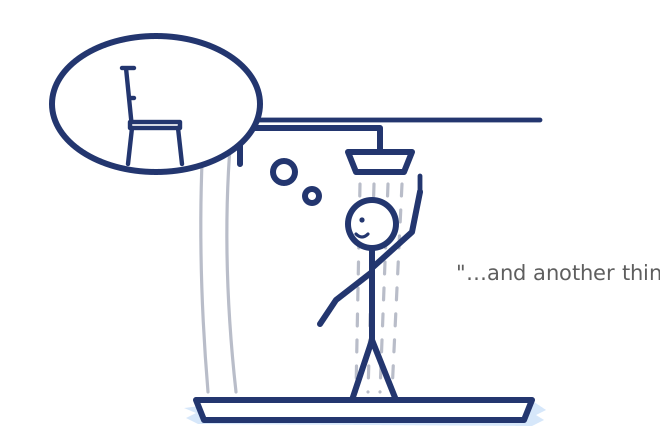
Here is the scene. You are in the shower, or on the drive home, and you are making a point. You are making it well. The person you are making it to has been dead for six years, or lives three states away and has not thought about you since the divorce, or is your mother, who is fine, and whom you will see on Sunday and say nothing to. You have made this point before. You will make it again. It never lands, because there is no one there, and the next day it is waiting for you in the car.
Perls called this unfinished business: an emotional situation from the past that was never completed, and that keeps intruding on the present until it is.1 Part 1 of this series was about the chairs. This one is about what they are for. I want to trace the idea from a Berlin café to a Toronto video lab, show you what it looks like when it resolves, lay out the evidence honestly, and compare the other doors into the same room, including the ones with medicine in them. And since this is not a topic anyone can read about without checking their own tabs, there are tools along the way for doing that.
- Unfinished business is an open loop. A feeling toward someone that never got expressed, or a need that never got met, stays live. The mind polls it, the body reacts to it, and the argument in the shower is the symptom.
- The idea has a lineage. Gestalt psychology's drive toward completion, Zeigarnik's interrupted tasks, Perls's clinical phrase, and Greenberg's lab, which found the steps that close the loop.
- Resolution has a shape. Complaint, then anger and sadness separated out, then the unmet need said as a need, then a shift in how you see the other person, then letting go or holding to account. People who reach the need resolve. People who stay in complaint mostly don't.
- The empty chair is the best-tested tool for this, in small trials with year-long follow-up. Writing, parts work, body work, EMDR, exposure therapies and psychedelic sessions are other doors; the room is the same.
- Two ways it goes wrong: avoiding it forever, and forcing it in one cathartic afternoon. The work is done in doses.
- Closure is not forgetting, and forgiveness is not required. It is the memory losing its charge, so that you can tell the story without the shower.
Open tabs
In 1927 a psychology student in Berlin named Bluma Zeigarnik noticed, or her supervisor Kurt Lewin noticed and she tested, that the waiters in a café could remember long unpaid orders in detail and forgot them completely once the bill was settled. In the lab she gave people a series of small tasks, interrupted half of them, and found that the interrupted ones were remembered about twice as well as the finished ones.2,3 An unfinished task, Lewin's theory went, leaves a tension in the system that keeps it active until it is discharged. Finishing discharges it. The effect has had a rocky replication history, like most things from 1927, and it is clearly sensitive to how much the task matters to you.4 But the part that has held up is the part that matters here: unfulfilled goals intrude on attention, and simply making a concrete plan to finish them makes the intrusion stop, even before you do anything.5
Gestalt psychology, from which Perls took his name and little else, had already made the general point: the mind completes things. Show it three-quarters of a circle and it sees a circle. Perls's move was to say that the same drive runs in emotional life.6,1 An unexpressed feeling toward someone is a figure that never got to close, and until it closes, it stays in the foreground, pulling at everything else.
Open tabs
Each tab is a loop that never closed. Close them and watch the load drop. The names are invented; the loops are everyone's.
The tab metaphor is more exact than it sounds. Each open loop is a background process. It does not cost much on any given day. It costs something every day, and it spikes whenever something in the present resembles it: the boss's tone, the song in the grocery store, the holiday. Closing the loop is not deleting the memory. It is paying the bill, so the waiter can finally forget the order.
Perls, and the phrase
Friedrich Salomon Perls was born in Berlin in 1893 to a Jewish family, was thrown out of school at thirteen for being impossible, trained briefly as an actor, served as a medic in the First World War, and became a psychiatrist and then a psychoanalyst.7,8 He trained with Wilhelm Reich, worked under the neurologist Kurt Goldstein, whose holism he absorbed, and in 1933 fled Germany with his wife Lore, later Laura, a psychologist and the uncredited half of everything that followed. They went to the Netherlands, then South Africa, where Fritz wrote his first book and, by his own account, stared down a lion on safari, which fits the man even if it did not happen.9,8 In 1946 they reached New York; in 1951 the book came out; by the 1960s Fritz was at Esalen in Big Sur, bearded, chain-smoking, running the hot seat in a jumpsuit, and telling a client who said he felt like a piece of shit to be the best piece of shit he could be.10
- 1893Berlin. Born. Expelled at 13. Acting, then medicine, then the war.
- 1926–33Frankfurt, Vienna, Berlin. Psychoanalysis; Reich; Goldstein's organismic theory; marries Laura. Flees in 1933.
- 1942South Africa. Ego, Hunger and Aggression: the break with Freud, written with Laura.9
- 1951New York. Gestalt Therapy, with Hefferline and Goodman. The phrase "unfinished business" enters the clinic.1
- 1964–69Esalen. The hot seat, the demonstrations, the films, the Gestalt Prayer that became a poster and that he later said everyone misread.
- 1970Chicago. Dies, famous, with the method almost entirely unstudied. The studying is the next part of the story.
Gestalt therapy, as the Perlses built it, has four commitments that run straight into everything below: awareness of what is happening in you right now; the here and now as the only place change can happen; responsibility for your own feelings and acts; and wholeness, the person as more than a list of symptoms.1 The empty chair was the technique that tied them together. The past is not dealt with by recounting it. It is dealt with by bringing it into the present, where it can finally be completed. "It is insufficient to recall a past incident," Perls wrote; "one has to psychodramatically return to it."10 The chair, as part 1 covered, he borrowed from Moreno.11
Perls could do this, and he could not say how. He left no manual and no data, only films of a brilliant, impatient man making volunteers cry. That is where Les Greenberg comes in, and why an idea from Big Sur ended up in a randomized trial.
How a loop stays open
Why doesn't time do this on its own? The folk theory is that it does: give it a year, you'll get over it. For small things it is true. For the ones that end up in the shower, it mostly is not, and there are three reasons.
The body keeps reacting. An emotion that was never allowed to finish its action tendency, the anger that never pushed back, the grief that never reached out, does not evaporate. It stays primed. Suppressing an emotion's expression does not reduce its physiology; in Gross's lab it raised sympathetic arousal while leaving the feeling intact.12 Pennebaker's line of work found that people who had never disclosed a trauma had more illness, and that writing about it for four days improved immune markers and cut doctor visits.13,14 The body is treating the unfinished situation as current.
The mind rehearses instead of completing. Rumination feels like processing and is its opposite. Going over the grievance again and again keeps the anger and the sadness live without ever reaching the need under them; in Bushman's experiments, ruminating about a provocation raised anger and aggression where distraction lowered them.15,16 The argument in the shower is rehearsal. It has no listener, so it can never be finished.
We repeat what we do not repair. Freud's observation, which psychodynamic therapy still rests on, is that unresolved situations get re-created: the person abandoned by a parent picks partners who leave, and then is surprised.17 You do not need the metapsychology to see the pattern. The open loop looks for a new chance to close, and usually picks the wrong person to close it with.
Greenberg's clinical definition pulls these together. Unfinished business is a lingering, unresolved feeling toward a significant other, with the markers that the feeling is still live when the person comes up, that it was never fully expressed to them, and that there is a need underneath that was never met.18,19 Usually, when you dig, the need is one of a short list: to be seen, to be protected, to be loved, to be told it was not your fault.
Do you have any?
Everyone does. The useful question is which ones are costing you something. The recognizer below is not a scale and has no validation; it is the set of questions I ask in a first session, in roughly the order I ask them.
Seven questions
Answer honestly. Nothing is stored.
Two clues are more reliable than the rest. The first is the disproportionate reaction: a present slight that produces a response three sizes too big for it. The size of the reaction is a measurement of how much of it is about something else. The second is the "why" question. People complain because they were hurt and feel wronged, and the complaint tends to fuse into a why: why did you leave, why did you hit her, why didn't you come. In the chair, that question is never answered, because it was never really a question. It is a complaint wearing a question's clothes, and it dissolves on its own once the anger and the sadness inside it have been separated and felt.20
What resolution looks like
In the early 1990s Greenberg and Foerster did to the empty chair what nobody had done to Perls: they filmed it, dozens of times, and compared the dialogues that ended in resolution to the ones that did not.20 Out of that came a model of the steps, which was then checked against outcome in a larger sample.21 The sequence is remarkably consistent, and it is the same in a ketamine integration session as in a Toronto clinic. Step through it and watch the charge.
Closing the loop
The six markers of a resolved empty-chair dialogue, with the emotional charge of the memory at each one. Composite client, as in part 1; the steps are Greenberg's.20,21
Three things in that sequence deserve underlining. First, both anger and sadness have to be reached. The process research is consistent that resolvers express both, and the 2025 sequencing experiment suggests that for people stuck in anger, sadness is often the way down, while people stuck in sadness are helped less by order.22,23 Second, the hinge is the need, stated as a need. "You should have been there" is a complaint. "I needed you there, and I deserved it" is the same content in a form that completes. Greenberg and Malcolm found this marker, plus a shift in the view of the other, in the resolved dialogues and almost nowhere else.21 Third, forgiveness is optional. Resolution means the other person becomes either more human, their limits visible, or more clearly accountable, and the client either lets go or holds them to it. Both are closure. The 2008 trial on emotional injuries found that EFT produced more forgiveness than psychoeducation, but it also produced more letting-go without forgiveness, and the symptom relief did not depend on which.24 This matters because the pressure to forgive, from families and from a certain kind of spiritual teacher, is one of the most common reasons loops stay open: you cannot forgive your way past an anger you have not yet had.
The evidence
The empty-chair literature is small, old, and almost entirely from one lab. It is also, within those limits, unusually good, because it measured the process and not only the outcome.
The trial that started it, in 1995, took 34 people with lingering unresolved feelings toward a significant other and randomized them to twelve sessions of experiential therapy built around empty-chair dialogue, or to a psychoeducation group about unfinished business.25 The chair condition did better on general symptoms, on interpersonal distress, on target complaints, and on a measure of resolution, with large effects, and the gains held at four months and at a year. In 2002, Greenberg and Malcolm showed that it was the clients who got to the need and the shift in view, the markers above, who improved; expressing the feeling without reaching those steps was not enough.21 And in 2008, the emotional-injury trial replicated the outcome against psychoeducation, this time with forgiveness and letting go as endpoints.24 Forgiveness interventions as a class, in a 2014 meta-analysis of 54 studies, reduce depression and anxiety modestly and reliably; EFT's version is among the more emotionally intense of them.26
Honest caveats: these are small samples, the comparison is psychoeducation rather than another active therapy, the lab that built the method ran the trials, and the whole literature would fit in a drawer. I would grade the empty chair for unfinished business a B: real, replicated once, process well mapped, and in need of someone else's trial. What I would not do is dismiss it for being small. Few techniques this specific have been checked this carefully for how they work.
Other doors into the room
Nearly every therapy has a way of closing loops, and they are more alike than their founders admit. Each one gets the unfinished situation into the present, raises the feeling to a workable intensity, reaches something underneath it, and ends with the memory meaning something different. Here are the main doors, graded as I grade everything on this site: how well tested, how well replicated, and whether they change what I do on a Tuesday.
- Bchair
- B+writingExpressive writing and the unsent letter
Pennebaker's paradigm, fifteen to twenty minutes a day for three or four days, writing your deepest feelings about the thing. Across nearly 150 studies the effect on health and mood is real and small, larger for people who write about something that was never disclosed.28 The unsent letter is the chair with a pen: it addresses the person, says what was never said, and reaches for the need. Tool below.
- A−traumaExposure and cognitive processing therapies
For unfinished business that meets criteria for PTSD, the best-tested doors by a wide margin: prolonged exposure, cognitive processing therapy, and trauma-focused CBT, strongly recommended in every guideline, with dozens of trials.29,30 They work by the same principle as the chair, approaching the memory until it finishes, with more structure and less theater. Complicated grief treatment adds imagined conversations with the dead, and beat interpersonal therapy in its trial.31 Imagery rescripting, from schema therapy, has the client re-enter the childhood scene and give the child what was needed; it is the empty chair run inside the memory.32
- A−trauma
- B−partsInternal Family Systems
Unfinished business as a burden carried by an exiled part, usually a child, guarded by protectors. The work is to earn the protectors' permission, reach the exile, and let it unburden. The best door I know for the loops you have with yourself, and the one my eating disorder clients take to most readily.34 Evidence is early: a rheumatoid arthritis trial and a pilot in depression; the PTSD trials are coming. I wrote about it in The committee inside.35
- B−bodySomatic approaches
Levine's claim is that an unfinished loop is also an unfinished defensive action, a push or a run that was never completed, and that the body has to complete it, in small doses, swinging between activation and safety.36,37 One randomized trial of Somatic Experiencing for PTSD found large effects against a waitlist; the literature is otherwise thin.38 The titration idea, though, is the single most useful thing in this post, and I borrow it for every other door. See Coming home to the body.
- BdepthPsychodynamic therapy
The loop re-enacted in the room, with the therapist, and worked through over time. Slower, less structured, better supported than its reputation: effect sizes comparable to CBT, with gains that continue after therapy ends.39 The door for loops you cannot name yet.
- BmedicinePsychedelic-assisted therapy
MDMA's two Phase 3 trials for PTSD, with about two-thirds of participants no longer meeting criteria after three sessions versus a third on placebo plus the same therapy, are the strongest evidence that a medicine can open a loop that years of avoidance kept shut.40,41 The FDA asked for another trial in 2024, and the field is still absorbing that.42 What the sessions themselves look like, from the chair beside the mat, is unfinished business surfacing on its own: the dead parent, the thing that was never said. The medicine lowers the guard; it does not close the loop. That is what integration is for, and integration, when it goes well, is the chair.43
The grades say something about trials and nothing about which door is right for a given person. Someone with a single unfinished loss and no trauma history may close it in one good chair session or one honest letter. Someone with a decade of unfinished loops stacked on a childhood that taught them feelings were dangerous needs the slow doors first, and a therapist who knows which door is which.
Two ways it goes wrong
The clinic sees two failure modes, and they are opposites.
Avoidance. The loop is painful to look at, so it is not looked at, and the not-looking is reinforced every time, because in the short run it works. Intellectualizing, compartmentalizing, staying busy, "I've made my peace with it." The cost is paid in the body and in the next relationship. The pressure to forgive before the anger has been felt is a respectable form of this, and John Welwood's name for it, spiritual bypassing, has stuck for a reason.44
Forcing. The opposite error, more common in people who have just discovered emotional work and in facilitators who mistake intensity for depth. One cathartic afternoon, a big cry, "I'm over it." Rarely true, and sometimes harmful: re-living a trauma at full intensity without support is not processing, it is re-exposure, and it can make the loop worse.
The answer to both is the same word: titration. Levine's term, from chemistry, for approaching the activation in small amounts, swinging back to safety, and going a little further each time.36 Greenberg's working distance, from part 1, is the same idea at the level of the session: enough feeling to be real, not so much that no one is home. Dial it.
In doses
A session, in profile. The line swings between safety and activation; the dial sets how big the swings are. Schematic, not data.
Two practical signs. If after a session or an exercise you feel raw, worse, and without any relief, it was probably too much, too fast; the next dose should be smaller. If you can tell the story and feel something, and then feel the something subside, that is the loop closing. Healing is nonlinear: layers come off, the loop flares, recedes, flares again more quietly. What you are watching for over months is not the absence of the feeling but the falling of its charge, until one day you notice that the shower is just a shower.
A letter you will not send
The chair works best with a therapist in the room. The letter is the version you can do tonight. It is the empty chair with a pen, and it follows the same steps, which is why the prompts below are in that order. Pennebaker's instruction is the only rule: write your deepest feelings, continuously, without worrying about grammar or whether it makes sense, for fifteen to twenty minutes. Nothing you type here leaves this page; there is no server on the other end, and the burn button clears it.
The unsent letter
To the person at the center of the loop. Four parts. Then burn it, or keep it, your call; the writing was the point.
Private: nothing here is saved, sent, or seen by anyone, including me.
If the letter brings up more than you expected, that is information, and the next step is a person, not a second letter. If it brings up a clear, hot anger and then a wave of sadness and then something like relief, you have just done, alone, what the 1995 trial measured. And if you get to "what I needed" and cannot write anything, you have found the loop, which is further than most people get.
Perls was wrong about many things and right about this: the past is not behind us. It is in the room, in the body, in the shower, waiting for the sentence that will finish it. The sentence is usually short. It is usually a need. And it has to be said to someone, even if the chair is empty.
This post is education, not treatment. The recognizer and the letter are for ordinary unfinished business; if what comes up is traumatic, frightening, or involves thoughts of harming yourself, stop and talk to a clinician. In the US, call or text 988.
References
- Perls F, Hefferline R, Goodman P. Gestalt Therapy: Excitement and Growth in the Human Personality. Julian Press; 1951.
- Zeigarnik B. Das Behalten erledigter und unerledigter Handlungen. Psychol Forsch. 1927;9:1–85.
- Lewin K. A Dynamic Theory of Personality. McGraw-Hill; 1935.
- Van Bergen A. Task Interruption. North-Holland; 1968.
- Masicampo EJ, Baumeister RF. Consider it done! Plan making can eliminate the cognitive effects of unfulfilled goals. J Pers Soc Psychol. 2011;101(4):667–683.
- Koffka K. Principles of Gestalt Psychology. Harcourt, Brace; 1935.
- Clarkson P, Mackewn J. Fritz Perls. Sage; 1993.
- Shepard M. Fritz: An Intimate Portrait of Fritz Perls and Gestalt Therapy. Saturday Review Press; 1975.
- Perls F. Ego, Hunger and Aggression. Allen & Unwin; 1947.
- Perls F. Gestalt Therapy Verbatim. Real People Press; 1969.
- Pugh M. Pull up a chair. The Psychologist (British Psychological Society). June 2017; updated July 2024.
- Gross JJ. Antecedent- and response-focused emotion regulation: divergent consequences for experience, expression, and physiology. J Pers Soc Psychol. 1998;74(1):224–237.
- Pennebaker JW, Beall SK. Confronting a traumatic event: toward an understanding of inhibition and disease. J Abnorm Psychol. 1986;95(3):274–281.
- Pennebaker JW, Kiecolt-Glaser JK, Glaser R. Disclosure of traumas and immune function: health implications for psychotherapy. J Consult Clin Psychol. 1988;56(2):239–245.
- Nolen-Hoeksema S, Wisco BE, Lyubomirsky S. Rethinking rumination. Perspect Psychol Sci. 2008;3(5):400–424.
- Bushman BJ. Does venting anger feed or extinguish the flame? Catharsis, rumination, distraction, anger, and aggressive responding. Pers Soc Psychol Bull. 2002;28(6):724–731.
- Freud S. Beyond the Pleasure Principle. 1920. In: Strachey J, ed. Standard Edition, vol. 18. Hogarth; 1955.
- Greenberg LS, Paivio SC. Working with Emotions in Psychotherapy. Guilford; 1997.
- Greenberg LS. Emotion-Focused Therapy: Coaching Clients to Work Through Their Feelings. 2nd ed. American Psychological Association; 2015.
- Greenberg LS, Foerster FS. Task analysis exemplified: the process of resolving unfinished business. J Consult Clin Psychol. 1996;64(3):439–446.
- Greenberg LS, Malcolm W. Resolving unfinished business: relating process to outcome. J Consult Clin Psychol. 2002;70(2):406–416.
- Pascual-Leone A, Greenberg LS. Emotional processing in experiential therapy: why "the only way out is through." J Consult Clin Psychol. 2007;75(6):875–887.
- Nardone S, Pascual-Leone A, et al. Changing emotion with emotion: the best sequence depends on the target concern. Cogn Ther Res. 2025. doi:10.1007/s10608-025-10590-5
- Greenberg LS, Warwar SH, Malcolm WM. Differential effects of emotion-focused therapy and psychoeducation in facilitating forgiveness and letting go of emotional injuries. J Couns Psychol. 2008;55(2):185–196.
- Paivio SC, Greenberg LS. Resolving "unfinished business": efficacy of experiential therapy using empty-chair dialogue. J Consult Clin Psychol. 1995;63(3):419–425.
- Wade NG, Hoyt WT, Kidwell JEM, Worthington EL. Efficacy of psychotherapeutic interventions to promote forgiveness: a meta-analysis. J Consult Clin Psychol. 2014;82(1):154–170.
- Kellogg S. Transformational Chairwork: Using Psychotherapeutic Dialogues in Clinical Practice. Rowman & Littlefield; 2015.
- Frattaroli J. Experimental disclosure and its moderators: a meta-analysis. Psychol Bull. 2006;132(6):823–865.
- American Psychological Association. Clinical Practice Guideline for the Treatment of Posttraumatic Stress Disorder (PTSD) in Adults. 2017.
- Bisson JI, Roberts NP, Andrew M, Cooper R, Lewis C. Psychological therapies for chronic post-traumatic stress disorder (PTSD) in adults. Cochrane Database Syst Rev. 2013;(12):CD003388.
- Shear K, Frank E, Houck PR, Reynolds CF. Treatment of complicated grief: a randomized controlled trial. JAMA. 2005;293(21):2601–2608.
- Arntz A, Weertman A. Treatment of childhood memories: theory and practice. Behav Res Ther. 1999;37(8):715–740.
- Shapiro F. Eye Movement Desensitization and Reprocessing: Basic Principles, Protocols, and Procedures. 2nd ed. Guilford; 2001.
- Schwartz RC. No Bad Parts. Sounds True; 2021.
- Shadick NA, Sowell NF, Frits ML, et al. A randomized controlled trial of an internal family systems-based psychotherapeutic intervention on outcomes in rheumatoid arthritis: a proof-of-concept study. J Rheumatol. 2013;40(11):1831–1841.
- Levine PA. Waking the Tiger: Healing Trauma. North Atlantic Books; 1997.
- van der Kolk B. The Body Keeps the Score. Viking; 2014.
- Brom D, Stokar Y, Lawi C, et al. Somatic Experiencing for posttraumatic stress disorder: a randomized controlled outcome study. J Trauma Stress. 2017;30(3):304–312.
- Shedler J. The efficacy of psychodynamic psychotherapy. Am Psychol. 2010;65(2):98–109.
- Mitchell JM, Bogenschutz M, Lilienstein A, et al. MDMA-assisted therapy for severe PTSD: a randomized, double-blind, placebo-controlled phase 3 study. Nat Med. 2021;27(6):1025–1033.
- Mitchell JM, Ot'alora G M, van der Kolk B, et al. MDMA-assisted therapy for moderate to severe PTSD: a randomized, double-blind, placebo-controlled phase 3 trial. Nat Med. 2023;29(10):2473–2480.
- Reardon S. FDA rejects ecstasy as a therapy: what's next for psychedelics? Nature. August 2024. News.
- Thayer S, Robison R. Unfinished business. Psychedelic Therapy Frontiers (podcast), 2025.
- Welwood J. Toward a Psychology of Awakening. Shambhala; 2000. (Source of the phrase "spiritual bypassing".)