Coming home to the body
Embodiment is the felt sense of living in, and as, your body. What the science of interoception says about it, why trauma and stress push us out, which body-based practices have real evidence, and a few ways back in that you can try right now.
By Reid Robison, MD. About 30 minutes, with eight things to try. Some of them you do with your body, not your thumbs.
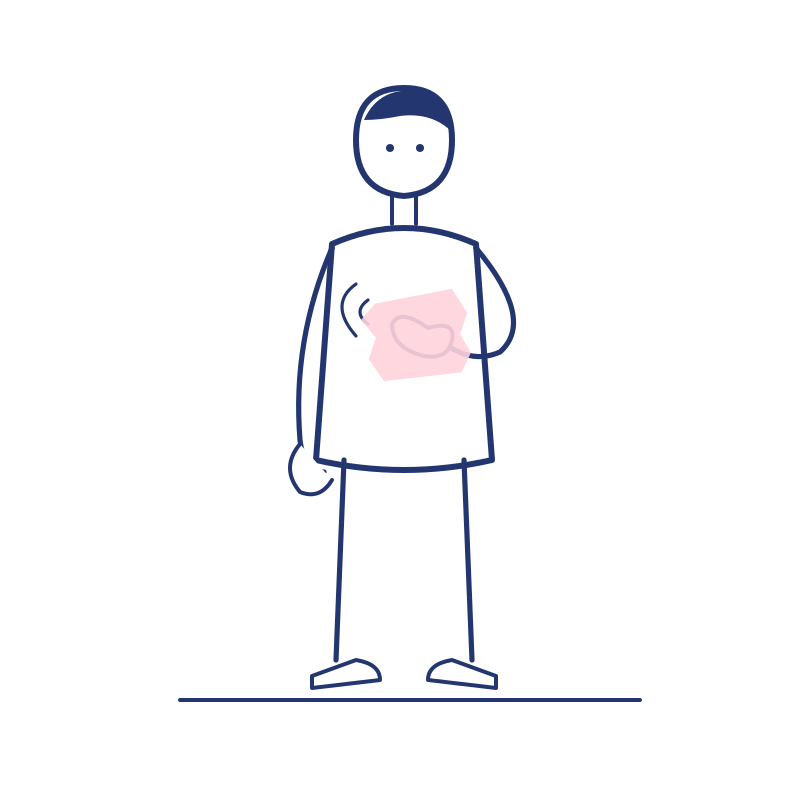
There's a line in one of James Joyce's stories that I've never been able to shake. Describing a bureaucrat who lives a careful, bloodless life, Joyce writes that Mr Duffy "lived at a little distance from his body."1 That's most of us, a lot of the time. Walking down a street with the eyes on a screen and the body on autopilot. Sitting hunched in a car, texting people in other cities. Thinking about the last conversation and the next one while the one that's happening passes through a body nobody is home in.
For years I've taught embodiment to people recovering from eating disorders, trauma and the ordinary wear of a stressful life. Embodiment is your first-person experience of being a body in the world: a sense of wholeness, of being at home in yourself. It's not the same as noticing the body or scanning it from a distance. It's being aware as the body, which is the only place anything is ever felt and the only instrument you have for perceiving, thinking, feeling and acting. Your body is always in the present moment. That is why it's the doorway back to it.
This post is a walk home. It goes through what neuroscience now knows about the body's sense of itself, why that sense goes quiet under stress and trauma, which body-based practices hold up when they're tested properly, and some things to try along the way. I've also used it to update a few things I used to teach that the science has since moved past. If you want the companion on attention, Meditation, deconstructed is the other half of this.
- You have an eighth senseInteroception: the brain’s running account of the body’s inside. It is where feelings are made.
- The self is built, moment to momentBody ownership can be moved onto a rubber hand in two minutes. It can also be lost in trauma.
- Stress pulls you outThreat tightens the body and turns down the signal. Feeling and thinking stop happening together.
- There are ways homeMovement, breath, trained attention to the body. Several now have randomised trials behind them.
- Interoception is a real, mappable sense. Signals from the heart, lungs, gut and skin are gathered in the insula and used, with the brain’s predictions, to build the feeling of being a body.2,3 A 2018 roadmap made it a research priority in psychiatry because it is disturbed in anxiety, depression, eating disorders, PTSD and addiction.4
- Emotions have body maps. Across 700 people in three countries, anger was felt in the head and arms, sadness in the chest, happiness everywhere, and depression as a dimming of the whole body.5
- The body shapes the mind, more modestly than the memes. In a 26-lab test, moving your face into a smile nudged happiness a little.6 Posture studies show slumping makes people feel worse and more fatigued; standing tall adds less than slumping subtracts, and the famous hormone claims didn’t replicate.7,8,9
- Body-based treatments are gaining evidence. Trauma-informed yoga beat health education for chronic PTSD (52% vs 21% no longer met criteria);10 Somatic Experiencing beat a waiting list in a randomised trial;11 interoceptive training cut anxiety in autistic adults;12 and in a network meta-analysis of 218 trials, dance, walking, yoga and strength training all reduced depression, with effects in the range of antidepressants.13
- Two ideas I used to teach need updating. The "reptilian brain" is a myth of brain evolution,14 and polyvagal theory’s five core claims have been seriously challenged.15 The practices built on them still work; the explanations have changed.
Part 1The eighth sense
You learned five senses in school. Neuroscience counts more, and the one this post is about is interoception: the sense of the body from the inside. Your heart rate, your breathing, the fullness of your stomach, the temperature of your skin, the tension in your muscles, the ache that means you've sat too long. All of it is carried up the spinal cord and the vagus nerve to the brainstem, then to a strip of cortex folded deep inside each hemisphere called the insula, where it is assembled into something you can feel.2,16 The body's surface has had a map in the brain since Penfield drew the homunculus in 1937; interoception is the map of the inside.17
The surprise of the last twenty years is what that assembly is for. It is not just plumbing reports. Antonio Damasio argued in the 1990s that feelings are the brain's reading of the body's state, and that reasoning without them falls apart.18 The current version, from Lisa Feldman Barrett, Anil Seth and others, is that the brain doesn't wait for the body to report; it predicts what the body should be doing next and compares the prediction with what arrives. Emotions are what those predictions feel like from the inside.3,19 A racing heart in a quiet room becomes dread if the brain predicts danger and excitement if it predicts a first date. The feeling is made, moment to moment, from the body and the story about it.
Researchers now separate three things that often get lumped together.20
- Accuracy
- How well you detect the signal: can you count your heartbeats without taking your pulse? (The classic test for this turns out to be shaky; newer ones are better.21)
- Sensibility
- How much you tend to notice and attend to bodily sensation day to day, by your own account.
- Awareness
- Whether you know how good you are: the match between confidence and accuracy. This metacognitive piece is the one most linked to anxiety.
Why does this matter for mental health? Because the sense goes wrong in specific ways. In panic and anxiety, ordinary bodily noise is read as threat.22 In depression, the signal is muted and the body feels far away. In anorexia, hunger, fullness and the arousal around a meal are misread.23 In PTSD and dissociation, the body can go almost silent. A 2018 roadmap from thirty researchers put interoception at the centre of a new agenda for psychiatry for exactly this reason.4
A sixty-second check-in
The simplest embodiment practice there is. Press start, close your eyes if you like, and let the prompts come. Nothing is recorded.
Part 2Where you feel it
Ask people where in the body they feel an emotion and you'd expect chaos. You get the opposite. In 2014, Finnish researchers showed 701 people in Finland, Sweden and Taiwan a blank body outline and asked them to colour where activity increased and decreased when they felt each of fourteen emotions. The maps were consistent across cultures and across people. Anger lit the head and the arms. Sadness sat in the chest with the limbs gone quiet. Fear and anxiety were a tight band through the chest and throat. Happiness and love warmed the whole body. Depression was the inverse of happiness: everything dimmed, especially the arms and legs.5
Bodily maps of emotion
Choose an emotion. Warm colour is where people reported more sensation, cool is where they reported less. An approximate rendering of the published maps.
These maps are self-report, not physiology, but that's the point: they show how the mind locates feeling in the body, and how shared that is. They're also a useful vocabulary. When someone in my office can't name what they feel, "where is it, and what's it doing there?" usually works better than "what's the emotion?"
Part 3A self you can move
Here's an experiment you can do at a kitchen table. Hide your left hand under a board and put a rubber hand in front of you where your hand would be. Have someone stroke both hands, real and rubber, in the same places at the same time. Within a couple of minutes most people feel the touch in the rubber hand, and when the experimenter suddenly threatens it with a hammer, their body flinches.24 With video goggles the same trick can be played on the whole body: people come to feel they are standing in front of themselves.25
What these illusions show is that the sense of owning a body, and of being located inside it, is not a given. The brain builds it every moment by combining vision, touch, balance and interoception, and when those streams are made to disagree it will relocate "you" to wherever they agree.26 That's unnerving and also hopeful. A sense of self that is built can be rebuilt.
The clinical version of a disrupted build is depersonalisation: feeling detached from one's body, as if watching from outside, with the world looking flat or unreal. It's common during panic, after trauma, with some drugs, and in a chronic disorder of its own.27 Philosophers of psychiatry have long described depression and schizophrenia partly as disorders of embodiment, a body that has become an object rather than the place one lives from.28 Psychedelics push the construction the other way, loosening body boundaries so far that the sense of a separate self can dissolve; that is measurable, and it's one reason those experiences can feel like the opposite of depression's heaviness.29
Part 4Does the body shape the mind?
I used to teach this with a demonstration. Sit in a chair, hunch forward, roll your shoulders in, look at the floor and say out loud, "I am empowered to accomplish what I want in my life." It doesn't fit. Then stand tall, imagine a cape in the wind, and notice the difference. The point was that mind and body are mutually influential: engage one and you engage the other, and when they disagree, the disagreement is unsustainable. I still think that's true. The science behind it has had a rough decade, and the honest version is more interesting than the slogan.
- Facial feedback. The famous pen-in-the-teeth study largely failed to replicate. But in 2022 a 26-lab collaboration with nearly 4,000 people found that mimicking a smile or deliberately moving the face into one does raise self-reported happiness, by a small, reliable amount.6 The face does feed back. Gently.
- Posture. "Power posing" was supposed to raise testosterone and risk-taking; a 200-person replication found neither.9 What survived is felt power and mood, and a 2022 meta-analysis of 73 studies found the effect comes mostly from the contractive side: slumping makes people feel worse, while expanding beyond neutral adds little.7 In a randomised trial, people made to sit upright under stress kept more self-esteem and better mood than people made to slump,8 and in people with depressive symptoms, sitting upright improved mood and fatigue over a short task.30 Slumped posture also tilts memory toward negative words in depressed patients.31
- Breath. This is the strongest lever. Slow breathing with a long exhale reliably shifts the autonomic nervous system toward calm, and a meta-analysis of heart-rate-variability biofeedback, which is slow breathing with a screen, found moderate benefits for anxiety and depression.32,33 Herbert Benson's "relaxation response," which I used to quote, was the 1970s version of this finding.34
So the demonstration stands, with one correction: the cape adds a little, the slump costs a lot. Un-hunching is the intervention. Test it on yourself.
The two-minute posture experiment
Rate your mood and energy now. Then sit slumped for sixty seconds (shoulders rolled, eyes down), rate again; sit upright and open for sixty seconds, rate again. It’s one person, one afternoon, but it’s your data.
Part 5How stress and trauma push us out
Trauma, in the definition I find most useful, is any experience you couldn't fully take in because it was too frightening or painful. In the moment, the body does what bodies do under threat: it braces. Heart up, breath shallow, muscles tight, attention narrowed to the danger. That is appropriate for a minute. The trouble starts when it doesn't end.
Bracing is partly a way of feeling less. We tighten the chest to hold off grief the way we tighten the belly after a punch. Over months, the tightening becomes posture, and the posture becomes a way of being: constricted, guarded, thin-skinned, and oddly numb at the same time. Feeling and thinking stop happening together. People describe watching themselves from the ceiling, or living from the neck up, or not knowing they were hungry, cold or exhausted until they collapse. Bessel van der Kolk's phrase for the clinical picture is that the body keeps the score;35 the interoception researchers' version is that the body's signal is either turned down to nothing or turned up to alarm, and the person can no longer use it to steer.4,22
Wounds don't need a catastrophe. A child growing up in a family, school or faith where shaming is routine usually doesn't have the resources to say "you can't speak to me that way," and the wound lands in the body as much as in the mind. The pattern afterwards is the same: push the sensation away, and it grows; brace against it, and it becomes a fear of fear. Which is why the way back is not to think harder about the body but to feel it again, slowly, in doses the nervous system can tolerate.
Once you're back in your body there's a sense of weight, volume and substance that is steadying. You can be in a hard conversation and stay.
Part 6Two ideas I’ve retired
I used to open trauma groups with the triune brain: a reptilian brainstem that only reacts, a limbic brain that feels, a neocortex that thinks, stacked up like geological layers. And I'd show Dan Siegel's hand model, where the fingers folded over the thumb are the cortex holding the limbic brain, and "flipping your lid" is the fingers springing open.36 The hand model is a fine metaphor for what losing your temper feels like. The triune brain is not how brains evolved. Reptiles have cortex; mammals didn't add a layer on top of a lizard; the brain's parts changed together rather than piling up.14 I've stopped teaching it as neuroscience.
The second is polyvagal theory, which became the lingua franca of trauma therapy over the last decade with its ventral vagal "social engagement" state, sympathetic fight-or-flight, and dorsal vagal shutdown.37 Its five foundational claims about the vagus nerve have been challenged in detail by physiologists, and several appear to be wrong.15 What remains true, and well supported by other evidence, is simpler: the autonomic nervous system has a calming branch, slow breathing engages it, feeling safe with another person settles the body, and the practices built on those facts help.32,33 The map was wrong in places. The territory is still there.
Part 7What works: the evidence
"Body-based" covers everything from a ten-week yoga course to a weekend workshop with a certificate. Here is what the better studies show, graded.
Body-based practices, graded
Filter by how solid the evidence is.
- Strong218 trials
Exercise for depression. In a network meta-analysis of 14,170 people, walking or jogging, yoga, strength training and dance all reduced depression versus active controls, with moderate effects. Dance had the largest point estimate, from few trials.13
- Strongmeta-analyses
Slow breathing and HRV biofeedback. Consistent reductions in anxiety and improvements in mood across many small trials; a cheap, safe first step.32,33
- Moderateseveral RCTs
Yoga. For depressive symptoms in people with mental disorders, a meta-analysis of 19 trials found a moderate benefit, with more sessions per week doing more.38 For chronic PTSD, a 10-week trauma-informed yoga class beat health education: 52% versus 21% no longer met criteria.10
- ModerateRCTs, small
Interoceptive training. Six sessions of heartbeat-detection training with feedback reduced anxiety in autistic adults compared with an active control, with the benefit holding at a year.12 A systematic review of interoception-targeted treatments across disorders found early but encouraging results.39
- ModerateRCTs
Mindful Awareness in Body-oriented Therapy (MABT). Eight sessions of guided interoceptive awareness, added to treatment for substance use disorder, reduced substance use and distress over a year compared with treatment as usual.40,41
- Moderateone RCT + reviews
Somatic Experiencing. In 63 people with PTSD, fifteen sessions beat a waiting list on PTSD and depression symptoms.11 A scoping review found consistent positive findings but few controlled trials.42 Promising; not yet proven against an active treatment.
- Moderatemeta-analysis
Dance movement therapy. A meta-analysis of 41 studies found benefits for depression, anxiety, quality of life and body awareness, with the usual caveats about small trials.43
- Moderatemechanism
Mindfulness and the body. Eight weeks of MBSR changed how the insula responds to attention to the breath, a plausible mechanism for why the body scan does what it does.44 Meditation, deconstructed covers the clinical trials.
- Earlytheory + small studies
Interoceptive exposure. Deliberately producing feared body sensations (spinning, breathing through a straw) is a well-established part of panic treatment, and is being extended to eating disorders and other conditions.45
- Earlyproprietary methods
Branded somatic therapies other than SE (sensorimotor psychotherapy, various "nervous system regulation" programmes) mostly rest on case series and theory. Reasonable to try with a good clinician; not yet evidence-based in the trial sense.46
Part 8Ways home
Everything below comes from things I've taught in groups. None of it needs equipment, a certificate or a belief system. If you've had trauma, go slowly, keep your eyes open if closing them feels unsafe, and stop any exercise that starts to overwhelm; the goal is to be a little more in the body than you were, not to flood it.
Pendulation
This is Peter Levine's exercise, from Somatic Experiencing,47 and it's the one I'd keep if I could keep only one. The idea is that every body has, at any moment, somewhere that hurts or is activated and somewhere that is quiet, and that moving attention slowly between the two teaches the nervous system that it can come back.
Pendulation, guided
About five minutes. Name your two places first, then press start and follow the cues. Go slowly; the point is the going back and forth.
Four more
- Find your breath
- Breathe in for 3, hold 3, out for 6. Three rounds. The long exhale is the lever. There's a guided pacer in Ten signposts out of the woods.
- Un-hunch
- Twice a day, notice the slump, and open: feet flat, sit bones down, crown up, shoulders back and down, eyes level. Don't puff up. Just stop folding.
- Move with attention
- Any movement counts if you're in it: a walk where you feel your feet, a stretch where you follow the sensation, dancing in the kitchen. The trials say the type matters less than doing it, and that attention to the body is what distinguishes yoga from stretching.13,46
- Welcome the aversive
- Sit, breathe, and let attention rest on anything that feels uncomfortable, irritating or scary. If it's a thought, find the sensation that goes with it. Then choose: let it go, or investigate it with curiosity. If it gets too big, move on. That choice, made over and over, is the skill.
Questions for a partner, or a journal
- What was your experience of your body as a child?
- How did your family, school, faith or culture shape whether you were allowed to feel your body?
- What experiences as an adult changed how attuned you are to it, for better or worse?
- Think of one small thing someone does daily that irritates you. Close your eyes and notice where that lives in your body. Describe it without judging it.
- What do you hope for, for your relationship with your body?
Merleau-Ponty wrote that by remaking contact with the body and the world, we rediscover ourselves.48 Gibson put it more plainly: we see the world not with the eyes but with the eyes in a head on shoulders on a body that gets about.49 The body is not where you keep your self. It's where your self is happening. The walk home is short, and it starts wherever your feet are.
This post is educational and isn't medical advice or a substitute for trauma treatment. If body-focused exercises bring up more than you can manage, stop and talk with a clinician. If you're struggling, in the US you can call or text 988 any time.
References
- Joyce J. A painful case. In: Dubliners. Grant Richards; 1914.
- Craig AD. How do you feel? Interoception: the sense of the physiological condition of the body. Nat Rev Neurosci. 2002;3(8):655–666.
- Barrett LF, Simmons WK. Interoceptive predictions in the brain. Nat Rev Neurosci. 2015;16(7):419–429.
- Khalsa SS, Adolphs R, Cameron OG, et al. Interoception and mental health: a roadmap. Biol Psychiatry Cogn Neurosci Neuroimaging. 2018;3(6):501–513.
- Nummenmaa L, Glerean E, Hari R, Hietanen JK. Bodily maps of emotions. Proc Natl Acad Sci USA. 2014;111(2):646–651.
- Coles NA, March DS, Marmolejo-Ramos F, et al. A multi-lab test of the facial feedback hypothesis by the Many Smiles Collaboration. Nat Hum Behav. 2022;6(12):1731–1742.
- Elkjær E, Mikkelsen MB, Michalak J, Mennin DS, O'Toole MS. Expansive and contractive postures and movement: a systematic review and meta-analysis of the effect of motor displays on affective and behavioral responses. Perspect Psychol Sci. 2022;17(1):276–304.
- Nair S, Sagar M, Sollers J, Consedine N, Broadbent E. Do slumped and upright postures affect stress responses? A randomized trial. Health Psychol. 2015;34(6):632–641.
- Ranehill E, Dreber A, Johannesson M, Leiberg S, Sul S, Weber RA. Assessing the robustness of power posing: no effect on hormones and risk tolerance in a large sample of men and women. Psychol Sci. 2015;26(5):653–656.
- van der Kolk BA, Stone L, West J, et al. Yoga as an adjunctive treatment for posttraumatic stress disorder: a randomized controlled trial. J Clin Psychiatry. 2014;75(6):e559–e565.
- Brom D, Stokar Y, Lawi C, et al. Somatic Experiencing for posttraumatic stress disorder: a randomized controlled outcome study. J Trauma Stress. 2017;30(3):304–312.
- Quadt L, Garfinkel SN, Mulcahy JS, et al. Interoceptive training to target anxiety in autistic adults (ADIE): a single-center, superiority randomized controlled trial. EClinicalMedicine. 2021;39:101042.
- Noetel M, Sanders T, Gallardo-Gómez D, et al. Effect of exercise for depression: systematic review and network meta-analysis of randomised controlled trials. BMJ. 2024;384:e075847.
- Cesario J, Johnson DJ, Eisthen HL. Your brain is not an onion with a tiny reptile inside. Curr Dir Psychol Sci. 2020;29(3):255–260.
- Grossman P. Fundamental challenges and likely refutations of the five basic premises of the polyvagal theory. Biol Psychol. 2023;180:108589.
- Craig AD. How do you feel, now? The anterior insula and human awareness. Nat Rev Neurosci. 2009;10(1):59–70.
- Penfield W, Boldrey E. Somatic motor and sensory representation in the cerebral cortex of man as studied by electrical stimulation. Brain. 1937;60(4):389–443.
- Damasio AR. Descartes' Error: Emotion, Reason, and the Human Brain. Putnam; 1994.
- Seth AK. Interoceptive inference, emotion, and the embodied self. Trends Cogn Sci. 2013;17(11):565–573.
- Garfinkel SN, Seth AK, Barrett AB, Suzuki K, Critchley HD. Knowing your own heart: distinguishing interoceptive accuracy from interoceptive awareness. Biol Psychol. 2015;104:65–74.
- Desmedt O, Luminet O, Walentynowicz M, Corneille O. The new measures of interoceptive accuracy: a systematic review and assessment. Neurosci Biobehav Rev. 2023;153:105388.
- Paulus MP, Stein MB. Interoception in anxiety and depression. Brain Struct Funct. 2010;214(5–6):451–463.
- Khalsa SS, Craske MG, Li W, Vangala S, Strober M, Feusner JD. Altered interoceptive awareness in anorexia nervosa: effects of meal anticipation, consumption and bodily arousal. Int J Eat Disord. 2015;48(7):889–897.
- Botvinick M, Cohen J. Rubber hands "feel" touch that eyes see. Nature. 1998;391(6669):756.
- Lenggenhager B, Tadi T, Metzinger T, Blanke O. Video ergo sum: manipulating bodily self-consciousness. Science. 2007;317(5841):1096–1099.
- Blanke O. Multisensory brain mechanisms of bodily self-consciousness. Nat Rev Neurosci. 2012;13(8):556–571.
- Sierra M. Depersonalization: A New Look at a Neglected Syndrome. Cambridge University Press; 2009.
- Fuchs T, Schlimme JE. Embodiment and psychopathology: a phenomenological perspective. Curr Opin Psychiatry. 2009;22(6):570–575.
- Nour MM, Evans L, Nutt D, Carhart-Harris RL. Ego-dissolution and psychedelics: validation of the Ego-Dissolution Inventory (EDI). Front Hum Neurosci. 2016;10:269.
- Wilkes C, Kydd R, Sagar M, Broadbent E. Upright posture improves affect and fatigue in people with depressive symptoms. J Behav Ther Exp Psychiatry. 2017;54:143–149.
- Michalak J, Mischnat J, Teismann T. Sitting posture makes a difference: embodiment effects on depressive memory bias. Clin Psychol Psychother. 2014;21(6):519–524.
- Zaccaro A, Piarulli A, Laurino M, et al. How breath-control can change your life: a systematic review on psycho-physiological correlates of slow breathing. Front Hum Neurosci. 2018;12:353.
- Lehrer P, Kaur K, Sharma A, et al. Heart rate variability biofeedback improves emotional and physical health and performance: a systematic review and meta analysis. Appl Psychophysiol Biofeedback. 2020;45(3):109–129.
- Benson H, Klipper MZ. The Relaxation Response. Morrow; 1975.
- van der Kolk BA. The Body Keeps the Score: Brain, Mind, and Body in the Healing of Trauma. Viking; 2014.
- Siegel DJ. Mindsight: The New Science of Personal Transformation. Bantam; 2010. (The "hand model of the brain.")
- Porges SW. The Polyvagal Theory: Neurophysiological Foundations of Emotions, Attachment, Communication, and Self-Regulation. Norton; 2011.
- Brinsley J, Schuch F, Lederman O, et al. Effects of yoga on depressive symptoms in people with mental disorders: a systematic review and meta-analysis. Br J Sports Med. 2021;55(17):992–1000.
- Heim N, Bobou M, Tanzer M, et al. Psychological interventions for interoception in mental health disorders: a systematic review of randomized-controlled trials. Psychiatry Clin Neurosci. 2023;77(10):530–540.
- Price CJ, Hooven C. Interoceptive awareness skills for emotion regulation: theory and approach of Mindful Awareness in Body-oriented Therapy (MABT). Front Psychol. 2018;9:798.
- Price CJ, Thompson EA, Crowell SE, et al. Longitudinal effects of interoceptive awareness training through mindful awareness in body-oriented therapy (MABT) as an adjunct to women's substance use disorder treatment: a randomized controlled trial. Drug Alcohol Depend. 2019;198:140–149.
- Kuhfuß M, Maldei T, Hetmanek A, Baumann N. Somatic experiencing: effectiveness and key factors of a body-oriented trauma therapy: a scoping literature review. Eur J Psychotraumatol. 2021;12(1):1929023.
- Koch SC, Riege RFF, Tisborn K, Biondo J, Martin L, Beelmann A. Effects of dance movement therapy and dance on health-related psychological outcomes: a meta-analysis update. Front Psychol. 2019;10:1806.
- Farb NAS, Segal ZV, Anderson AK. Mindfulness meditation training alters cortical representations of interoceptive attention. Soc Cogn Affect Neurosci. 2013;8(1):15–26.
- Boettcher H, Brake CA, Barlow DH. Origins and outlook of interoceptive exposure. J Behav Ther Exp Psychiatry. 2016;53:41–51.
- Schmalzl L, Crane-Godreau MA, Payne P. Movement-based embodied contemplative practices: definitions and paradigms. Front Hum Neurosci. 2014;8:205.
- Levine PA, Frederick A. Waking the Tiger: Healing Trauma. North Atlantic Books; 1997.
- Merleau-Ponty M. Phenomenology of Perception. 1945. Translated by Smith C. Routledge; 1962.
- Gibson JJ. The Ecological Approach to Visual Perception. Houghton Mifflin; 1979.