EMOTION SCIENCE · PART 1
The empty chair
I did my Level 1 training in Emotion-Focused Therapy with Les Greenberg over Zoom, during the pandemic, and I can report that it was a lot of chair work. This is what the chairs are for, where they came from, why the exercise feels like leaving your comfort zone, and why the emotion it most often sets free is anger.
By Reid Robison, MD. 5,503 words, with a dashboard you can light up, a sorting quiz, a chair scene you can step through, and a dial for how much feeling is the right amount.
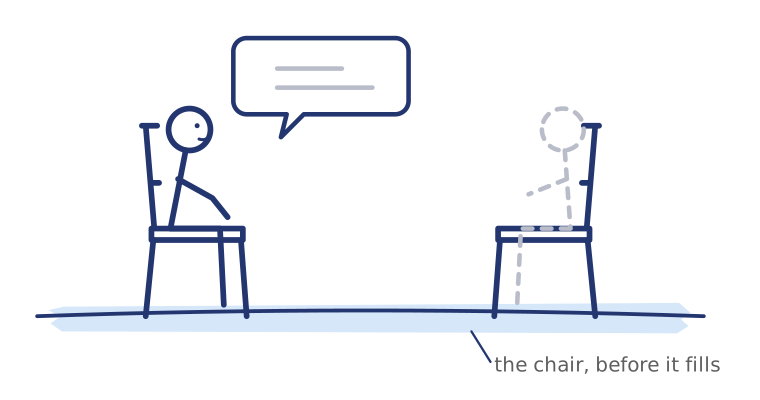
There is a moment in every Level 1 that the trainers can see coming. A volunteer sits in a chair and is asked to imagine their mother in the chair opposite and speak to her. Not about her. To her. The room goes quiet in a particular way, and the volunteer says some version of: this is weird, I feel stupid, can't I just tell you about her? And Les, or whoever is running the room, says no, in the kindest possible way, and waits.
What happens next is the subject of this post, and of the series it begins. I want to do three things. First, a short primer on what emotions are for, because the chairs make no sense without it. Second, the history: chair work did not start with EFT, or even with Gestalt, and the lineage explains a lot about why it looks the way it does. Third, the emotion that most often comes out of the chair, which is anger, and the distinction that I think is the single most useful idea in the whole model: the difference between the anger that heals and the anger that doesn't.
- Emotions are signals with a job. Each one has a felt sense, a need and an action tendency. Tune them out and you are driving without a dashboard.
- Not every feeling is the feeling. Greenberg's four kinds, primary adaptive, primary maladaptive, secondary and instrumental, are the sorting hat. Most symptoms are secondary. Most of the work is underneath.
- Chair work is a hundred years old. Moreno's psychodrama in 1920s Vienna, Perls's Gestalt hot seat, then Greenberg, who took the technique apart on videotape and put it back together with evidence.
- It works by arousal. You cannot leave a place you have never arrived at. The feeling has to be in the room, in the body, at a workable intensity. That is why it is uncomfortable, and the discomfort is not a side effect.
- Anger is the point more often than people expect. Suppressed anger is as much a clinical problem as too much of it. Healthy anger is assertive, clear about the need, and can be gentle. The other kind blames, and is usually covering something.
- Emotions change emotions. Shame is not argued away; it is transformed by anger and grief that reach the need under it. The sequence has been mapped, and it predicts who gets better.
A short primer
I wrote a longer version of this in Feelings are data, so here is the sixty-second edition. Emotions are evolved signals. They are the dashboard of the car and the GPS, and they orient us to the world faster than thought can. LeDoux's low road, from thalamus to amygdala, has the body reacting before the cortex has finished the sentence, which is why you have stepped back from the ledge before you have decided to.1 Every emotion carries three things: a bodily felt sense, a need, and an action tendency that points at the need.2,3 Sadness is heavy and asks for comfort; the action is to reach out. Fear is a racing heart and asks for safety; the action is to run or hide. Anger is heat in the chest and asks for a boundary; the action is to push back. Joy is light and asks to be shared.
The dashboard
Four core emotions, the ones the EFT handouts in my clinic focus on. Pick one to light up the body map and see the need and the action tendency. Adapted from the emotion basics handout we use in emotion-focused ketamine-assisted psychotherapy, itself adapted from Lafrance and colleagues.4
Two more facts and we can move on. First, emotions are fast but they are also short. Left alone, the physiology of a feeling rises and falls in something like a minute or two; the popular figure is ninety seconds, which comes from a neuroanatomist's account of her own stroke rather than a measurement, but the shape is right.5 What makes a feeling last for hours is the story we attach to it, and the next feeling we have about the first one. Second, naming a feeling changes it. Putting an emotion into words measurably quiets the amygdala's response to it; the label is not a description, it is an intervention.6 Greenberg's phrase is symbolizing, and the first principle of emotional change in his model is simply becoming aware of what you feel, in words, in the context of what it is about.3
Culture has mostly told us to tune the dashboard out, and there are reasons: feelings are uncomfortable, sometimes painful, and often inconvenient. But a system that is tuned out does not stop sending signals. It sends them louder, or sideways, into the body or into the nearest relationship. "I think, therefore I am" is a fine sentence. In my clinic, "I feel, therefore I am" is closer to the truth, with the caveat that I am not my feelings any more than I am my thoughts. They are parts of me with a job to do, and the job is to be heard.
Four kinds of feeling
Here is where confusion comes up all the time, in trainings and in sessions, so I want to slow down. Greenberg's most important clinical move is to say that not every feeling is the feeling. He sorts emotional experience into four kinds, and the whole practice depends on telling them apart in the moment.3,7
Primary adaptive emotions are the first gut response to a situation, and they fit it. Sadness at a loss. Fear at a threat. Anger at a violation. These are irreducible: there is nothing underneath them to unpack. In therapy they are not explored; they are validated and followed, because the action tendency in them is the solution to the problem.
Primary maladaptive emotions are also immediate and also gut-level, but they are reactions to the past in the present. Shame at a boss's tone that happens to echo a father's. Disgust at a partner's touch after an assault years ago. They were adaptive once, in the situation that taught them, and they are not now. Greenberg's line, which I quote to clients often, is that accessing these feelings in therapy is not making anyone feel bad. They already feel bad. The feeling is already there; speaking it does not create it, and not speaking it does not make it go away.3
Secondary emotions are feelings about feelings, or feelings that cover feelings. Anger that protects against shame. Fear of one's own anger. Hopelessness sitting on top of inadequacy. Most of the feelings that walk into a clinic as symptoms, panic, helplessness, hopelessness, are secondary, which is why treating the presenting feeling so often fails to reach the thing producing it.
Instrumental emotions are expressed to get something from someone else: tears that end an argument, anger that intimidates. They are often automatic rather than calculated, and they work in the short run and poison things in the long run, because the person never has to risk asking directly.
No emotion belongs to one category. Anger can be any of the four depending on what is under it and what it is for. That is exactly why the sorting matters, and why it is a skill rather than a chart. Try it.
What kind of feeling is this?
Seven scenes. Sort each one. The categories are Greenberg's; the scenes are composites.
The pattern that emerges, over a few hundred hours of this, is that two primary maladaptive emotions do most of the damage: fear and shame. Antonio Pascual-Leone, who has done more than anyone to measure what happens inside EFT sessions, puts their core messages as fear: I won't survive and shame: I deserve it.8 Fear is the engine of most anxiety; shame is the engine of most depression. Even loneliness, when you sit with it, is usually laced with one or the other. And over and over, in the treatment trajectories, what comes up first is shame, and what comes out later, for a great many people, is anger. Hold that thought.
Where the chair came from
Nobody in an EFT training mentions that the chair is a hundred years old and was not invented by anyone in the room. It is worth knowing, because the lineage explains why the technique looks like theater, and why that is a feature.
- 1921Vienna. Jacob Levy Moreno. A young psychiatrist who thought Freud had it backwards, and reportedly told him so: you analyze people's dreams; I try to give them the courage to dream again. Moreno's first public experiment in action therapy, at a Viennese theater on April Fools' Day 1921, was by most accounts a flop. Over the next two decades he built it into psychodrama: group work in which a protagonist enacts rather than recounts, with auxiliaries, doubles and mirrors, and an empty chair standing in for the absent person or the disowned part.9,10 His slogan was that action speaks louder than words. He also, by the way, coined the phrase group therapy.
- 1951New York. Fritz and Laura Perls. Gestalt therapy arrives in a book that is mostly unreadable and partly brilliant.11 Perls had trained as a psychoanalyst, worked under the neurologist Kurt Goldstein, fled Germany in 1933, and absorbed Moreno's methods along the way; he was the first to bring chair work out of the group and into one-to-one therapy, with the rule that only the client plays every role, so the material stays theirs.10 Two Gestalt ideas run straight into EFT: that the past is dealt with by bringing it into the here and now, and that unresolved feeling toward someone is unfinished business, which has a drive toward completion. More on that in part 2.
- 1960sEsalen. The hot seat. Perls became a counterculture figure at Big Sur, running demonstrations in which a volunteer sat in the hot seat and was walked, sometimes roughly, into a dialogue with a parent or a dream figure. "It is insufficient to recall a past incident," he wrote; "one has to psychodramatically return to it."12 The demonstrations were electric and the method was mostly intuition. Perls died in 1970 with the technique famous and almost entirely unstudied.
- 1979–Toronto. Les Greenberg. A South African engineer turned psychologist at York University, Greenberg did something nobody had done with Gestalt: he put the chair work on videotape, watched hundreds of hours of it, and asked what the clients who resolved their conflicts did differently from the ones who didn't. The method was called task analysis.13,14 Out of it came the two-chair dialogue for internal splits and the empty-chair dialogue for unfinished business, each with a map of the steps that predicted a good outcome, each later tested in trials.15,16 With Laura Rice and Robert Elliott he folded the chairs into a therapy built on Rogers's empathy, and in 2002 renamed it Emotion-Focused Therapy.17
- 2010sEverywhere. Chair work turns up in schema therapy, in compassion-focused therapy, in CBT's "chairwork," in emotion-focused family therapy for eating disorders, and in the integration sessions of psychedelic trials.18,19,4 The chairs are the same. What changed is that someone finally checked whether they worked, and roughly how.
So when a trainer says talk to the chair, you are being handed a Viennese theater exercise by way of Big Sur and a Toronto video lab. It feels like performance because it descends from one. And the performance is the mechanism: enacting a feeling toward a person recruits the body and the memory in a way that describing the feeling to a therapist does not.
What happens in the chair
There are two main chair tasks in EFT, and they are for different problems. The two-chair dialogue is for a split inside the self, most often between a harsh inner critic and the part of you it criticizes. You sit in one chair as the critic and say the criticism to the other chair, then move, sit as yourself, and answer. The empty-chair dialogue is for unfinished business with another person, living or dead, present or long gone. You speak to them in the empty chair, say what was never said, and sometimes move across and answer as them.
Here is a composite of each, with what the therapist is watching for at every step. The steps are not a script; they are the markers Greenberg's lab found in the sessions that resolved.13,16,20 Step through it.
Two tasks, one pair of chairs
Pick a task, then step through the dialogue. The figure moves when the client changes chairs. The notes on the right are the therapist's.
A few things to notice. The therapist almost never argues with the critic or consoles the self. She directs traffic and deepens: say that again, to her. What happens in your body when you hear that? What do you need from him? The work is in the client's own voice, which is the Perls rule. And the pivot in both tasks is the same: a need, stated as a need, from the vulnerable chair. "I deserved better." "I need you to back off." "I needed you to see me." Greenberg's claim, which the process research supports, is that the need is always already there inside the maladaptive feeling, and that reaching it is what converts collapse into the emotions that can carry a person out: assertive anger and grief.21
The other thing to notice is that none of this is possible while talking about the mother. The chair exists to turn a report into an encounter.
The comfort zone, measured
People say chair work takes them out of their comfort zone, and they are right, and it is worth being precise about why. The comfort zone, for most of us, is talking about feelings from a safe distance: clear, articulate, slightly past tense. EFT's position is that insight at that distance does not change much, and its slogan for this is Greenberg's: you cannot leave a place until you have arrived at it.3 You have got to feel it to heal it, as the handouts say, with the important addendum that you have got to feel it at the right intensity.
This has been measured, and the result is an inverted U. In depressed clients in EFT, the amount of emotional arousal expressed in session predicted outcome, but not in a straight line: moderate arousal in a substantial minority of the session did best, and both flat sessions and flooded ones did worse.22,23 Arousal alone was not enough, either. What predicted change was arousal plus reflection: the feeling in the room and someone home to make sense of it, which the Toronto group called emotional productivity.24 So the discomfort is doing something, but only within a range, and the therapist's job is to keep you in it.
The working distance
Drag the dial. The curve is schematic; the shape is from the process studies.23,24
This is also why a lot of good therapy, and a lot of skills training, only gets people halfway. Teaching someone to turn big feelings down, which is what much of DBT and most coping-skills work does, is essential when the feelings are overwhelming and the behavior is dangerous. But if that is all that happens, you get a person who has learned to down-regulate across the board, including the feelings that were trying to tell them something, and the signals start coming out sideways. The chair does the opposite job, at the opposite moment: it turns a feeling up, on purpose, in a safe room, so that the need inside it can finally be heard.
In the ketamine and psilocybin rooms I work in, the medicine does some of this turning up for us, which is both its gift and its hazard. The arousal arrives whether or not anyone is ready to reflect on it. That is why the integration session afterward so often looks, if you squint, like chair work.
The healing power of anger
As an undergraduate I taught anger management at the Utah State Prison, as part of a life-skills series. The curriculum was entirely about turning anger down, and for that room it was the right curriculum. It took me another fifteen years to learn that for most of the people who walk into an outpatient clinic, the problem with anger is the reverse.
Anger is an innate response to being wronged, blocked or violated, and in its healthy form it is an approach emotion: it moves you toward the problem to set a boundary.25,26 Acknowledging previously unacknowledged anger in therapy tells the person something true, that they were treated unfairly, mobilizes them to do something about it, and, when it is expressed, changes the relationship it is about. Shelves of books have been written about anger control. Far fewer have been written about anger suppression, and Greenberg's argument is that interrupted anger is at least as common a clinical problem as excessive anger, and more often missed.26 Anger inhibition, submissiveness and poor assertiveness are linked with depression; many depressions carry unexpressed primary anger underneath the secondary hopelessness; and blocked anger, what Paul Gilbert calls arrested fight, raises stress rather than lowering it.27,28
The distinction that makes all of this usable is between adaptive and maladaptive anger, and the EFFT handout we give families puts it better than I can.4
Protects a boundary or prevents a violation. Assertive, connecting, and clear about what is needed. It can be gentle. In a relationship, the stance is: "I love you, and I love me too, and I need something different."
- Says what it needs
- Stays in contact
- Rises, does its job, settles
Blames or rejects. A negative evaluation of the other person and a pushing away. Much less clear about the need, because it is usually covering a more vulnerable feeling: fear, shame, sadness, powerlessness.
- Says what is wrong with you
- Breaks contact
- Recurs, because the need under it was never reached
Notice that the line is not between loud and quiet, or between felt and acted on. Anger is a feeling; aggression is a behavior; they are not the same thing, and most of the damage done in the name of anger is done by aggression that follows anger which was never allowed to be a feeling first.29 Nor is the line between justified and unjustified. Payback anger can be perfectly justified and still be the kind that does not heal anyone. The line is whether the anger is pointed at a need or at a person.
Say it two ways
The same anger, blaming and then assertive. The second version is blurred; click to reveal it, and notice which one you could actually say to the person.
One more myth needs clearing, because it is the one most people believe about anger. Venting does not reduce it. The idea that anger is a pressure that has to be let off, by hitting a pillow or screaming into a bag or ranting to a friend, is catharsis theory, and it has failed essentially every test since the 1990s.30 A 2024 meta-analysis of 154 studies and more than ten thousand participants found that activities which raise physiological arousal, including venting and, surprisingly, jogging, did not lower anger and sometimes raised it; activities which lower arousal, slow breathing, muscle relaxation, mindfulness, a time-out, did.31 This is not a contradiction of anything above. Venting is anger with the arousal and without the need. Assertive anger is the need with just enough heat to carry it. The chair is not a place to blow off steam. It is a place to find out what the steam was about.
Shame and anger, two-way street
Shame is the master emotion of the clinic: the most painful, the least discussed, the most avoided.32 It is the feeling of being not good enough in the eyes of others, and its action tendency is to hide, shrink, and stop thinking because thinking hurts. Its evolutionary job was belonging: avert the eyes, make the body small, show submission, stay in the tribe.25,26 Which means shame and anger are opposites in one sense, one withdraws and one approaches, and intimately connected in another: each can cause the other, and each can cure it. Greenberg's recent book on the pair maps four main routes.26 Click the arrows.
Four roads between shame and anger
Each arrow is a different clinical picture. Only one of them is the exit.
- 1 · Shame → healthy angerthe exit
- 2 · Shame → reactive angerkicking the cat
- 3 · Shame blocks angerembarrassed to be angry
- 4 · Hair-trigger angerold protection, new targets
Road one is what the empty chair is for. A person who was invalidated as a child carries maladaptive shame, I deserve it, into every room. You cannot talk them out of it; shame does not listen to arguments. But if, in the chair, facing the person who did the invalidating, they can reach the sentence I deserved better, and feel the heat of it in the chest, the shame transforms. Not because anger is nicer than shame. Because anger's action tendency, to stand up and push back, is physically incompatible with shame's, to shrink and hide. You cannot do both at once, and the body knows it.
Roads two and three are what most of us do instead. We kick the cat, which is to say we feel like failures and get angry at someone smaller. Or we were raised in a house where anger was disrespectful, and we are now embarrassed to feel it at all, which seals the shame in. Parents have been taught for generations that a child's anger is defiance to be shut down; the best corrective I know is Hagen and Dolhanty's book for families, whose core advice is to validate the anger first, because a child who is allowed to be angry at you learns that the relationship can hold it.33 Road four is the trauma survivor's: anger that was once a correct response to real danger, now firing at a partner who reached for the remote. Each road has a different therapy. Sorting them is the skill.
Changing emotion with emotion
Everything above adds up to the fifth of Greenberg's six principles of emotional change, and the one that makes EFT different from most of what is around it: you change an emotion with another emotion.3 You do not reason shame away or breathe fear into submission, although regulation has its place. You reach the maladaptive feeling, in the room, and then help the person find the adaptive one that was underneath or alongside it, and let that one do the work. Assertive anger transforms shame. Grief transforms rejecting anger. Self-compassion transforms both.
Pascual-Leone and Greenberg watched this happen, session by session, and drew the map.21,8 Clients who improved moved through a sequence: undifferentiated global distress; then a sharpening into either fear and shame or rejecting anger; then a moment where the core negative self-belief is spoken alongside the unmet need; then the adaptive emotions, assertive anger or grief, often with self-soothing; and finally acceptance and a sense of agency. Clients who stayed in distress and rejecting anger, cycling, did not improve. The only way out, as the paper's title has it, is through, and through has a shape.
The sequence
Three routes through the same map. The dot is a session. Adapted from Pascual-Leone and Greenberg's model of emotional processing.21
Does the order matter? A little, and it depends on the wound. In a 2025 experiment from Pascual-Leone's lab, people with lingering anger about an interpersonal hurt let go of the grudge more when they were guided into sadness first and anger second; for people whose main residue was sadness, order mattered less.34 For shame specifically, a separate experiment found that facilitating anger gave people a sense of direction out of the distress that attending to the shame itself did not.8 The practical reading, which matches what I see: if someone is stuck in hot anger, grief is often the way down; if someone is stuck in shame, anger is often the way out. And both are usually needed before anything that deserves the name forgiveness shows up.
What the evidence says
I grade therapies the way I grade everything on this site: how well tested, how well replicated, and whether it changes what I do on a Tuesday. EFT is a well-studied therapy with a small evidence base, which is not a contradiction. The trials are good, the samples are small, and most of them were run by people who invented the method.
- B+depression
- Bunfinished businessEmpty-chair dialogue
The 1995 trial that started it: 34 clients with lingering feelings toward a significant other, randomized to twelve sessions of experiential therapy built around the empty chair or to a psychoeducation group. The chair condition did better on symptoms, interpersonal distress and resolution, and held it at four months and a year.15 The process study that followed found that clients who expressed the unmet need and shifted their view of the other were the ones who resolved.16 The subject of part 2.
- B−self-criticismTwo-chair dialogue
A 2012 pilot: nine sessions of two-chair work for self-critical people, with large reductions in self-criticism, depression and anxiety and gains in self-compassion.20 Promising, uncontrolled, small. The critic-softening step is the best-supported marker in the model.
- B−anxietyEFT for generalized anxiety
A 2022 feasibility trial in Dublin: 58 people randomized to EFT or CBT, with large and equivalent gains on both, held at six months, and lower dropout in EFT (10% vs 27%, not significant).38 Feasibility trials are not efficacy trials. Watch this space.
- BfamilyEmotion-focused family therapy
The caregiver version, built for eating disorders, teaches parents the coaching and the chair work. I use it weekly and the open trials are encouraging; a controlled evidence base is still being built.4
- A−processThe mechanisms
The strongest part of the EFT literature is not the outcome trials but the process research: arousal predicts change in an inverted U, reflection on arousal predicts it better, and the emotional sequence predicts who resolves.22,23,24,21 This is what sets EFT apart from Gestalt, which had the same chairs and none of the tape.
- B+the familyHumanistic-experiential therapies as a class
Across nearly two hundred studies in the big handbook review, the experiential therapies as a group produce large pre-post changes and roughly equal outcomes to CBT, with EFT among the best-performing members.39 The usual caveats: researcher allegiance is strong on both sides of every comparison.
What I take from this: the chairs do something real, the something is best explained by arousal plus reflection reaching a need, and the field badly needs trials run by people who did not train with Les. I would also say, as someone who did train with Les, that the model is more valuable to me as a way of listening than as a protocol. Knowing which of the four kinds of feeling is in the room, and which road between shame and anger a person is on, changes every session I run, including the ones with no chairs in them.
A practice, carefully
You can do a version of the two-chair dialogue alone, and a lot of people do without knowing it has a name. It is the argument you have with yourself in the car. The difference is doing it on purpose, out loud if you can, and all the way to the need. Two cautions first. This is for the ordinary inner critic, not for trauma; if what comes up is a memory you cannot put down, stop and do this with a therapist. And the goal is not to defeat the critic. Critics that get shouted down come back louder. The goal is to find out what it is afraid of.
The two chairs, at home
Six steps. Nothing you type here is saved or sent anywhere; it clears when you finish. Use two actual chairs if you can, and change seats when the step says to.
STEP 1 · THE SCENE
Pick one recent moment when you were hard on yourself. One sentence.
STEP 2 · THE CRITIC'S CHAIR
Sit as the critic. Say it to the other chair, in the second person. "You…" Not "I tell myself." Make it as harsh as it actually is.
STEP 3 · CHANGE SEATS
Sit as yourself. Before you answer, notice: what happens in your body when you are spoken to like that? Where is it? Name the feeling, not the thought.
STEP 4 · THE NEED
From that feeling, what do you need from the critic? Say it as a need, not a complaint. "I need…" "I deserve…"
STEP 5 · BACK TO THE CRITIC
Change seats again. Having heard that, what does the critic actually want for you? Most critics, asked this, turn out to be scared of something.
STEP 6 · NEGOTIATE
As yourself: can you hear that? What could the critic say instead that you could actually use?
If you get to step five and the critic softens, you have done in your living room what the process research says predicts a good outcome.20 If it does not soften, that is information too, and it is the kind of information worth bringing to someone.
Les would end a demonstration by saying something like: the chair is only empty for the first minute. After that it fills with whoever you put there, and then with whatever you had been carrying toward them. The volunteer who said this is weird, I feel stupid is, twenty minutes later, almost always crying or almost always angry, and usually both, and almost always, afterward, lighter. That is not a mystery. It is what the dashboard was for.
This post is education, not treatment. Chair work is a therapy technique and is most useful, and safest, with a trained therapist; the home practice above is for the everyday inner critic. If what comes up is traumatic, frightening, or involves thoughts of harming yourself, stop and talk to a clinician. In the US, call or text 988.
References
- LeDoux J. The Emotional Brain: The Mysterious Underpinnings of Emotional Life. Simon & Schuster; 1996.
- Frijda NH. The Emotions. Cambridge University Press; 1986.
- Greenberg LS. Emotion-Focused Therapy: Coaching Clients to Work Through Their Feelings. 2nd ed. American Psychological Association; 2015.
- Lafrance A, Henderson KA, Mayman S. Emotion-Focused Family Therapy: A Transdiagnostic Model for Caregiver-Focused Interventions. American Psychological Association; 2020.
- Taylor JB. My Stroke of Insight. Viking; 2008. (Source of the popular "ninety seconds" figure; a clinical observation, not a measured constant.)
- Lieberman MD, Eisenberger NI, Crockett MJ, Tom SM, Pfeifer JH, Way BM. Putting feelings into words: affect labeling disrupts amygdala activity in response to affective stimuli. Psychol Sci. 2007;18(5):421–428.
- Greenberg LS, Paivio SC. Working with Emotions in Psychotherapy. Guilford; 1997.
- Pascual-Leone A. How clients "change emotion with emotion": a programme of research on emotional processing. Psychother Res. 2018;28(2):165–182.
- Moreno JL. Psychodrama, Volume 1. Beacon House; 1946.
- Pugh M. Pull up a chair. The Psychologist (British Psychological Society). June 2017; updated July 2024.
- Perls F, Hefferline R, Goodman P. Gestalt Therapy: Excitement and Growth in the Human Personality. Julian Press; 1951.
- Perls F. Gestalt Therapy Verbatim. Real People Press; 1969.
- Greenberg LS. Toward a task analysis of conflict resolution in Gestalt therapy. Psychotherapy. 1983;20(2):190–201.
- Rice LN, Greenberg LS, eds. Patterns of Change: Intensive Analysis of Psychotherapy Process. Guilford; 1984.
- Paivio SC, Greenberg LS. Resolving "unfinished business": efficacy of experiential therapy using empty-chair dialogue. J Consult Clin Psychol. 1995;63(3):419–425.
- Greenberg LS, Malcolm W. Resolving unfinished business: relating process to outcome. J Consult Clin Psychol. 2002;70(2):406–416.
- Greenberg LS. Emotion-Focused Therapy. Rev. ed. Theories of Psychotherapy Series. American Psychological Association; 2017.
- Pugh M. Cognitive Behavioural Chairwork: Distinctive Features. Routledge; 2019.
- Kellogg S. Transformational Chairwork: Using Psychotherapeutic Dialogues in Clinical Practice. Rowman & Littlefield; 2015.
- Shahar B, Carlin ER, Engle DE, Hegde J, Szepsenwol O, Arkowitz H. A pilot investigation of emotion-focused two-chair dialogue intervention for self-criticism. Clin Psychol Psychother. 2012;19(6):496–507.
- Pascual-Leone A, Greenberg LS. Emotional processing in experiential therapy: why "the only way out is through." J Consult Clin Psychol. 2007;75(6):875–887.
- Missirlian TM, Toukmanian SG, Warwar SH, Greenberg LS. Emotional arousal, client perceptual processing, and the working alliance in experiential psychotherapy for depression. J Consult Clin Psychol. 2005;73(5):861–871.
- Carryer JR, Greenberg LS. Optimal levels of emotional arousal in experiential therapy of depression. J Consult Clin Psychol. 2010;78(2):190–199.
- Auszra L, Greenberg LS, Herrmann I. Client emotional productivity: optimal client in-session emotional processing in experiential therapy. Psychother Res. 2013;23(6):732–746.
- Izard CE. Human Emotions. Plenum; 1977.
- Greenberg LS. Shame and Anger in Psychotherapy. American Psychological Association; 2024.
- Gilbert P, Gilbert J. Entrapment and arrested fight and flight in depression: an exploration using focus groups. Psychol Psychother. 2003;76(2):173–188.
- Greenberg LS, Watson JC. Emotion-Focused Therapy for Depression. American Psychological Association; 2006.
- Retzinger SM. Identifying shame and anger in discourse. Am Behav Sci. 1995;38(8):1104–1113.
- Bushman BJ. Does venting anger feed or extinguish the flame? Catharsis, rumination, distraction, anger, and aggressive responding. Pers Soc Psychol Bull. 2002;28(6):724–731.
- Kjærvik SL, Bushman BJ. A meta-analytic review of anger management activities that increase or decrease arousal: what fuels or douses rage? Clin Psychol Rev. 2024;109:102414.
- Dearing RL, Tangney JP, eds. Shame in the Therapy Hour. American Psychological Association; 2011.
- Hagen AHV, Dolhanty J. Angry Kids, Angry Parents: Understanding and Working with Anger in Your Family. APA LifeTools; 2023.
- Nardone S, Pascual-Leone A, et al. Changing emotion with emotion: the best sequence depends on the target concern. Cogn Ther Res. 2025. doi:10.1007/s10608-025-10590-5
- Greenberg LS, Watson J. Experiential therapy of depression: differential effects of client-centered relationship conditions and process experiential interventions. Psychother Res. 1998;8(2):210–224.
- Goldman RN, Greenberg LS, Angus L. The effects of adding emotion-focused interventions to the client-centered relationship conditions in the treatment of depression. Psychother Res. 2006;16(5):537–549.
- Watson JC, Gordon LB, Stermac L, Kalogerakos F, Steckley P. Comparing the effectiveness of process-experiential with cognitive-behavioral psychotherapy in the treatment of depression. J Consult Clin Psychol. 2003;71(4):773–781.
- Timulak L, Keogh D, Chigwedere C, et al. A comparison of emotion-focused therapy and cognitive-behavioral therapy in the treatment of generalized anxiety disorder: results of a feasibility randomized controlled trial. Psychotherapy. 2022;59(1):84–95.
- Elliott R, Greenberg LS, Watson JC, Timulak L, Freire E. Research on humanistic-experiential psychotherapies. In: Lambert MJ, ed. Bergin and Garfield's Handbook of Psychotherapy and Behavior Change. 6th ed. Wiley; 2013:495–538.