Meditation, deconstructed
A field guide to training attention: what meditation is, what it changes, what the trials actually show, how to begin today, and where the mystery still lives.
By Reid Robison, MD. A 25-minute read with eight things to try, including a guided first sit.
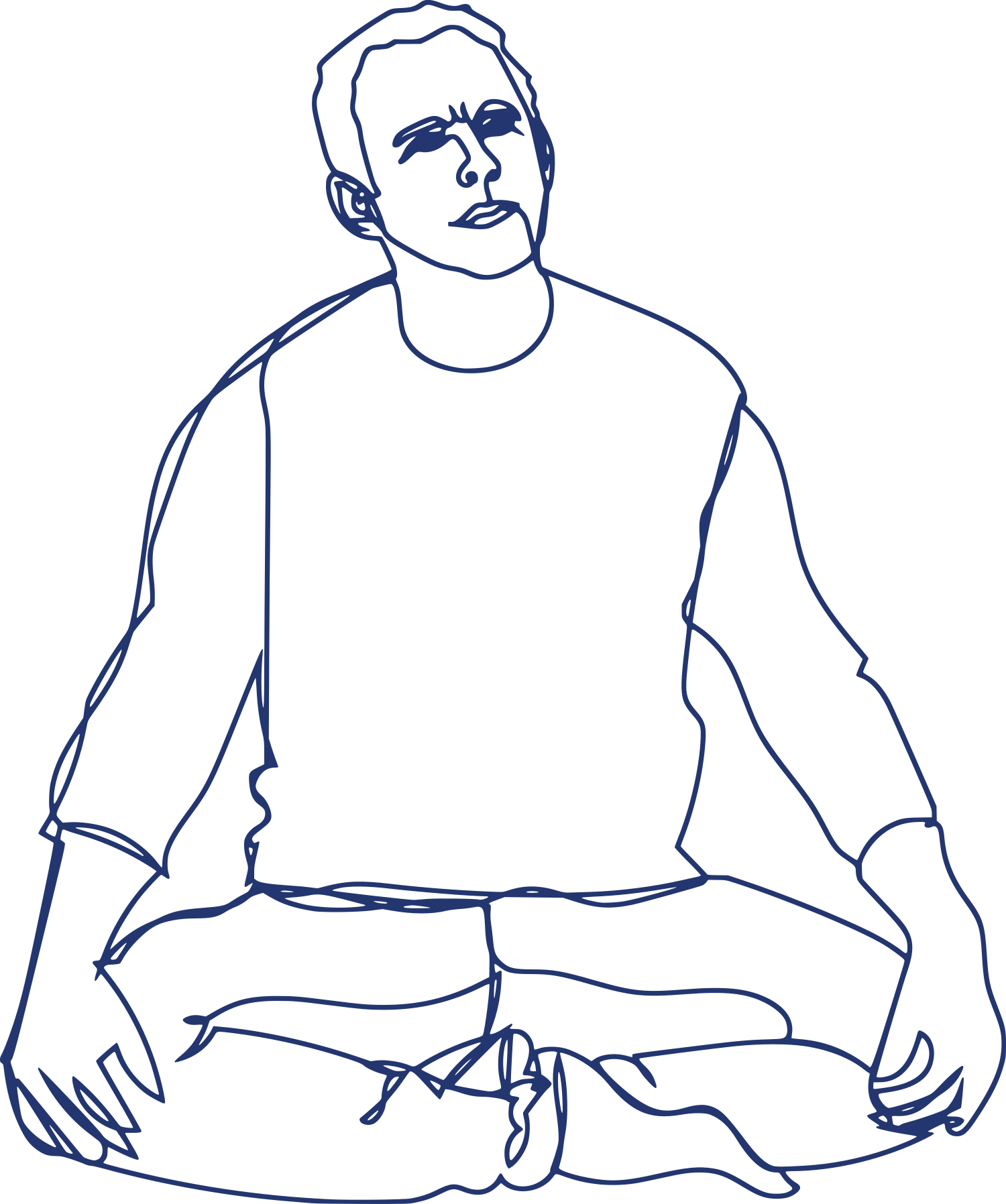
I'm a psychiatrist. I have written a great many prescriptions, and I still believe in a lot of them. But the most useful thing I have learned about the human mind did not come from a pill bottle or a textbook. It came from sitting still, noticing that my mind had wandered off for the four-hundredth time, and coming back.
Meditation has two reputations. One is mystical: robes, incense, enlightenment. The other is clinical: an app, a stress-reduction protocol, a brain scan with a few regions lit up. Both are partly right. This guide tries to hold both at once. I want to take meditation apart, piece by piece, and show you the machinery. And I want to do it without disenchanting it. Understanding how a sunset works has never made a sunset less beautiful.
- Meditation is attention training, not mind-emptying. You will think the whole time. The skill is noticing you've wandered and coming back, kindly. Every return is a repetition, like a curl at the gym.
- Your mind wanders about half the time, and people are less happy while it does, even when the daydream is pleasant.1
- The evidence is real but modest. It's best for preventing depression from coming back, reasonable for anxiety, low mood, chronic pain and sleep, and still thin for many popular claims.9,10,13
- About 10 to 15 minutes a day is a fine dose to start. In one trial, 13 minutes a day for eight weeks measurably improved attention and mood in beginners.22
- It isn't risk-free. A minority of people have difficult experiences. Knowing the signs, and when to ease off, is part of doing it well.25–27
- And it isn't only a health habit. For 2,500 years people have used these practices to look directly at the nature of their own minds. Some of what they found, science is only starting to describe.
1. What meditation is, and isn't
Let's clear away the biggest myth first. You are not trying to stop thinking. Asking a mind to stop thinking is like asking a heart to stop beating. If you sit down expecting silence, you'll decide within a week that you're "bad at meditation," and you'll quit. Almost everyone who quits, quits for this reason.
Here is a better working definition. Meditation is a set of practices that train two capacities you already have:
- Attention, the spotlight: what you're focused on right now.
- Awareness, the lit room around the spotlight: the open background sense of everything else, including what your own mind is doing.
That's the whole game. Every technique below is a different way of strengthening one or both. Jon Kabat-Zinn, who brought mindfulness into Western medicine in 1979, defined mindfulness as paying attention "on purpose, in the present moment, and nonjudgmentally."33 Mindfulness is the quality. Meditation is the gym where you build it. Daily life is where you use it.
The word itself has a history worth knowing. "Mindfulness" is a translation of the ancient Pali word sati, which carries a sense of remembering: remembering to be here. The English rendering was popularized by a British scholar, T. W. Rhys Davids, in 1881.43 So the most modern-sounding word in wellness is a Victorian translation of a 2,500-year-old idea.
Researchers sort the hundreds of meditation styles into a few families, based on what each one trains.5,6 Explore them below. Each has a 60-second version you can try right now.
The families of practice
Pick a family, then a practice. Each one says what you do, what it trains, and how to try it in a minute.
2. The mind you're sitting with
In 2010, Harvard researchers Matthew Killingsworth and Daniel Gilbert built an iPhone app that pinged about 2,250 people at random moments and asked three questions: What are you doing? Are you thinking about something else? How happy are you? People's minds were wandering in 46.9% of the samples. They were measurably less happy when wandering than when present, even when the daydream was pleasant. The paper's title said it plainly: a wandering mind is an unhappy mind.1
The wandering has a home in the brain. When you aren't doing a task, a set of regions called the default mode network lights up: the medial prefrontal cortex, the posterior cingulate, parts of the parietal lobe.2 It's busiest when you're thinking about yourself, replaying the past, rehearsing the future, or imagining what other people think of you. It's useful (it's how you plan and remember) but left alone it tends to drift toward worry and rumination. Experienced meditators show quieter activity in this network, and different wiring within it, both during meditation and at rest.3
How hard is it to simply be with your own mind? In 2014, psychologist Timothy Wilson left people alone in a bare room for 15 minutes with nothing to do but think. They could press a button to give themselves a mild electric shock, one they had earlier said they'd pay money to avoid. Two-thirds of the men and a quarter of the women shocked themselves rather than sit with their thoughts.31 Blaise Pascal saw this coming in the 1600s, when he wrote that all of humanity's problems stem from our inability to sit quietly in a room alone.
The wandering isn't the failure. The moment you notice it is the whole point.
Here's the part almost everyone gets backwards. In 2012, neuroscientist Wendy Hasenkamp put meditators in a scanner and had them press a button the instant they realized their mind had wandered. That revealed a four-step cycle, and each step had its own brain signature.4 Focus. Drift. Notice. Return. The noticing step, a burst of activity in what's called the salience network, is the very capacity meditation trains. It is a moment of the brain becoming aware of itself. Most people greet it with a flinch: ugh, I lost it again. I'd like you to greet it like good news.
Catch the wander
Ninety seconds. Rest your attention on your breathing and silently count breaths from 1 to 10, then start over. Every time you realize you've drifted off (lost count, thinking about lunch), tap the button and start again at 1. Click any step of the cycle to read what's happening in your brain.
Click a step of the cycle, or start the exercise.
3. Your first sit
Theory is nice, but meditation is 1% theory and 99% practice. So let's practice. Here's the setup I teach on a first day:
- Posture: comfortable but awake. A chair is perfect. Feet on the floor, spine tall without being rigid, shoulders soft, hands resting wherever they're easy. Lying down is allowed, but it invites sleep.
- Eyes closed, or open with a soft downward gaze. Either is fine.
- Find the breath where it's clearest. For many people that's the air at the rim of the nostrils (cool coming in, slightly warm going out). For others it's the rise and fall of the belly. There's no wrong choice, only the one that's clearest for you.
- Don't control the breath. Let the body breathe itself. You're just watching.
- When you wander, come back. No scolding. That return is the rep.
A tip from my own early practice, for those of us blessed with a little extra mind-wandering: focus on the in-breath, and let the mind relax on the out-breath. It's a more forgiving rhythm, and the emphasis stays on the return rather than the lapse.
A guided first sit
Pick a length and press begin. Short prompts will appear, with long quiet stretches between them. That quiet is the practice. A soft bell marks the start and the end (turn your sound on, or keep it silent).
Find a comfortable seat. When you're ready, press begin.
How did that feel? Restless, sleepy, peaceful and frustrating are all normal answers. Notice one thing, though: you sat with your own mind, on purpose, and didn't reach for the shock button. That's the first skill. In the system I'll describe in section 7, "showing up" is literally the whole goal of stage one.
4. Two dials: focus and energy
Once you've sat a few times, two problems show up. They're opposites, and seeing them as two ends of one dial makes the whole practice easier to steer.32
Distraction is the mind with too much energy: scattering outward, grabbing at plans and memories. Dullness is the mind with too little: the breath goes faint, the edges blur, and it starts to feel pleasantly drowsy. Dullness is the sneaky one, because it feels like peace. Real meditative calm is clear. Dullness is calm without the clarity.
The sweet spot is in the middle: bright but settled, alert but at ease. Psychologists have described this shape for over a century as the inverted U between arousal and performance.44 Drag the dial below to find where your mind tends to sit, and what to do about it.
Read your energy dial
Move the slider to match how your mind usually feels a few minutes into a sit.
5. What the science shows (and doesn't)
Since the 1970s there have been thousands of meditation studies, and an equal number of breathless headlines. Here is my honest read as a clinical trialist. The benefits are real, and mostly moderate. Many early studies were small, compared meditation to nothing, and relied on self-report. A group of 15 researchers wrote a widely cited paper in 2018 called "Mind the Hype," warning that public enthusiasm had outrun the data.13 I agree with them. Meditation doesn't need to be a miracle to be worth doing.
Filter the list by how solid the evidence is. The ratings are mine, based on the trials cited.
The evidence, claim by claim
- Keeps depression from coming backStrongMindfulness-based cognitive therapy (MBCT) cut the risk of relapse by about 31% in people with recurrent depression, across 9 trials and 1,258 patients, and did a bit better than other active treatments.10 This is the best-established use.
- Eases anxietyGoodModerate effects in a JAMA review of 47 trials.9 In 2023, an 8-week mindfulness course was as effective as escitalopram (Lexapro) for anxiety disorders in a randomized trial of 276 adults.11
- Lifts low moodGoodModest improvement in depressive symptoms, about as large as other active psychological treatments, but not reliably larger.9,37
- Softens chronic painGoodSmall to moderate reductions in pain and better quality of life.38 Brain imaging suggests it works partly through different routes than placebo.17
- Improves sleepGoodModerate improvement in sleep quality compared with education or waitlist controls, in a meta-analysis of 18 trials.39
- Reduces stress in healthy adultsGoodLower anxiety, depression and distress than doing nothing, across 136 trials in non-clinical settings. But not clearly better than other active wellness practices such as exercise.12
- Sharpens attention and memoryMixedSome trials show gains (13 minutes a day for eight weeks;22 a two-week course that raised working memory and reading scores35). Meta-analysis suggests small effects that vary by attention type.42
- Builds warmth and connectionMixedLoving-kindness practice increased daily positive emotion in a well-known trial.20 Claims that it raises heart-rate variability (vagal tone) are less certain.21
- Helps with cravings and quittingMixedPromising results, such as higher quit rates than a standard program in one smoking trial,41 but the evidence is still uneven across substances.
- Grows your brainMixedEarly studies found thicker cortex in long-term meditators and more gray matter after 8 weeks of training.15,16 But the largest and best-controlled trial to date, with 218 people, found no structural change.14 Function may change before structure does, if structure changes at all.
- Boosts the immune systemEarlySome markers of inflammation and immune function shift in small trials, but results are inconsistent.40,45
One more honest note. The benefits above come mostly from structured courses such as MBSR and MBCT, typically 8 weeks with a teacher, a group and daily home practice. Apps and casual practice probably help too, but they've been studied less rigorously.
6. How it works
If meditation helps, how? The best single framework comes from Britta Hölzel and colleagues, who proposed four interacting mechanisms.8
- Attention regulation. The rep you just practiced: notice the drift, return. It exercises the brain's executive and salience networks, the anterior cingulate in particular.7 Over time the gap between wandering and noticing gets shorter.
- Body awareness. Feeling the breath at the nostrils is a refined form of interoception, the sense of your body's inner state. It runs through the insula, a region tied to emotional awareness. Many of us notice an emotion in the body before we have words for it.
- Emotion regulation. Meditation teaches you to feel a sensation or emotion without immediately reacting to it, a kind of gentle exposure. Even just naming a feeling ("anxious," "irritated") quiets the amygdala and recruits the prefrontal cortex. Researchers call it affect labeling; I call it "name it to tame it."19
- A change in how you see yourself. You start to notice that thoughts arise and pass on their own, like weather. You are not your thoughts; you're the one who notices them. That shift in perspective, from being in the story to watching it, may be the deepest mechanism of all.6
There's an old yogic image for how practice reshapes us: samskaras, grooves worn by repetition, like wagon-wheel ruts in a dirt road. Each time you take the path, the next time is easier. Neuroscience has its own version, Donald Hebb's 1949 principle usually summarized as "neurons that fire together wire together."46 Two languages, one observation: we become what we practice. Every moment, we're growing something. The question is what.
7. A map for the road
Most beginner courses ask you to trust a feeling. I prefer a map. The one I use is from The Mind Illuminated, by neuroscientist and meditation teacher John Yates (known as Culadasa). It lays out ten stages of attention training, integrating Buddhist practice manuals with cognitive science.32 It isn't the only map (Zen, Tibetan and Theravada traditions each have their own), but it's the most practical I've found for a Western beginner, because it tells you what to work on next.
- Establishing a practice. Sitting most days. That's the whole goal.
- Interrupted attention. Catching the wander sooner, returning without judgment.
- Extended attention. Rarely forgetting the breath entirely; noticing dullness.
- Continuous attention. The breath stays center stage; working with strong dullness and gross distraction.
- Overcoming subtle dullness. Keeping the mind bright as it settles.
- Subduing subtle distraction. Exclusive, single-pointed attention.
- Effortless attention. Exclusive attention without strain.
- Mental pliancy. Joy and physical ease begin to arise.
- Calming intensity. Joy settles into tranquility.
- Tranquility and equanimity. Deep stability that carries into daily life.
Where are you on the map?
Four quick questions about the last two weeks, as they really went; there's no prize for skipping ahead.
I'm recording a free 30-day course that walks through stages one to four, one short guided session a day, each tied to a specific skill and the science behind it. It's coming soon on this site.
8. The attitudes that make it work
Technique matters less than the attitude you bring to it. Kabat-Zinn named seven attitudes as the foundation of mindfulness practice.33 I've kept them on an index card for years:
- Non-judgingBe an impartial witness. When you notice yourself judging, don't judge the judging.
- PatienceSome things unfold in their own time. Why rush through this moment to get to a "better" one? This one is your life too.
- Beginner's mindSee things as if for the first time: the breath, the sky, the person you've known for twenty years.
- TrustIn your own experience and inner wisdom, even while making mistakes.
- Non-strivingThe irony: the goal of meditation is to be yourself, and you already are. Perfectionism is a prerequisite for nothing but pain.
- AcceptanceSeeing what is actually here. Not resignation; you can't change what you won't first see clearly.
- Letting goYou already know how. Every night, when you fall asleep, you let go.
The most important of these in practice is how you come back. If you scold yourself every time you wander, your brain learns that noticing brings pain, and it will start to avoid noticing. If you come back kindly (a small inward smile, welcome back), it learns that awareness is safe. Self-compassion research backs this: people who meet setbacks kindly persist longer and learn faster than people who criticize themselves.47 Gentleness isn't the soft option. It's the efficient one.
9. Honoring the mystery
I've spent most of this guide on mechanisms, and I believe in them. But I'd be leaving out something important if I let you think meditation is only a stress-management tool. For most of its history, it wasn't. It was a way of investigating consciousness from the inside, a first-person science of the mind.
In 1902, William James, the father of American psychology, tried to describe what people meant by mystical experience. He named four marks. It is ineffable: it can't be adequately put into words. It is noetic: it feels like knowledge, an insight into something true. It is transient: it doesn't last. And it is passive: it happens to you more than you make it happen.48 Long-term meditators describe exactly these qualities, and science has begun, cautiously, to follow them:
- Tibetan monks with tens of thousands of hours of practice produced unusually strong, synchronized high-frequency brain activity (gamma waves) during compassion meditation, at levels rarely seen in the lab.34
- Researchers are now studying "nondual awareness," the reported state in which the felt boundary between observer and observed relaxes, and finding distinct patterns of brain-network activity.36
- Philosopher Thomas Metzinger has surveyed hundreds of meditators about "pure awareness," awareness with seemingly no content at all, to map what the experience is actually like.49
- Psychologists now group these under "self-transcendent experiences": moments when the sense of a separate self softens and connection takes its place, whether through meditation, awe, flow or, in some research settings, psychedelics.50,51
I don't think any of this explains the experience away, any more than a brain scan of someone in love explains love. The scan tells you where. It doesn't tell you what it's like, or what it means. That part is still yours to discover, and sitting quietly with your own mind is one of the oldest ways to look.
Zen has a practice for this that I love: the ensō, a circle drawn in a single brushstroke. You can't go back and fix it. It's never perfect, and that's the point: it captures one moment of your mind, exactly as it was. Sometimes the circle is left open, a reminder that this moment isn't separate from everything else. Try one.
Draw an ensō
One breath, one stroke. Press and draw a circle in a single motion. No undo, and no judging the result.
Take a breath. Then draw.
10. When meditation is hard
Meditation is usually described as gentle and harmless. Mostly it is. But it's a powerful way of turning toward your own mind, and sometimes what's there is difficult. Taking that seriously is part of practicing responsibly.
A systematic review of 83 studies found that about 8% of people reported some adverse effect, most often anxiety or low mood.26 Willoughby Britton's group at Brown followed people through 8-week mindfulness courses and asked carefully. 58% reported at least one meditation-related side effect, usually brief. 37% had effects that briefly disrupted daily life. About 6% had effects lasting more than a month, a rate similar to other psychological treatments.27 Interviews with experienced practitioners have documented a wide range of challenging experiences, including fear, re-experiencing old trauma, and feeling detached from oneself or the world.25
Panic or intense fear during practice; vivid traumatic memories; feeling unreal, numb, or disconnected from your body; very poor sleep; or unusual perceptions. Grounding helps: open your eyes, feel your feet on the floor, name five things you can see. A walking meditation or a body practice like yoga is often safer than long silent sits when things are raw.
Practice with a qualified clinician's support if you have a history of trauma or PTSD, psychosis or bipolar disorder, or are in a period of severe depression. Intensive silent retreats are not a good starting point for anyone, and especially not then.
If you're struggling right now, please don't sit with it alone. In the US, call or text 988 to reach the Suicide & Crisis Lifeline, any time. Outside the US, local emergency services or a crisis line can help.
11. Making it stick
The research on habits is sobering and freeing at the same time. When Phillippa Lally's group at University College London tracked people forming a new daily habit, it took a median of 66 days to become automatic, with a huge range of 18 to 254 days. Missing a single day didn't derail anyone.23 Yogic tradition has a lovely parallel: 40 days of practice plants a seed, 90 days lets it sprout, 120 days lets it grow, and 1,000 days brings it to bloom. The science and the tradition agree: this is a months-long project, and a skipped day is a blip, not a failure.
Three things make the biggest difference:
- Anchor it to something you already do. "After I pour my coffee, I'll sit." Plans in this "when X, then Y" form roughly double follow-through in study after study.24
- Choose a floor, not a ceiling. Ten minutes you'll actually do beats thirty you'll skip. You can always sit longer.
- Set up each sit the same way. Culadasa's "six points" take 30 seconds: why you're sitting, your goal for this session, letting go of expectations, a promise to keep returning, expecting distractions, and nodding to anything heavy you're carrying in.32 Then arrive gradually: present moment, body, breath in the body, breath at one spot.
Design your practice
Build a one-sentence plan, then track the first 40 days. Your plan and tracker stay in this browser only.
The first 40 days
Tap a day when you've sat. Miss one? Just tap the next.
12. Check your baseline
Mindfulness isn't something you pass or fail. But it can be useful to see where you're starting, and to check again in a couple of months. This is the 24-item short form of the Five Facet Mindfulness Questionnaire, a research tool that breaks mindfulness into five skills: observing, describing, acting with awareness, not judging your inner experience, and not reacting to it.28,29 Nothing you enter leaves your device.
Five facets of mindfulness
For each statement, how true has it been for you over the past month? Answer for what's really true, not what you think should be.
0 of 24 answered
Where to go from here
If you take one thing from this guide, let it be the moment of waking up. Somewhere today, in a meeting, at a red light, halfway through scrolling, you'll notice you've been on autopilot. That instant of noticing is meditation. Welcome it. Take one breath. That's a rep.
- Sit for 10 minutes a day for the next 8 weeks. Use the guided sit above, or any timer.
- Practice off the cushion. Three conscious breaths at a red light. The first sip of coffee, fully tasted. One breath before you answer a hard email.
- Read the map. The Mind Illuminated for a step-by-step path;32 Full Catastrophe Living for the MBSR program;33 Altered Traits for a skeptical tour of the science.30
- Play. The Zen dojo in the art room is a ten-step meditation path you can walk through.
- Find a group or a course. An 8-week MBSR or MBCT course with a trained teacher is the format with the best evidence.
Ram Dass used to say we're all just walking each other home. Be patient with yourself on the way. You sit, you wander, you come back. You sit, you wander, you come back. That's it. That's the whole path.
This guide is educational and isn't a substitute for care from a licensed clinician. If you're in treatment for a mental health condition, talk with your clinician before starting an intensive practice.
References
- Killingsworth MA, Gilbert DT. A wandering mind is an unhappy mind. Science. 2010;330(6006):932. doi:10.1126/science.1192439
- Raichle ME, MacLeod AM, Snyder AZ, et al. A default mode of brain function. PNAS. 2001;98(2):676-682. doi:10.1073/pnas.98.2.676
- Brewer JA, Worhunsky PD, Gray JR, et al. Meditation experience is associated with differences in default mode network activity and connectivity. PNAS. 2011;108(50):20254-20259. doi:10.1073/pnas.1112029108
- Hasenkamp W, Wilson-Mendenhall CD, Duncan E, Barsalou LW. Mind wandering and attention during focused meditation: a fine-grained temporal analysis of fluctuating cognitive states. NeuroImage. 2012;59(1):750-760. doi:10.1016/j.neuroimage.2011.07.008
- Lutz A, Slagter HA, Dunne JD, Davidson RJ. Attention regulation and monitoring in meditation. Trends Cogn Sci. 2008;12(4):163-169. doi:10.1016/j.tics.2008.01.005
- Dahl CJ, Lutz A, Davidson RJ. Reconstructing and deconstructing the self: cognitive mechanisms in meditation practice. Trends Cogn Sci. 2015;19(9):515-523. doi:10.1016/j.tics.2015.07.001
- Tang YY, Hölzel BK, Posner MI. The neuroscience of mindfulness meditation. Nat Rev Neurosci. 2015;16(4):213-225. doi:10.1038/nrn3916
- Hölzel BK, Lazar SW, Gard T, et al. How does mindfulness meditation work? Proposing mechanisms of action from a conceptual and neural perspective. Perspect Psychol Sci. 2011;6(6):537-559. doi:10.1177/1745691611419671
- Goyal M, Singh S, Sibinga EMS, et al. Meditation programs for psychological stress and well-being: a systematic review and meta-analysis. JAMA Intern Med. 2014;174(3):357-368. doi:10.1001/jamainternmed.2013.13018
- Kuyken W, Warren FC, Taylor RS, et al. Efficacy of mindfulness-based cognitive therapy in prevention of depressive relapse: an individual patient data meta-analysis from randomized trials. JAMA Psychiatry. 2016;73(6):565-574. doi:10.1001/jamapsychiatry.2016.0076
- Hoge EA, Bui E, Mete M, et al. Mindfulness-based stress reduction vs escitalopram for the treatment of adults with anxiety disorders: a randomized clinical trial. JAMA Psychiatry. 2023;80(1):13-21. doi:10.1001/jamapsychiatry.2022.3679
- Galante J, Friedrich C, Dawson AF, et al. Mindfulness-based programmes for mental health promotion in adults in nonclinical settings: a systematic review and meta-analysis of randomised controlled trials. PLoS Med. 2021;18(1):e1003481. doi:10.1371/journal.pmed.1003481
- Van Dam NT, van Vugt MK, Vago DR, et al. Mind the hype: a critical evaluation and prescriptive agenda for research on mindfulness and meditation. Perspect Psychol Sci. 2018;13(1):36-61. doi:10.1177/1745691617709589
- Kral TRA, Davis K, Korponay C, et al. Absence of structural brain changes from mindfulness-based stress reduction: two combined randomized controlled trials. Sci Adv. 2022;8(20):eabk3316. doi:10.1126/sciadv.abk3316
- Hölzel BK, Carmody J, Vangel M, et al. Mindfulness practice leads to increases in regional brain gray matter density. Psychiatry Res Neuroimaging. 2011;191(1):36-43. doi:10.1016/j.pscychresns.2010.08.006
- Lazar SW, Kerr CE, Wasserman RH, et al. Meditation experience is associated with increased cortical thickness. NeuroReport. 2005;16(17):1893-1897. doi:10.1097/01.wnr.0000186598.66243.19
- Zeidan F, Emerson NM, Farris SR, et al. Mindfulness meditation-based pain relief employs different neural mechanisms than placebo and sham mindfulness meditation-induced analgesia. J Neurosci. 2015;35(46):15307-15325. doi:10.1523/JNEUROSCI.2542-15.2015
- Kjaer TW, Bertelsen C, Piccini P, et al. Increased dopamine tone during meditation-induced change of consciousness. Cogn Brain Res. 2002;13(2):255-259. doi:10.1016/S0926-6410(01)00106-9
- Lieberman MD, Eisenberger NI, Crockett MJ, et al. Putting feelings into words: affect labeling disrupts amygdala activity in response to affective stimuli. Psychol Sci. 2007;18(5):421-428. doi:10.1111/j.1467-9280.2007.01916.x
- Fredrickson BL, Cohn MA, Coffey KA, Pek J, Finkel SM. Open hearts build lives: positive emotions, induced through loving-kindness meditation, build consequential personal resources. J Pers Soc Psychol. 2008;95(5):1045-1062. doi:10.1037/a0013262
- Kok BE, Coffey KA, Cohn MA, et al. How positive emotions build physical health: perceived positive social connections account for the upward spiral between positive emotions and vagal tone. Psychol Sci. 2013;24(7):1123-1132. doi:10.1177/0956797612470827
- Basso JC, McHale A, Ende V, Oberlin DJ, Suzuki WA. Brief, daily meditation enhances attention, memory, mood, and emotional regulation in non-experienced meditators. Behav Brain Res. 2019;356:208-220. doi:10.1016/j.bbr.2018.08.023
- Lally P, van Jaarsveld CHM, Potts HWW, Wardle J. How are habits formed: modelling habit formation in the real world. Eur J Soc Psychol. 2010;40(6):998-1009. doi:10.1002/ejsp.674
- Gollwitzer PM. Implementation intentions: strong effects of simple plans. Am Psychol. 1999;54(7):493-503. doi:10.1037/0003-066X.54.7.493
- Lindahl JR, Fisher NE, Cooper DJ, Rosen RK, Britton WB. The varieties of contemplative experience: a mixed-methods study of meditation-related challenges in Western Buddhists. PLoS One. 2017;12(5):e0176239. doi:10.1371/journal.pone.0176239
- Farias M, Maraldi E, Wallenkampf KC, Lucchetti G. Adverse events in meditation practices and meditation-based therapies: a systematic review. Acta Psychiatr Scand. 2020;142(5):374-393. doi:10.1111/acps.13225
- Britton WB, Lindahl JR, Cooper DJ, Canby NK, Palitsky R. Defining and measuring meditation-related adverse effects in mindfulness-based programs. Clin Psychol Sci. 2021;9(6):1185-1204. doi:10.1177/2167702621996340
- Bohlmeijer E, ten Klooster PM, Fledderus M, Veehof M, Baer R. Psychometric properties of the Five Facet Mindfulness Questionnaire in depressed adults and development of a short form. Assessment. 2011;18(3):308-320. doi:10.1177/1073191111408231
- Baer RA, Smith GT, Hopkins J, Krietemeyer J, Toney L. Using self-report assessment methods to explore facets of mindfulness. Assessment. 2006;13(1):27-45. doi:10.1177/1073191105283504
- Goleman D, Davidson RJ. Altered Traits: Science Reveals How Meditation Changes Your Mind, Brain, and Body. Avery; 2017.
- Wilson TD, Reinhard DA, Westgate EC, et al. Just think: the challenges of the disengaged mind. Science. 2014;345(6192):75-77. doi:10.1126/science.1250830
- Yates J (Culadasa), Immergut M, Graves J. The Mind Illuminated: A Complete Meditation Guide Integrating Buddhist Wisdom and Brain Science. Touchstone; 2017.
- Kabat-Zinn J. Full Catastrophe Living. Delacorte; 1990 (revised 2013); and Wherever You Go, There You Are. Hyperion; 1994.
- Lutz A, Greischar LL, Rawlings NB, Ricard M, Davidson RJ. Long-term meditators self-induce high-amplitude gamma synchrony during mental practice. PNAS. 2004;101(46):16369-16373. doi:10.1073/pnas.0407401101
- Mrazek MD, Franklin MS, Phillips DT, Baird B, Schooler JW. Mindfulness training improves working memory capacity and GRE performance while reducing mind wandering. Psychol Sci. 2013;24(5):776-781. doi:10.1177/0956797612459659
- Josipovic Z. Neural correlates of nondual awareness in meditation. Ann N Y Acad Sci. 2014;1307:9-18. doi:10.1111/nyas.12261
- Goldberg SB, Tucker RP, Greene PA, et al. Mindfulness-based interventions for psychiatric disorders: a systematic review and meta-analysis. Clin Psychol Rev. 2018;59:52-60. doi:10.1016/j.cpr.2017.10.011
- Hilton L, Hempel S, Ewing BA, et al. Mindfulness meditation for chronic pain: systematic review and meta-analysis. Ann Behav Med. 2017;51(2):199-213. doi:10.1007/s12160-016-9844-2
- Rusch HL, Rosario M, Levison LM, et al. The effect of mindfulness meditation on sleep quality: a systematic review and meta-analysis of randomized controlled trials. Ann N Y Acad Sci. 2019;1445(1):5-16. doi:10.1111/nyas.13996
- Black DS, Slavich GM. Mindfulness meditation and the immune system: a systematic review of randomized controlled trials. Ann N Y Acad Sci. 2016;1373(1):13-24. doi:10.1111/nyas.12998
- Brewer JA, Mallik S, Babuscio TA, et al. Mindfulness training for smoking cessation: results from a randomized controlled trial. Drug Alcohol Depend. 2011;119(1-2):72-80. doi:10.1016/j.drugalcdep.2011.05.027
- Sumantry D, Stewart KE. Meditation, mindfulness, and attention: a meta-analysis. Mindfulness. 2021;12:1332-1349. doi:10.1007/s12671-021-01593-w
- Gethin R. On some definitions of mindfulness. Contemporary Buddhism. 2011;12(1):263-279. doi:10.1080/14639947.2011.564843
- Yerkes RM, Dodson JD. The relation of strength of stimulus to rapidity of habit-formation. J Comp Neurol Psychol. 1908;18(5):459-482.
- Davidson RJ, Kabat-Zinn J, Schumacher J, et al. Alterations in brain and immune function produced by mindfulness meditation. Psychosom Med. 2003;65(4):564-570. doi:10.1097/01.PSY.0000077505.67574.E3
- Hebb DO. The Organization of Behavior. Wiley; 1949.
- Neff KD. Self-compassion: an alternative conceptualization of a healthy attitude toward oneself. Self Identity. 2003;2(2):85-101. doi:10.1080/15298860309032
- James W. The Varieties of Religious Experience. Longmans, Green; 1902. Lectures XVI–XVII. Project Gutenberg
- Metzinger T. Minimal phenomenal experience: meditation, tonic alertness, and the phenomenology of "pure" consciousness. Philos Mind Sci. 2020;1(I):7. doi:10.33735/phimisci.2020.I.46
- Yaden DB, Haidt J, Hood RW, Vago DR, Newberg AB. The varieties of self-transcendent experience. Rev Gen Psychol. 2017;21(2):143-160. doi:10.1037/gpr0000102
- Smigielski L, Kometer M, Scheidegger M, et al. Characterization and prediction of acute and sustained response to psychedelic psilocybin in a mindfulness group retreat. Sci Rep. 2019;9:14914. doi:10.1038/s41598-019-50612-3