The problem child grows up
Eighty years of giving LSD to human beings for science: a chemist on a bicycle, the alcohol wards of Saskatchewan, the CIA's worst ideas, a long silence, a quiet Swiss revival, and three phase 3 trials that reported this year. A timeline, a meta-analysis you can lean on, and a few rabbit holes.
By Reid Robison, MD. 6,943 words, with a timeline of LSD human research, a scale for how little a dose weighs, the 1960s alcohol trials to stress-test yourself, the modern trials side by side, and a drawer of fun facts.
Almost every scientific paper about LSD opens with the same sentence. You can watch the ritual repeat across decades and countries: the full name, the parentheses, the three letters, and then a short verdict on what kind of thing this is.
"…the classic hallucinogen lysergic acid diethylamide (LSD)…"Liechti, 20171
"Lysergic acid diethylamide (LSD) is a semisynthetic compound with strong psychoactive properties."Liester, 20142
"Lysergic acid diethylamide (LSD), described as a classical hallucinogen…"Das, 20163
"Lysergic acid diethylamide (LSD) is a potent hallucinogenic substance that was extensively investigated by psychiatrists during the 1950s and 1960s."Müller, 20194
"Lysergic acid diethylamide (LSD) is a potent classic serotonergic psychedelic…"Hirschfeld, 20235
I have read some version of that sentence a few hundred times, and it still makes me smile, because the second half is where the authors quietly tell you what they think the molecule is: a hallucinogen, a psychedelic, a semisynthetic compound, a substance psychiatrists once studied "extensively." The argument over that second half is the whole history of LSD research in miniature. This post is that history: who was given LSD for science, what for, what the studies found, what they could not find, and what went badly wrong.
I should say where I sit, because it shapes how you should read the last third. I have two roles with the company that runs the lysergide program, MindMed, which renamed itself Definium Therapeutics this January.6 The first is as a researcher. Inner Space Research, the clinical research site I cofounded, is contracted and paid by the company to run its studies, and I serve as principal investigator. I was a site principal investigator on the phase 2b trial in generalized anxiety disorder and the first author of the paper that reported it in JAMA, one name on a long list of investigators, raters, coordinators and statisticians who did the work, and I have been an investigator on the phase 3 trials in generalized anxiety and in major depression, one of which is still under way.7 The second is as a paid consultant on how a treatment like this might be rolled out in clinics, if it is approved, drawing on my years of running clinics that give esketamine (Spravato), the closest thing psychiatry has to a precedent for a supervised, in-clinic dosing day. Everything in this post comes from published papers and the company's public announcements; nothing in it draws on confidential information. I have tried to write about the modern trials the way I would want a colleague to, numbers first and caveats in plain view, but you should know the conflicts are there.
- LSD was studied in people heavily between about 1950 and 1966. The usual estimate is more than a thousand papers and tens of thousands of patients, nearly all of it uncontrolled by modern standards.8
- The best of the old evidence is in alcohol use disorder. Six randomized trials, pooled, favored a single high-dose LSD session at the first follow-up; by twelve months the difference was gone.9 You can stress-test that result below.
- The worst of the old research was done in secret, without consent, by the CIA and the Army. It cost at least one life and still shapes how the public hears the word "experiment."
- Research nearly stopped from the late 1960s into the 2000s. It came back in Switzerland, slowly, and in 2026 three phase 3 trials of a single 100 µg dose reported positive results in anxiety and depression.101112 Those are company toplines, not yet peer reviewed, and LSD is not an approved medicine anywhere.
1Eighty years in one line
Start with the shape. Human research with LSD came in two waves with a long trough between them, and the trough is not an accident of science. It is the shadow of a law, and of a few scandals that made the law easy to pass. Tap any point; the buttons pull out the threads I follow in the rest of the post.
LSD in human research, 1938 to now
Pen-blue for research, yellow for the people and the culture, maroon for harm and misconduct, grey for the law. The faint hill behind the line is a sketch of how busy the field was, not a count.
Tap a point on the line.
2The problem child
On November 16, 1938, Albert Hofmann, a 32-year-old chemist at Sandoz in Basel, made the twenty-fifth compound in a series of lysergic acid derivatives he was building in the hope of finding a circulation stimulant. Hence LSD-25. The animal pharmacologists found it unremarkable, and it sat on a shelf for five years.1314 In April 1943 he made it again on what he called a "peculiar presentiment," got a trace on his fingers, and spent an afternoon in "a not unpleasant intoxicated-like condition" of colors and shapes. Three days later, on April 19, he did what chemists of his era did with a new substance: he tested it on himself, starting at what he took to be a cautious dose, 250 micrograms. It was, we now know, more than twice the dose used in the phase 3 trials. His assistant walked him home on bicycles, because wartime Basel had few cars, and the ride became the first recorded LSD experience, now celebrated as Bicycle Day.13
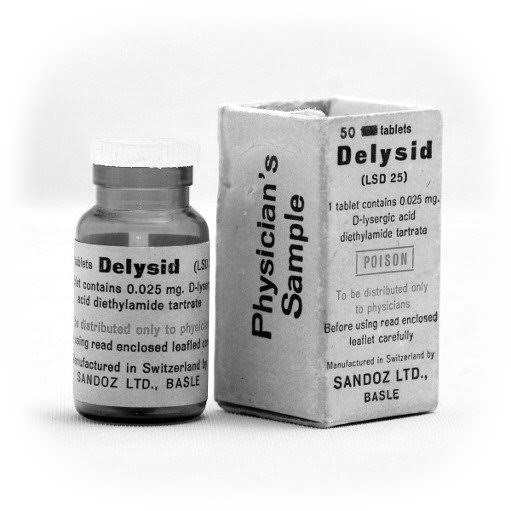
The first systematic human study came from Werner Stoll, a psychiatrist in Zurich and, as it happens, the son of Hofmann's boss. In 1947 he published the effects of LSD in healthy volunteers and in patients with schizophrenia, and Sandoz began sending it to researchers under the trade name Delysid, with no clear idea what it was for.13 The package insert offered two uses. One was to help patients "release repressed material" in psychotherapy, starting at 25 µg. The other is one I think about often: psychiatrists were encouraged to take it themselves, so that "by taking Delysid himself, the psychiatrist is able to gain an insight into the world of ideas and sensations of mental patients."13 For a decade, LSD was mainly a tool for producing a temporary "model psychosis," a way to study madness from the inside. Then the people taking it began to describe something that did not sound like madness at all.
Hofmann lived to 102. Late in life he called LSD his "problem child," the title of his 1980 memoir, and by his account the head of Sandoz once told him he wished he had never discovered it.1514
3How little a dose weighs
Before going further, it helps to feel the units, because LSD is strange among drugs in how little of it there is. Most psychiatric medicines are dosed in milligrams. LSD is dosed in micrograms, millionths of a gram. The phase 3 dose of 100 µg is a tenth of a milligram; one regular aspirin tablet weighs as much as 3,250 of them. Effects begin to be noticeable around 25 µg in controlled studies, and the "good drug effect" ratings in Basel's dose-finding work plateaued around 100 µg.16 One thing this scale shows that surprised me when I first lined it up: the 1960s alcohol trials used doses two to eight times higher than anything used in clinical trials today.
Slide the dose
Each point marks a dose given in a study mentioned in this post. Slide to see which studies used roughly that amount.
4Saskatchewan and the alcohol wards
The most interesting early work happened somewhere few people would have guessed: the prairie hospitals of Saskatchewan. Humphry Osmond, a British psychiatrist, arrived at the Weyburn mental hospital in 1951 and, with the biochemist-psychiatrist Abram Hoffer, began giving LSD to people with severe alcohol use disorder. The original idea was the model-psychosis idea turned to a practical end: perhaps a terrifying LSD session would mimic delirium tremens and scare drinkers sober. What they reported instead was that the patients who did best had something closer to a conversion experience, and their uncontrolled series claimed recovery rates of 50 to 90 percent.17 Those numbers are not believable as stated, but they shifted the question from "can this drug frighten people" to "can one experience change a life."
Osmond also named the thing. In a correspondence with Aldous Huxley, who had tried mescaline under Osmond's supervision, the two traded rhyming proposals. Huxley offered "phanerothyme." Osmond answered: "To fathom Hell or soar angelic, just take a pinch of psychedelic." He introduced the word, meaning "mind-manifesting," at the New York Academy of Sciences in 1957.18
Two schools grew up, and the split still matters. In Britain and Europe, Ronald Sandison at Powick Hospital began giving LSD in 1952 in small, repeated doses as an accelerant to psychoanalytic therapy, the "psycholytic" model; his unit treated 683 patients over 13,785 sessions.19 In North America, the "psychedelic" model used a single large dose meant to occasion an overwhelming experience, with careful preparation and a guide. The modern trials are descendants of the second, with one important twist I will come back to.
The people drawn in were not who you might expect. Bill Wilson, the cofounder of Alcoholics Anonymous, took LSD on August 29, 1956, under the supervision of the UCLA psychiatrist Sidney Cohen, with the writer Gerald Heard as his guide. He believed it could help some alcoholics reach the spiritual experience the program describes, and AA, understandably, did not follow him there.20 Cary Grant had more than a hundred sessions with a Beverly Hills psychiatrist between 1958 and 1962 and talked about them, glowingly, to the press.21 Oscar Janiger in Los Angeles gave LSD to about 900 people, artists among them, between 1954 and 1962, mostly to ask what it did to ordinary minds.22 This was the high-water mark: LSD as a respectable research drug, supplied by a Swiss pharmaceutical company, written up in good journals, discussed in Time and Look.
The estimate you will see everywhere is that the 1950s and early 60s produced more than a thousand papers on some forty thousand patients.8 I repeat it with a caveat: it is an estimate handed from book to book, not a count anyone can reproduce, and most of those papers were case series, small open trials and clinical impressions. The interesting question is what survives when you keep only the randomized trials.
5Stress-test the alcohol trials
In 2012 Teri Krebs and Pål-Ørjan Johansen did exactly that for alcohol. They found six randomized controlled trials from 1966 to 1970, five in the United States and one in Toronto, with 536 participants in all: 325 given a single high dose of LSD, between about 210 and 800 µg, and 211 given a control, which was variously a low dose of LSD, a stimulant such as amphetamine or ephedrine, or ordinary treatment.9 In the five trials that reported a yes-or-no outcome, 59 percent of the LSD group and 38 percent of the control group were rated improved at the first follow-up. Pooled, the odds ratio was 1.96, with a 95 percent confidence interval of 1.36 to 2.84 and no measurable heterogeneity among the trials. That is a number needed to treat of about six, which would be respectable for any medicine in addiction psychiatry.
Then look at the follow-up times. The advantage was clear at two to three months and at six months, and gone by twelve. The tool below shows the published pooled estimates side by side. It also has a dial for the problem everyone in this field has to face: the patients and often the staff knew who got LSD. Turn the dial to ask how much that kind of bias, on its own, would have to inflate the result to fully explain it.
The 1960s LSD-for-alcohol trials, pooled
Odds ratios with 95% confidence intervals, from Krebs and Johansen's random-effects meta-analysis. Right of the line favors LSD. Pick an outcome, then turn the bias dial.
Here is how I read it. The first-follow-up result is real in the sense that it is not a fluke of one study; six trials pointing the same way, with no heterogeneity, is better than most of what the 1960s produced. The E-value, a standard way of asking how strong an unmeasured bias would have to be to explain a result away, comes out a little above 2 for the first follow-up.23 That is not enormous, and expectancy effects in an unblinded psychedelic trial could plausibly be that large. The fade is the more important finding. Torsten Passie and Michiel van Elk published a careful re-reading of eleven controlled studies from 1965 to 1977 this September and titled it, without hedging, "Psychedelic therapy without durable effects."24 I think they are right about the old trials, with one point in the trials' defense: most gave a single session, with little therapy before or after, to people with severe, chronic drinking, and then measured them a year later. No one would expect a single dose of any medicine to last a year in that setting. Whether a dose can be repeated, and whether therapy around it changes durability, are the questions modern trials are built to answer.
It uses the published pooled estimates rather than letting you re-pool individual trials, because the per-trial counts in the 2012 analysis appear only in a figure, and I would rather show you real numbers than reconstructed ones. And I deliberately do not pool the modern trials further down. They differ in design, dose, outcome scale and comparator, and a single pooled number would look more certain than it is.
6The other experiments
There is a second history running underneath the first, and any honest account has to include it. On April 13, 1953, CIA director Allen Dulles approved a program called MKUltra. Over the next decade it funded about 150 projects, many at universities and hospitals whose staff did not know where the money came from, to explore drugs as tools of interrogation and control. LSD was the star. Some subjects were prisoners, addicts in federal treatment centers or psychiatric patients; some were unwitting members of the public, dosed in CIA safehouses. The files were ordered destroyed in 1973, and what survives came out in Senate hearings in 1977.25 The agency reportedly tried to buy an enormous supply from Sandoz before turning to an American manufacturer.26
The best-known casualty was Frank Olson, an Army scientist who was given LSD without his knowledge at a retreat on November 19, 1953, became severely disturbed, and died nine days later in a fall from a New York hotel window. His family learned about the drugging only in 1975 and received a settlement and a presidential apology.27 The Army ran its own program at Edgewood Arsenal, testing LSD and other agents on soldiers. None of this was research in any sense a modern ethics board would recognize. I mention it not to tie it to the clinical work, which mostly ran in daylight, but because it is part of why the public came to distrust the word "experiment" when it sat next to "LSD," and because it is one more reason informed consent sits at the center of every trial I run.
The clinical side was not without harm either, and it was tracked. In 1960 Sidney Cohen surveyed 44 investigators who between them had given LSD or mescaline about 25,000 times to some 5,000 people. In volunteers, he found psychotic reactions lasting more than 48 hours in fewer than one per thousand; in psychiatric patients, about two per thousand, and a small number of suicides, all in patients.28 That is a reassuring rate for a drug given by clinicians to screened people, and a reminder that the risk was never zero and fell hardest on those who were already ill.
7The door closes
The 1962 Kefauver–Harris amendments, passed after thalidomide, required proof of efficacy before approval and brought investigational drugs under closer federal control; informed consent rules followed in 1963 and institutional review in 1966.2930 That was good law, and LSD research could have adapted to it. What it could not survive was the street. By the mid-1960s LSD was everywhere, Timothy Leary was on stage, and the headlines were about emergency rooms. Sandoz stopped distributing LSD in 1965 and 1966, handing its remaining supply to the government, which then licensed a small number of investigators.3130 California banned it on October 6, 1966.31 Congress made possession a federal crime in 1968, and the Controlled Substances Act of October 27, 1970 placed LSD in Schedule I: high potential for abuse, no accepted medical use, no accepted safe use under medical supervision.3233 The 1971 UN Convention on Psychotropic Substances spread the same classification worldwide.34
Science helped close the door, too. In 1967 a paper in Science reported chromosome breakage in white blood cells exposed to LSD, and the claim that LSD caused birth defects ran everywhere. A large review in the same journal four years later concluded that pure LSD at ordinary doses did not damage chromosomes in people.35 The correction got a fraction of the attention. The last sustained psychedelic research program of that era in the United States, at the Maryland Psychiatric Research Center, where Stanislav Grof and colleagues gave LSD to people with alcohol use disorder and to patients dying of cancer, ended in 1976.3637
8The Swiss keep a candle lit
For about two decades, legal human research with LSD all but stopped. The exception was the country where it started. From 1988 to 1993, the Swiss government gave a handful of psychiatrists special permits to use LSD and MDMA in psycholytic therapy, and a follow-up survey of their patients was largely positive, though it was a survey, not a trial.38 In January 2006, more than two thousand people came to Basel for a symposium on Hofmann's 100th birthday, and he spoke.39 In December 2007, Swiss regulators approved Peter Gasser's small randomized trial of LSD-assisted therapy for anxiety in people with life-threatening illness, the first therapeutic LSD study approved anywhere in about forty years.40 Hofmann died the following April, at 102, a few months after it was approved.15
Gasser's trial was tiny: twelve patients, eight given 200 µg and four given 20 µg as an active placebo, in two sessions with psychotherapy. Anxiety improved more in the full-dose group, and there were no serious adverse events.41 It proved mostly that the thing could be done again, carefully, inside a modern ethics and regulatory framework. That mattered more than the numbers.
9Basel, London, and the microdosers
The modern science of what LSD does in the human body comes largely from Matthias Liechti's laboratory at University Hospital Basel. In 2015 his group published the first modern placebo-controlled study of LSD's acute effects in healthy volunteers, and it went on to map dose responses, blood levels, interactions and safety in dozens of papers.42161 In 2023 the group published a randomized trial in 42 patients with anxiety, with and without life-threatening illness: two sessions of 200 µg against placebo, with large reductions in anxiety sixteen weeks later (an effect size of about 1.2).43 Their depression trial, published in 2025, compared high-dose against low-dose LSD with therapy and found a benefit on one rating scale that weakened after adjusting for baseline differences: promising, not conclusive.44
In London, Robin Carhart-Harris and colleagues at Imperial College published the first brain images of people on LSD in 2016, funded partly by the Beckley Foundation and partly by a crowdfunding campaign.4546 A year later, a team at the University of North Carolina solved the crystal structure of LSD sitting in a serotonin receptor and found that a loop of the receptor folds over the molecule like a lid, which helps explain why its effects last so long after blood levels fall.47
Then there is microdosing, the practice of taking about a tenth of a typical dose every few days, which spread widely in the 2010s on the strength of anecdote. The controlled trials have been sobering. Low doses produce measurable effects, and people with depressed mood seem to feel them more strongly.484950 But a clever self-blinded citizen-science study of 191 microdosers found the benefits people reported were largely explained by whether they believed they were on the drug, and a 6-week home-dosing trial did not support its main hypotheses.5152 In adults with ADHD, repeated 20 µg doses were no better than placebo.53 I find that reassuring, in an odd way. A field that can publish its negative results is a field doing science.
10Phase 2b, from the inside
The study I know best began dosing in August 2022 at 22 outpatient research sites in the United States, mine among them.547 It took a different bet from almost everything before it. There was no psychotherapy. Participants received one dose of lysergide, or placebo, alone in a private, comfortable room, with two trained dosing-session monitors present at all times and a physician available, for at least twelve hours. The monitors were there for safety and comfort; the protocol explicitly prohibited psychotherapy, and the same two monitors could not rate the outcomes. Then participants went home to their ordinary lives.7 The bet was that if a drug is going to reach a lot of people with generalized anxiety, it has to work without a course of psychotherapy built around it, and this was the test of whether it could. One hundred ninety-eight adults with moderate to severe generalized anxiety were randomized to 25, 50, 100 or 200 µg or placebo. Independent central raters, blinded to treatment and never in the dosing room, scored anxiety on the Hamilton Anxiety Rating Scale.
The primary analysis was a dose-response model of the change in anxiety at week 4, and it was positive: the model put 100 µg at 5.0 points better than placebo on the Hamilton scale and 200 µg at 6.0, while 25 and 50 µg did not separate from placebo. Compared arm by arm, 100 µg was 7.6 points better than placebo at week 4 (effect size 0.88) and 7.7 points better at week 12 (0.81); 200 µg was 7.4 points better at week 12 (0.77). At week 12, 65.0 percent of people on 100 µg had responded, meaning their anxiety score fell by at least half, against 30.8 percent on placebo, and 47.5 percent were in remission against 20.5 percent.7 The paper reports side effects by grouped category: "visual perception changes," a bucket that combines illusions, pseudo-hallucinations and hallucinations, were recorded in 92.5 percent of people at 100 µg and all 40 at 200 µg, against 10.3 percent on placebo; nausea in 40.0 and 60.0 percent, against 7.7 percent; headache in 35.0 and 27.5 percent, against 23.1 percent. Of all adverse events, 98.5 percent occurred on the dosing day.7 Because 200 µg brought more side effects without more benefit, 100 µg was carried into phase 3, and the FDA granted the program Breakthrough Therapy designation in March 2024.755
The honest weak point of every trial like this is blinding. About 85 percent of participants who received the drug correctly guessed that they had, and more than 65 percent of those on placebo guessed placebo. The independent central raters, who interviewed participants by phone without knowing the dose or the visit, stayed blinded in more than 80 percent of the anxiety assessments. And the 25 and 50 µg groups were unblinded too, yet did not separate from placebo, which argues against unblinding alone explaining the result.7 Still, the central raters were a mitigation, not a cure, and later trials added a 50 µg arm partly so that "I felt something" would not tell anyone which dose they got. Neither fully solves the problem. No one has, for any psychedelic.
The modern controlled trials, side by side
Standardized effect sizes (Cohen's d) on each trial's primary anxiety or depression outcome, with sample size as the dot area. These are different designs on different scales, so I have not pooled them. Tap a trial.
Tap a trial.
One pattern in that chart is worth naming, because it is one of the most reliable patterns in all of medicine. The smallest trials show the biggest effects. As trials get larger, more blinded and more multicenter, effect sizes shrink toward a more believable middle. That happened here: from about 1.2 in the small Swiss studies to 0.6 to 0.8 in the large phase 3 trials. An effect size around 0.6 to 0.8 is still large by psychiatric standards: in a meta-analysis of 21 placebo-controlled trials of existing medications for generalized anxiety, the overall effect size was 0.39 (0.36 for SSRIs, 0.38 for benzodiazepines).56 But it is a better guide to what a clinic would see than the early numbers were.
11Phase 3, and what comes next
This year the three phase 3 trials reported, each testing a single 100 µg dose of an orally disintegrating tablet with no psychotherapy.101112
- Emerge, major depression, June 2026. 149 adults. Depression scores (MADRS) fell 8.1 points more than with placebo at week 6, and the difference held at week 12. Remission at week 6: 24 percent versus 3 percent.10
- Voyage, generalized anxiety, August 2026. 214 adults. Anxiety scores fell 5.4 points more than with placebo at week 12, an effect size of 0.81. Response: 43 percent versus 16 percent.11
- Panorama, generalized anxiety, September 2026. 245 adults, with a 50 µg arm included partly to blur the "I can tell I got it" problem. At 100 µg, anxiety fell 5.1 points more than placebo at week 12, an effect size of 0.64. Response: 32 percent versus 14 percent.12
Perceptual changes on the dosing day were the most common side effect: in Panorama, "illusion" was recorded in 68 percent of people at 100 µg, nausea in 37 percent and headache in 24 percent.12 Across the trials, the companies reported no new safety signals and no increase in suicidal thinking or behavior, and most participants were ready to go home within about six to eight hours.111210 The company says it plans to meet with the FDA this quarter and file for approval in the first half of 2027.12
I helped run some of this work, so take my reading with that in mind, and here it is. Three positive phase 3 trials of a single dose, with effects visible by the next day and lasting at least three months, are a result that would have been hard to imagine when I started in psychiatry. They are also press releases. Full publication will matter: the complete safety tables, what happened in the open-label extensions when people were offered more doses, how the raters' blinding held up, and who was excluded at screening. Approval is not a given, and even if it comes, the honest questions are practical ones. Who should not take it. How often it can be repeated. What happens after week 12. What a clinic needs to give it safely. Those answers will come from the next decade, not from this one.
A last thought on durability, since it is where the old trials failed. The 1960s alcohol studies saw an effect that faded by a year. The modern trials have so far measured to twelve weeks, plus open-label follow-up. If there is a lesson connecting the two eras, I suspect it is not that the effect is illusory, but that one dose is a beginning rather than a cure, and that the field is finally running trials that can tell the difference.
12Rabbit holes
For the curious. Each opens.
Why "25"?
It was the twenty-fifth compound in Hofmann's series of lysergic acid derivatives. The German name, Lysergsäurediäthylamid, gives the order of the letters: LSD.1314
Tusko the elephant
On August 3, 1962, researchers at the Oklahoma City zoo injected a male Asian elephant named Tusko with 297 milligrams of LSD, roughly three thousand human doses, to see whether it would mimic the "musth" state of bull elephants. He collapsed within minutes and died about an hour and forty minutes later, after the team gave him other drugs to reverse it; what actually killed him is still argued about. It was published in Science.57
Huxley's word lost
Aldous Huxley's candidate was "phanerothyme." His couplet: "To make this mundane world sublime, take half a gram of phanerothyme." Osmond's won.18
Francis Crick and the double helix: a myth
A widely repeated story says Crick was on LSD when he worked out the structure of DNA. His biographer Matt Ridley found that Crick first took LSD in 1967 or later, after his major discoveries.58
"Lucy in the Sky with Diamonds"
John Lennon always said the title came from a drawing his young son Julian made of a classmate named Lucy, and the drawing and the classmate were real. Paul McCartney later allowed that drug influences on their music at the time were "pretty obvious."59
Steve Jobs
Jobs told his biographer Walter Isaacson that taking LSD was "a profound experience, one of the most important things in my life."60
The lid on the receptor
LSD's effects last ten hours or more, long after much of it has left the blood. The 2017 crystal structure showed why: when LSD binds the serotonin receptor, a loop of the receptor closes over it like a lid, so it leaves slowly.47
A chemist's dose
Hofmann's "cautious" 250 µg on Bicycle Day is two and a half times the phase 3 dose. He had no way to know. Nothing he had ever made was active at a quarter of a milligram.13
Grof's four thousand sessions
Across his years in Prague and then Maryland, Stanislav Grof ran more than four thousand psychedelic therapy sessions, and his maps of what happened in them shaped a good deal of modern psychedelic therapy.37
13Where this leaves us
If you line the whole thing up, a few lessons stand out. The early researchers were not fools; some of their trials were better than their reputation, and their best result, in alcohol, holds up in pooled analysis. They were also working without the tools we now take for granted: randomization was rare, blinding nearly impossible, follow-up short. The worst things done with LSD were done in secret and without consent, by people who were not trying to heal anyone. The law that followed was a reaction to the street and the scandals more than to the science, and it cost decades. And the revival has been, for the most part, slow, careful and willing to publish disappointment, which is exactly why its positive results deserve a hearing.
That sentence at the top of every paper will keep changing. A semisynthetic compound. A classic hallucinogen. A substance psychiatrists once investigated extensively. Maybe, in a few years, a medicine for some people, with a label that lists who should not take it. Hofmann would have liked to read that one, I think. He spent his last decades hoping his problem child would grow up.
Disclosures. Reid Robison is a principal investigator for clinical trials sponsored by Definium Therapeutics (formerly MindMed), conducted at Inner Space Research under contract with the sponsor, and is a paid consultant to Definium on commercialization and clinical rollout. He has received research funding from Janssen (Johnson & Johnson), the maker of esketamine (Spravato), and from numerous other sponsors, has been a paid Spravato speaker in the past, and has owned and operated clinics that offered esketamine and ketamine. Full disclosures. He was first author of the phase 2b MM120 trial published in JAMA in 2025. This post uses only published and publicly announced data, was not reviewed or approved by the company, and is not medical advice. LSD (lysergide) is not approved by the FDA or any other regulator for any use, and outside approved research it is illegal in most places.
References
- Liechti ME. Modern clinical research on LSD. Neuropsychopharmacology. 2017;42(11):2114–2127. edoc.unibas.ch
- Liester MB. A review of lysergic acid diethylamide (LSD) in the treatment of addictions: historical perspectives and future prospects. Curr Drug Abuse Rev. 2014. doi:10.2174/1874473708666150107120522
- Das S, Barnwal P, Ramasamy A, Sen S, Mondal S. Lysergic acid diethylamide: a drug of 'use'? Ther Adv Psychopharmacol. 2016;6(3):214–228. doi:10.1177/2045125316640440 journals.sagepub.com
- Müller F, Borgwardt S. Acute effects of lysergic acid diethylamide (LSD) on resting brain function. Swiss Med Wkly. 2019;149:w20124. doi:10.4414/smw.2019.20124 smw.ch
- Hirschfeld T, Prugger J, Majić T, Schmidt TT, et al. Dose-response relationships of LSD-induced subjective experiences in humans. Neuropsychopharmacology. 2023;48(11):1602–1611. doi:10.1038/s41386-023-01588-2 link.springer.com
- Definium Therapeutics. MindMed rebrands to Definium Therapeutics. Press release, January 12, 2026. ir.definiumtx.com
- Robison R, Barrow R, Conant C, et al. Single treatment with MM120 (lysergide) in generalized anxiety disorder: a randomized clinical trial. JAMA. Published online September 4, 2025; October 21, 2025 issue. doi:10.1001/jama.2025.13481 edhub.ama-assn.org
- Grinspoon L, Bakalar JB. Psychedelic Drugs Reconsidered. Basic Books; 1979. (The source usually given for the estimate of more than a thousand papers and some forty thousand patients before 1965; it is an estimate repeated from source to source, not a count.)
- Krebs TS, Johansen PØ. Lysergic acid diethylamide (LSD) for alcoholism: meta-analysis of randomized controlled trials. J Psychopharmacol. 2012;26(7):994–1002. doi:10.1177/0269881112439253 author PDF
- Definium Therapeutics. Positive topline results from phase 3 Emerge study of DT120 ODT in major depressive disorder. Press release, June 22, 2026. ir.definiumtx.com
- Definium Therapeutics. Positive topline results from phase 3 Voyage study of DT120 ODT in generalized anxiety disorder. Press release, August 12, 2026. ir.definiumtx.com
- Definium Therapeutics. Positive topline results from phase 3 Panorama study of DT120 ODT in generalized anxiety disorder. Press release, September 14, 2026. ir.definiumtx.com
- Hofmann A. LSD: My Problem Child. McGraw-Hill; 1980. (Synthesis in 1938, the self-experiment of April 19, 1943, Werner Stoll's 1947 paper, and the Delysid prospectus.) erowid.org
- On the shoulders of a giant: Albert Hofmann. Novartis. live.novartis.com
- Albert Hofmann. Wikipedia, accessed Oct 24, 2026. en.wikipedia.org
- Holze F, Vizeli P, Ley L, et al. Acute dose-dependent effects of lysergic acid diethylamide in a double-blind placebo-controlled study in healthy subjects. Neuropsychopharmacology. 2021;46(3):537–544. doi:10.1038/s41386-020-00883-6
- Dyck E. Psychedelic Psychiatry: LSD from Clinic to Campus. Johns Hopkins University Press; 2008. See also: Psychedelic research in 1950s Saskatchewan. The Canadian Encyclopedia. thecanadianencyclopedia.ca
- The origin of the term "psychedelic." New York Academy of Sciences. nyas.org
- Ronald A. Sandison. Wikipedia, accessed Oct 24, 2026. (Powick Hospital, 1952; the LSD unit opened in 1955; 683 patients and 13,785 sessions.) en.wikipedia.org
- Bill Wilson's experience with LSD. AA Agnostica. (First session August 29, 1956, with Sidney Cohen and Gerald Heard.) aaagnostica.org
- Acid's first convert: Cary Grant. Bunk History. bunkhistory.org
- Oscar Janiger. Wikipedia, accessed Oct 24, 2026. (About 900 subjects, 1954–1962.) en.wikipedia.org
- VanderWeele TJ, Ding P. Sensitivity analysis in observational research: introducing the E-value. Ann Intern Med. 2017;167(4):268–274. doi:10.7326/M16-2607
- Passie T, van Elk M. Psychedelic therapy without durable effects: a review and re-evaluation of controlled studies between 1965 and 1977. J Psychopharmacol. Published online September 7, 2026. doi:10.1177/02698811261478606 journals.sagepub.com
- Project MKUltra, the CIA's program of research in behavioral modification. Joint hearing before the Select Committee on Intelligence and the Subcommittee on Health and Scientific Research, US Senate, August 3, 1977. See also: MKUltra. Wikipedia, accessed Oct 24, 2026. en.wikipedia.org
- Miller RL. Drugged: The Science and Culture Behind Psychotropic Drugs. Oxford University Press; 2013. (The CIA's attempt to buy LSD from Sandoz.) Excerpted in Salon, December 14, 2013. salon.com
- Frank Olson. Wikipedia, accessed Oct 24, 2026. (Covertly dosed November 19, 1953; died November 28, 1953; disclosed 1975; settlement 1976.) en.wikipedia.org
- Cohen S. Lysergic acid diethylamide: side effects and complications. J Nerv Ment Dis. 1960;130:30–40. Rates per 1,000 as summarized in Yensen R, Dryer D, via MAPS. maps.org
- Kefauver–Harris Amendment. Wikipedia, accessed Oct 24, 2026. en.wikipedia.org
- Bonson KR. Regulation of human research with LSD in the United States (1949–1987). Psychopharmacology. 2018;235(2):591–604. summary
- History of LSD. Wikipedia, accessed Oct 24, 2026. (Sandoz withdrawal, 1965–66; the California ban effective October 6, 1966.) en.wikipedia.org
- Johnson LB. Statement by the President upon signing bill relating to traffic in or possession of drugs such as LSD. October 25, 1968. The American Presidency Project. presidency.ucsb.edu
- Comprehensive Drug Abuse Prevention and Control Act of 1970, Pub L No. 91-513. ssa.gov
- This day in history: the 1971 Convention on Psychotropic Substances. UNODC. unodc.org
- Cohen MM, Marinello MJ, Back N. Chromosomal damage in human leukocytes induced by lysergic acid diethylamide. Science. 1967;155:1417–1419; and Dishotsky NI, Loughman WD, Mogar RE, Lipscomb WR. LSD and genetic damage. Science. 1971;172:431–440. Summary: erowid.org
- LSD research in the 1990s. MAPS Bulletin. (Maryland Psychiatric Research Center psychedelic work, 1968–1976.) maps.org
- Stanislav Grof. Erowid Character Vaults. erowid.org
- Gasser P. Psycholytic therapy with MDMA and LSD in Switzerland. MAPS Bulletin. 1994;5(3):3–7. maps.org
- LSD: Problem Child and Wonder Drug. International symposium on the occasion of the 100th birthday of Albert Hofmann, Basel, January 13–15, 2006. erowid.org
- LSD study breaks 40 years of research taboo. MAPS press release. maps.org
- Gasser P, Holstein D, Michel Y, et al. Safety and efficacy of lysergic acid diethylamide-assisted psychotherapy for anxiety associated with life-threatening diseases. J Nerv Ment Dis. 2014;202(7):513–520. doi:10.1097/NMD.0000000000000113 boris.unibe.ch
- Schmid Y, Enzler F, Gasser P, et al. Acute effects of lysergic acid diethylamide in healthy subjects. Biol Psychiatry. 2015;78(8):544–553. doi:10.1016/j.biopsych.2014.11.015
- Holze F, Gasser P, Müller F, Dolder PC, Liechti ME. Lysergic acid diethylamide–assisted therapy in patients with anxiety with and without a life-threatening illness: a randomized, double-blind, placebo-controlled phase II study. Biol Psychiatry. 2023;93(3):215–223. doi:10.1016/j.biopsych.2022.08.025 biologicalpsychiatryjournal.com
- Müller F, et al. Efficacy and safety of low- versus high-dose LSD-assisted therapy in patients with major depression. Med. 2025;6(9):100725. doi:10.1016/j.medj.2025.100725 research.uni-luebeck.de
- Carhart-Harris RL, Muthukumaraswamy S, Roseman L, et al. Neural correlates of the LSD experience revealed by multimodal neuroimaging. Proc Natl Acad Sci USA. 2016;113(17):4853–4858. doi:10.1073/pnas.1518377113
- Scientists use crowdfunding to boost LSD research. Pharmaceutical Journal, March 2015. pharmaceutical-journal.com
- Wacker D, Wang S, McCorvy JD, et al. Crystal structure of an LSD-bound human serotonin receptor. Cell. 2017;168(3):377–389. doi:10.1016/j.cell.2016.12.033 escholarship.org
- Bershad AK, Schepers ST, Bremmer MP, Lee R, de Wit H. Acute subjective and behavioral effects of microdoses of lysergic acid diethylamide in healthy human volunteers. Biol Psychiatry. 2019;86(10):792–800. doi:10.1016/j.biopsych.2019.05.019
- Family N, Maillet EL, Williams LTJ, et al. Safety, tolerability, pharmacokinetics, and pharmacodynamics of low dose lysergic acid diethylamide (LSD) in healthy older volunteers. Psychopharmacology. 2020;237(3):841–853. doi:10.1007/s00213-019-05417-7
- Greater subjective effects of a low dose of LSD in participants with depressed mood. de Wit laboratory, University of Chicago. Neuropsychopharmacology. 2024. doi:10.1038/s41386-023-01772-4 nature.com
- Szigeti B, Kartner L, Blemings A, et al. Self-blinding citizen science to explore psychedelic microdosing. eLife. 2021;10:e62878. doi:10.7554/eLife.62878
- Murphy RJ, Sumner RL, Evans W, et al. Acute mood-elevating properties of microdosed LSD in healthy volunteers: a home-administered randomized controlled trial. Biol Psychiatry. 2023;94(6):511–521. doi:10.1016/j.biopsych.2023.03.013
- Safety and efficacy of repeated low-dose LSD for ADHD treatment in adults: a randomized clinical trial. University Hospital Basel (Liechti laboratory). JAMA Psychiatry. 2025;82(6). doi:10.1001/jamapsychiatry.2025.0044. Summary: unibas.ch
- MindMed. Wikipedia, accessed Oct 24, 2026. (First patient dosed in the phase 2b study, August 2022.) en.wikipedia.org
- MindMed. MindMed receives FDA Breakthrough Therapy designation and announces positive 12-week durability data from phase 2b study of MM120 for generalized anxiety disorder. Press release, March 7, 2024. businesswire.com
- Hidalgo RB, Tupler LA, Davidson JR. An effect-size analysis of pharmacologic treatments for generalized anxiety disorder. J Psychopharmacol. 2007;21(8):864–872. doi:10.1177/0269881107076996
- West LJ, Pierce CM, Thomas WD. Lysergic acid diethylamide: its effects on a male Asiatic elephant. Science. 1962;138:1100–1103. Background: erowid.org
- Ridley M. Francis Crick: Discoverer of the Genetic Code. Atlas Books; 2006. mattridley.co.uk
- Lucy Vodden. Wikipedia, accessed Oct 24, 2026. en.wikipedia.org
- Isaacson W. Steve Jobs. Simon & Schuster; 2011. Quoted in: Steve Jobs: 10 revealing quotes from his biography. The Fiscal Times, October 24, 2011. thefiscaltimes.com