I finally read my own genome
Ten years ago I ran a company whose software helped labs read genomes. On the side I had a passion project: giving people access to their own. The FDA wrote me a letter two days after it launched. This month I finally got my own whole genome back. Here's the story, what I found, what I was relieved not to find, and what I think any of it is worth.
By Reid Robison, MD. 4,881 words, with the letter that ended a Kickstarter, the price of a genome over 25 years, one letter of my DNA you can flip, my results and the myths about sharing them.
Researched and reviewed by Reid Robison, MD × OpenEvidence × Claude How this post was made
- In 2016 we launched a side project to give people their own genomes. The campaign raised $74,560 from 114 backers in two weeks. A two-paragraph letter from the FDA ended it.12
- In 2026 I ordered my own online, for $399, and nobody wrote me a letter.
- Most of what I learned is what I don't have. No APOE ε4, the most common Alzheimer's risk variant. No Factor V Leiden clotting variant. And, pending a confirming test, not the tumor-risk variant that runs in my family.
- My old report got things wrong. A 2015 analysis of my exome listed thirteen alarming findings that turned out to be errors in the reading.
- The most useful findings were about medicines, not diseases: how my liver handles codeine and several antidepressants.
- A genome is a family document. Mine says things about my parents, siblings and kids, which is why I'm sharing selected results and not the whole file.
- The real privacy risk isn't cloning. It's life, disability and long-term-care insurance, which federal law doesn't protect.3
1Know thyself
Before I came back to psychiatry and clinical trials full time, I spent several years as CEO of Tute Genomics. I started it with Kai Wang, PhD, then a professor at USC and one of the smartest people I have ever met. Kai had written ANNOVAR, software that takes the millions of variants in a genome and annotates each one with what's known about it, and that labs all over the world still use.4 What we added at Tute was the machine learning: a huge database of variant knowledge, and algorithms trained on real diagnoses to narrow millions of variants down to the few that matter. This was years before most people were talking about AI in medicine. Research labs used it first, and then clinical labs.
Alongside that work I had a passion project. I wanted ordinary people to have access to their own information. Know thyself.
In 2015 we bought Knome, the company George Church helped start, which in 2007 had sold the first consumer genomes for $350,000 each. Church said afterward that Knome was "probably just too early."5 I liked the name, and I really liked spending time with George.
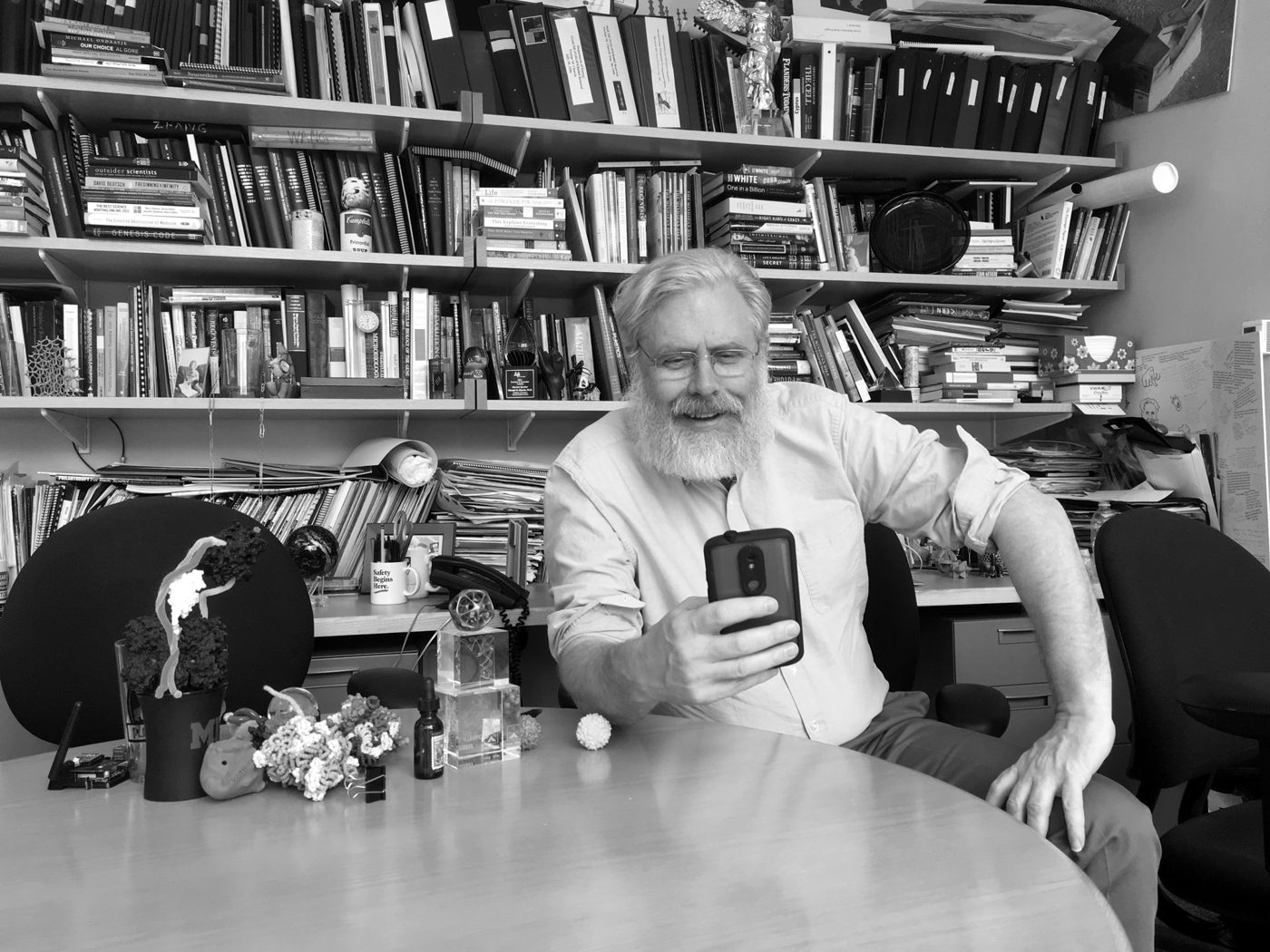
By 2016 the price of sequencing had fallen far enough that I thought everyone should be able to have theirs. I gave a TEDx talk that summer called "The genome revolution begins with you."6 A minute in, I put a slice of my own DNA sequence on the screen, from the exome I'd had done, and said: "Don't be alarmed as I bare my soul, but ladies and gentlemen, this is my genome. Well, some of it." The point of the stunt was the same as the point of this post. I've found that when someone else goes first, people fear the data a little less.
My 2016 TEDxSaltLakeCity talk.
After the acquisition the timing felt right. We would package our best genome-analysis technology in a well-designed app and keep the Knome name going as its brand, as a way of honoring what George had built. Two months after the talk we launched it on Kickstarter: "a place for curious beginners and serious self-searchers to own and understand their DNA." An exome was $399 for early backers and a whole genome was $999.78 It was about half funded within a day.
The commercial we made for the campaign, August 2016.
Of a $100,000 goal, from 114 backers, when we stopped. The campaign had four weeks left.1
2The letter
On September 15, two days after launch, this arrived.
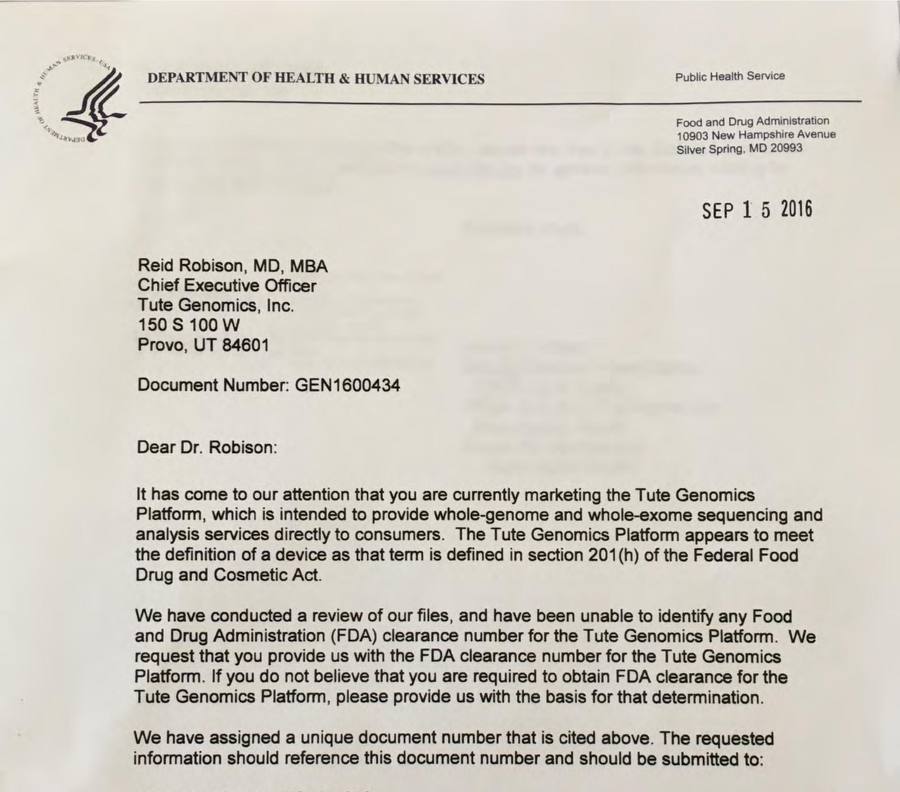
It's worth reading closely, because it doesn't say "stop." It says our service "appears to meet the definition of a device," that the agency couldn't find a clearance number for it, and asks us to send either the number or our reasons for thinking we didn't need one. In the FDA's world that's a question, a step below a warning letter. 23andMe had received the stronger kind three years earlier. Its carrier-status reports came back in 2015, and its disease-risk reports not until April 2017.910
We talked with the FDA, and we made a careful decision to stop. I wrote to our backers:
GenomeWeb · September 30, 2016Tute Genomics Suspends Kickstarter Campaign Following FDA LetterRead the articleI still strongly believe that everyone should have a right to, and own their DNA, but they should also respect the FDA and their credo to protect the consumer. I think both aims can be achieved and we're proactively engaging with the FDA and working on the right path forward to make this happen.
… Rest assured, you will be the first informed when we relaunch. In other words, we'll be back.
The comments under the campaign were angrier than I was. I understood the FDA's worry then and I understand it better now: a genome report can frighten someone over nothing, or reassure them falsely, and both can do harm. Later that fall Tute became part of PierianDx, and I went back to medicine. I didn't relaunch. But I never stopped thinking people should be able to read their own code, and this year I finally read mine.
3Ten years and a falling price
The first human genome took 13 years and about $2.7 billion. When I was in medical school, sequencing one more would have cost around $100 million. The $1,000 genome arrived in 2014, on a system sold as a set of ten machines for about $10 million. Today a whole genome costs less than many single-gene tests did when I trained.11
The price of one human genome
Approximate research cost by year, from NHGRI, on a scale where each line is ten times the one below. Tap a marker.
Tap a marker for what was happening.
In that talk I described a young girl I'd seen for a genetics consult who couldn't speak and had been from doctor to doctor without a diagnosis. I ordered two single-gene tests, my best guesses. Many weeks and several thousand dollars later, both came back negative. "Never again," I said on stage, "will I search for answers one gene at a time when you can now sequence the entire genome for even less cost."
That's what the price drop changed. Testing one gene at a time started to look like buying a book one page at a time. An exome, the roughly 2 percent of the genome that codes for proteins, could check thousands of disease genes at once for about $1,000. I wrote back then about how big a genome is as a file (about 200 gigabytes raw, 700 megabytes if you only keep the letters) and about moving them around Provo on Google Fiber.
4What came back
I ordered a 30x whole genome from Sequencing.com for $399. "30x" means each letter was read about thirty times, so errors get outvoted. It was the lowest tier, which comes with four free screening reports: carrier status, connective tissue, autoimmune and developmental conditions. I skipped the paid add-ons. I used to run a genomics company, and what I wanted was the raw data, with the quality and confidence of every call in plain view. I spat in a tube, mailed it, and waited several weeks. What came back was a set of files: all six billion letters, three billion from each parent, and a list of the four to five million places where mine differ from the reference genome. That number sounds alarming and isn't. Everyone has about that many, and nearly all of them do nothing.
The work is finding the few that matter. That used to be my company's whole business. This time I did it for one customer, working through the files with Claude, an AI assistant, and checking the clinically important findings against the medical literature with OpenEvidence. Ten years ago we were training algorithms to help read genomes. Now I can talk one through with an AI at my kitchen table.
5One letter, and a nickname to retire
Here is one of them, because it shows how small a "variant" is. In a gene called COMT, on chromosome 22, there's a spot where some people have a G and some have an A. COMT makes an enzyme that clears dopamine from the front of the brain. The G version builds the enzyme with the amino acid valine at position 158, and it works fast. The A version uses methionine, and the enzyme is less stable at body temperature. In human brain tissue, people with two A copies have roughly 40 percent less enzyme activity than people with two G copies, so dopamine lingers.1213
Flip one letter
The stretch of COMT around position 158. You have two copies, one from each parent. Tap a copy to change its letter.
I have G on both copies, so two fast ones. I'd love to tell you that explains my career. It doesn't. The enzyme difference is solid. Brain-imaging studies have reported differences in how the prefrontal cortex works.14 But in large pooled studies the effect on actual thinking tests is small to none,15 and the links to stress, anxiety and pain haven't shown up in the big genome-wide studies. One letter in one gene nudges; it doesn't decide. I wrote about why in Loaded, not fired.16
A confession about the name
You may know this gene by its nickname. The fast version gets called "warrior" and the slow version "worrier." I've never liked it. One name is a compliment and the other is a diagnosis, for a difference that's small at best. The idea behind the nickname is that the fast version does a little better under stress and the slow version does a little better at focused work when things are calm. That's a hypothesis, resting mostly on small studies, and I hold it loosely. But if the idea is that each version has a setting where it shines, the name should at least be fair to both.
So I'd like to retire it, and I'd like your help picking the replacement. Any nickname oversells one letter in one gene, so take these lightly. Here are my three favorites.
Rename the "warrior/worrier" gene
In each pair, the first name is for the fast version and the second is for the slow version. Pick the pair you'd use. One vote per reader.
6What I found
These are some of my results. Tap any card.
My results
From my 2026 whole genome, cross-checked against older consumer and exome data. These are my own readings of the data, not a clinical lab report, so anything I'd act on medically gets confirmed in a clinical lab first. Some genes are harder to read than others, and the cards say which.
Tap a card.
The medicine genes turned out to be the practical part. One of my two copies of CYP2D6 doesn't work and the other is slow. That enzyme turns codeine into its active form and clears several antidepressants and one ADHD medicine, atomoxetine, so codeine probably does less for me and some of those drugs would build up more. CYP2D6 is also one of the hardest genes to read from this kind of data, because it sits next to a near-identical copy, so this is the result I'd most want confirmed before it changed a prescription. Another enzyme, CYP2C19, runs fast in me, which can make certain SSRIs and the acid reducers called proton pump inhibitors a bit less effective at standard doses. None of this is rare. In the UK Biobank, 99.5 percent of people carried at least one result like these, and nearly 24 percent had been prescribed a medicine it affects.17 I wrote a whole post on what these tests can and can't do, One size fits few.18
I also have two copies of a mild iron-handling variant. On its own it rarely leads to iron overload.19 My iron labs are normal, so the action item is a blood test every few years. That's what a typical "finding" looks like: not a diagnosis, a reason to check something cheap.
7What my 2015 report got wrong
This wasn't my first report. In 2015 I had my exome sequenced and analyzed, and that report listed thirteen alarming findings. Three of them were frameshifts, a kind of change that usually breaks a gene, in FBN1, RYR1 and MYH11. Those genes are tied to Marfan syndrome, to a dangerous reaction to anesthesia, and to inherited aortic aneurysms. Any one of them, if real, would have meant a cardiology workup and a hard conversation with my family.
None of them were real. Neither of my parents carries any of the three, and my new genome doesn't show them. They were artifacts: errors made by the sequencing chemistry and the software of the time, in stretches of DNA that are easy to misread.
The same report called me an ultra-rapid metabolizer at CYP2D6, and I repeated that on the TEDx stage in 2016. My 2026 data says close to the opposite. My DNA didn't change in between. The reading did.
I knew enough at the time not to panic over that list. Most people handed thirteen alarming findings would not, and that is exactly what the FDA was worried about when it wrote to me. I argued then that people could handle their own data. I still think so, but my own old report is the best evidence I have for the agency's side of the argument. It's also why every result in this post comes with a note about how much to trust it.
8What I didn't find
The longest list is the rule-outs, and one of them I'd been carrying since medical school.
My grandfather had Alzheimer's, and it hit him hard. When I learned about APOE, the main risk gene, I wanted to know right away. A classmate wrote the lab order, and it somehow went through with "student doctor" scribbled after his signature. I remember telling him: if this is positive, I'm going to dedicate my career to Alzheimer's research. It was negative. No ε4 copy.20 I went into psychiatry. Twenty-odd years later the whole genome says the same thing, which is a nice thing about DNA: the sequence doesn't change. How well we read it does, and it keeps getting better.
The others: no Factor V Leiden, the common inherited clotting tendency. No copy of the SLCO1B1 variant tied to muscle symptoms on simvastatin. And when a relative with breast cancer wrote to the family this year about a tumor-risk variant found in her testing, I could look it up the same day. I don't see it in my data. Because this one matters for my children, I'm following my own rule and getting it confirmed with a clinical test before I tell them they can't have inherited it from me.
The four free screening reports that came with my order add up to a much longer list. They screened 889 autoimmune conditions, 1,055 connective tissue conditions, 1,654 developmental conditions and 4,777 conditions for carrier status, with plenty of overlap between them. At the highest evidence level, the first three found nothing at all. The carrier report found a recessive eye condition I carry one copy of, one copy of the common Gilbert's variant, and a stack of medicine-response results. Like nearly everyone, I also have a handful of "variants of uncertain significance": changes nobody yet knows how to interpret, which almost always turn out to be harmless.
Those reports were also a lesson in why interpretation matters. They're labeled beta and written partly by AI, and they wobble in ways a genetic counselor wouldn't. My fast CYP2C19 enzyme was filed under "carrier." The Gilbert's variant came under a heading that also named Crigler-Najjar syndrome, a far more serious condition I don't have. And a common variant in a seizure gene that slightly affects carbamazepine dosing came with a description of a severe childhood epilepsy and a suggestion that I get a brain MRI and see a pediatric neurologist. I'm 50. I knew to laugh. Someone else might not.
A clean result has limits, and they depend on what kind of change you're looking for.
Single-letter changes and small insertions or deletions in known disease genes. A 30x genome reads these well. "Not found" is a solid answer for the specific variants checked.
Repeat expansions (like Huntington's), large rearrangements and a few hard-to-read genes, including CYP2D6 and the repeat that sets most of a person's Lp(a) level.21 Whether these are ruled out depends on how the data was analyzed.
Conditions shaped by hundreds of small-effect genes plus life. That's most of what I treat: depression, anxiety, ADHD, eating disorders. No clean report makes those odds go to zero.
So "I don't have the Alzheimer's gene" really means "I don't have the commonest risk variant." It lowers my odds. It isn't a promise. And a clean genome doesn't replace the ordinary screening everyone should get. It doesn't get anyone out of a colonoscopy.
9A genome is a family document
You get half your DNA from each parent and pass half to each child, so every result of mine is a statement about other people too. Take COMT again. I have two fast copies. If the other parent has two slow copies, every one of our children gets one of each, with no dice involved.
An illustration of how one variant passes down, not a report on anyone in my family.
That's the harmless version. The serious version is the letter I mentioned. When someone learns they carry a variant that raises cancer risk, their relatives each have a real chance of carrying it too, and a targeted test for that one variant is cheap and definite. This is why genetic counselors draw family trees, and why the news travels by letter from cousin to cousin. It's called cascade testing, and it's one of the most useful things genetics does.
Many inherited traits are milder than that. Gilbert's syndrome is a good example: a common variant in a liver enzyme gene that, with two copies, lets a yellow pigment called bilirubin build up now and then, especially when you're sick or haven't eaten. It's harmless, it runs in families, and people who have it are often relieved to finally get a name for the lab result that keeps coming back slightly off. I carry one copy of the common Gilbert's variant. One copy usually isn't enough to have it, but each of my children had a coin-flip chance of getting that copy from me.
It's also why this post shows a slice of my genome and not the file. My kids each carry half of it and my parents and siblings share big pieces. Their results are theirs to tell. I can't fully keep that promise, and I should say so. Wherever I carry two copies of something, each of my children carries at least one. Posting my own results is a choice I made for myself, with the insurance gap below in mind, and it's one reason I'd tell most people to think before posting theirs.
10Should you be afraid of your DNA?
People bring a lot of worries to this. Some are myths and some are real. Tap each one.
Worries, sorted
What actually protects you in the US, and where the gaps are.
The law doing most of the protecting is the Genetic Information Nondiscrimination Act of 2008.3 It's a federal law, and its gaps are filled unevenly: some states limit what life and long-term-care insurers can do with genetic results, and many don't.22 The breach is the one at 23andMe in 2023.23 My own summary: the science-fiction fears are myths, the insurance gap and the family question are real, and both are manageable if you think about them before you test.
Many of my clinical trials include an optional consent form for genetic research. Plenty of people decline, and I fully respect that. My job is to explain it well enough that the choice is real. The case for saying yes is simple: every finding in this post exists because thousands of people let researchers compare their DNA with their health. The case for saying no is yours, and you don't owe anyone a reason.
11So what is it worth?
I spent years of my life on that question. In 2016 I called a genome "a user manual for yourself." I'd say it more modestly now. Here's my answer for a generally healthy adult.
- A few in a hundred people learn something big. Experts keep a list of 84 genes where a finding can change care, such as inherited cancer and heart conditions. In large sequencing programs roughly 2 to 4 percent of people have one; in the UK Biobank's genomes it was 4.1 percent.2425 If you're in that group, the test may be the most valuable one you ever take.
- Nearly everyone learns something about medicines, and you only need to learn it once.17
- Most people get a long list of rule-outs. I underrated that for years. Relief is worth something, as long as you remember what "not found" means: none of the known harmful variants that were checked.
- It won't tell you much about your mind. For the conditions I treat, your family history and your life still say more than your sequence does.16
- It gets more useful with age. The data doesn't change, but what we can read from it does. I'll be re-reading mine for the rest of my life.
The FDA was right that this information needs care. Reading my own genome proved it to me: the hardest parts were knowing which calls to trust, and catching the places where the software got things wrong: my 2015 report's thirteen false alarms, and this year's beta reports suggesting a brain MRI for a common dosing variant. I still believe people should be able to read their own code, with good help. The last ten years have mostly been the two sides working that out, and they aren't finished. I said we'd be back. This is a smaller comeback than I had in mind: one genome, mine, read at home. It was worth the wait.
Next: a field guide to genetic testing. Ancestry kits, gene panels, exomes and whole genomes, what each one can see, who regulates them, and how a newborn in intensive care can now be sequenced in a day.
Disclosures. Reid Robison co-founded Tute Genomics and was its CEO until its acquisition in 2016; he has no financial interest in any genomics company, including Sequencing.com, and paid $399 for his own sequencing. In the past three years he has received consulting or speaker fees from Beckley Psytech, Definium Therapeutics (formerly MindMed) and Janssen (Johnson & Johnson), and research funding paid to his research sites from many sponsors, listed on the disclosures page. This post is educational and isn't medical advice. Consumer and research-grade genetic results should be confirmed in a clinical lab before anyone acts on them.
How this post was made
I use AI tools in building this site, and I'd rather be open about how. The story and the opinions here are mine. Claude helped me work through my genome data, draft the text and build the interactive pieces. OpenEvidence, an evidence search tool for clinicians that cites the medical literature, then reviewed the draft. Its critique corrected about ten details, including the COMT enzyme figure, the share of people with a medically actionable finding, the limits of reading Lp(a) and CYP2D6 from this kind of data, and the wording on state insurance law. It also pushed me to say more plainly which results still need clinical confirmation, and to include the story of my 2015 report. Any errors are mine.
References
- GenomeWeb. Tute Genomics suspends Kickstarter campaign following FDA letter. September 30, 2016. genomeweb.com
- US Food and Drug Administration, Office of In Vitro Diagnostics and Radiological Health. Letter to Tute Genomics, Inc., document GEN1600434. September 15, 2016.
- National Human Genome Research Institute. Genetic discrimination and the Genetic Information Nondiscrimination Act of 2008 (GINA). genome.gov
- Wang K, Li M, Hakonarson H. ANNOVAR: functional annotation of genetic variants from high-throughput sequencing data. Nucleic Acids Res. 2010;38(16):e164. doi:10.1093/nar/gkq603
- Fierce Biotech. Ex-trailblazer Knome accepts buyout bid from tiny Tute. 2015. fiercebiotech.com
- Robison R. The genome revolution begins with you. TEDxSaltLakeCity, 2016. youtube.com
- Robison R. Knome: Sequence and Explore your DNA. Kickstarter campaign, September 13 to 28, 2016 (canceled). kickstarter.com
- Fierce Biotech. FDA letter prompts Tute to cancel genome sequencing crowdfunding campaign. September 2016. fiercebiotech.com
- US Food and Drug Administration. Warning letter to 23andMe, Inc. November 22, 2013.
- US Food and Drug Administration. FDA allows marketing of first direct-to-consumer tests that provide genetic risk information for certain conditions. April 6, 2017.
- National Human Genome Research Institute. DNA sequencing costs: data. genome.gov
- Lachman HM, Papolos DF, Saito T, et al. Human catechol-O-methyltransferase pharmacogenetics: description of a functional polymorphism and its potential application to neuropsychiatric disorders. Pharmacogenetics. 1996;6(3):243–250.
- Chen J, Lipska BK, Halim N, et al. Functional analysis of genetic variation in catechol-O-methyltransferase (COMT): effects on mRNA, protein, and enzyme activity in postmortem human brain. Am J Hum Genet. 2004;75(5):807–821.
- Mier D, Kirsch P, Meyer-Lindenberg A. Neural substrates of pleiotropic action of genetic variation in COMT: a meta-analysis. Mol Psychiatry. 2010;15(9):918-927. doi:10.1038/mp.2009.36
- Barnett JH, Scoriels L, Munafò MR. Meta-analysis of the cognitive effects of the catechol-O-methyltransferase gene Val158/108Met polymorphism. Biol Psychiatry. 2008;64(2):137–144.
- Robison R. Loaded, not fired: psychiatric genetics and heritability, from the genome up. Doctor Reid, 2026. doctorreid.com
- McInnes G, Lavertu A, Sangkuhl K, Klein TE, Whirl-Carrillo M, Altman RB. Pharmacogenetics at scale: an analysis of the UK Biobank. Clin Pharmacol Ther. 2021;109(6):1528–1537.
- Robison R. One size fits few: precision psychiatry and pharmacogenomic testing, explained. Doctor Reid, 2026. doctorreid.com
- Kowdley KV, Brown KE, Ahn J, Sundaram V. ACG clinical guideline: hereditary hemochromatosis. Am J Gastroenterol. 2019;114(8):1202-1218. doi:10.14309/ajg.0000000000000315
- Corder EH, Saunders AM, Strittmatter WJ, et al. Gene dose of apolipoprotein E type 4 allele and the risk of Alzheimer's disease in late onset families. Science. 1993;261(5123):921–923.
- Zekavat SM, Ruotsalainen S, Handsaker RE, et al. Deep coverage whole genome sequences and plasma lipoprotein(a) in individuals of European and African ancestries. Nat Commun. 2018;9(1):2606. doi:10.1038/s41467-018-04668-w
- Green RC, Lautenbach D, McGuire AL. GINA, genetic discrimination, and genomic medicine. N Engl J Med. 2015;372(5):397-399. doi:10.1056/NEJMp1404776
- Cybernews. California sues 23andMe over genetic data breach affecting 6.9 million users. cybernews.com
- Lee K, Abul-Husn NS, Amendola LM, et al. ACMG SF v3.3 list for reporting of secondary findings in clinical exome and genome sequencing: a policy statement of the American College of Medical Genetics and Genomics. Genet Med. 2025.
- Halldorsson BV, Eggertsson HP, Moore KHS, et al. The sequences of 150,119 genomes in the UK Biobank. Nature. 2022;607(7920):732-740. doi:10.1038/s41586-022-04965-x