The mat is a laboratory
About twelve years ago I wandered into a yoga class near my house, curious and completely clueless, and something lit up. I have practiced more days than not since. This is the why of it: what I think happens on the mat, what the science says a decade after I first stood on a stage and overstated it, and the part that doesn't fit in a study.
By Reid Robison, MD. 3,951 words, with a breath you can pace, a mind you can stir and watch settle, and a fact-check of my own keynote.
I didn't come to yoga through the science. I want to say that first, because the rest of this post is going to be full of it. Well over a decade ago I stumbled on a studio that caught my eye and tried a few classes on a whim. It was weird and hard, and after a handful of them something started to light up. Before long I was getting up at the crack of dawn for a daily Mysore-style Ashtanga practice. As I got more immersed in the practice and the community, some people found it interesting that there was this practicing psychiatrist, licensed to prescribe, who could also be found doing handstands and occasionally quoting the Yoga Sutras in Sanskrit. Then, circa 2015, I found myself on a stage giving a keynote at a yoga festival, doing what an academic psychiatrist does: clicker in hand, rattling off studies and fun facts.
Some of what I said then holds up. Some of it doesn't, and I've put the audit below, because I'd rather correct myself than be corrected. But the reason I still practice has very little to do with any of it. Here is the best way I've found to say it.
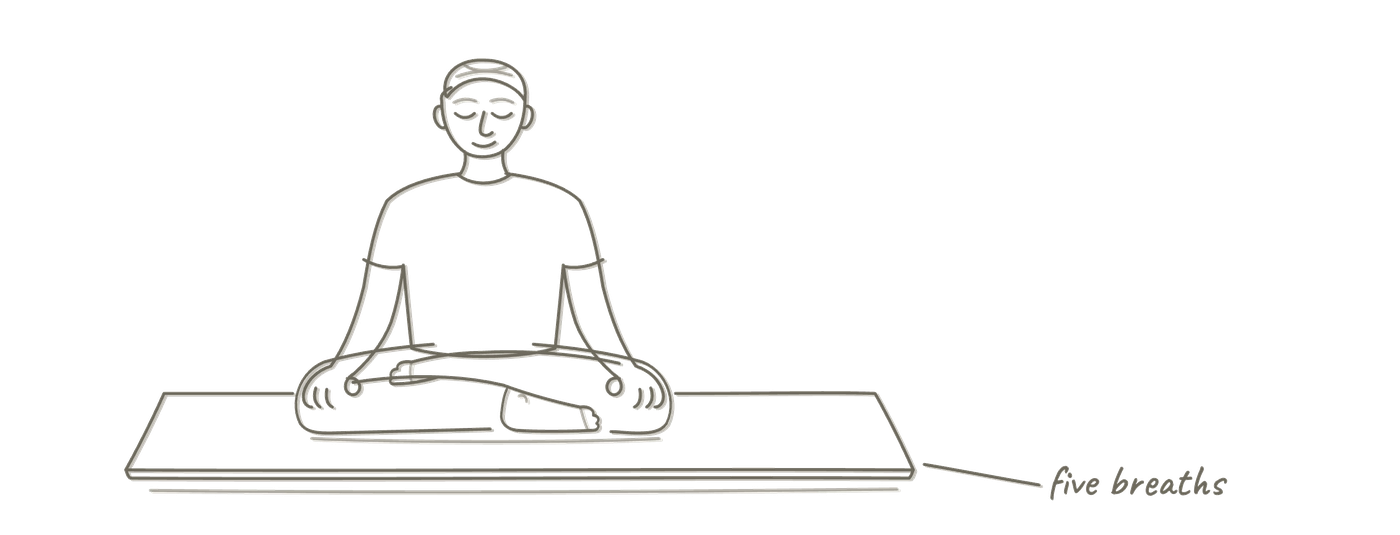
Yoga is a laboratory for your life. You get on your mat, and you are plugging into an old tradition, sequences handed down through more generations than anyone can count, and that's part of it. But you are also checking in, with awareness, on what is going on in your body, your mind, your heart, this morning, right now. You do these repetitive movements. You hold each pose for a prescribed number of breaths, five in my tradition, as a kind of offering. You slowly get stronger at the postures and, more interestingly, at staying present inside positions that are strange and often hard, some of which look frankly like circus tricks. And practiced over and over, something happens that I can only describe one way: you get out of your head and into your senses. That is where the transcendence is. Not of the body, which is doing most of the work, but of the ordinary spinning mind, the triggers and the stories and the things that trouble us. For an hour, they are not in charge.
I'm not prescribing this as a cure-all, or as the one path. Many people would be better served by a walk, a swim, a run with a friend, or by sitting still. I'm sharing a path that has been good to me, my reading of the evidence, and my attempt to take apart the why, because that's what I do.
- Yoga, the word, means union; Patanjali's second sutra defines it as the settling of the mind. Postures are one of eight limbs and the one the West noticed.
- The strongest evidence is for mood and anxiety: moderate, consistent effects across many trials, with a dose-response, and one careful head-to-head in which yoga beat a stress-education control but did not match CBT.
- The mechanisms are mostly about the breath and the vagus: slow breathing shifts the autonomic nervous system, and the posture-breath-gaze combination trains attention and body awareness the way meditation does, with a body in the loop.
- The brain changes are real and smaller than the headlines. Practitioners have measurably different gray matter and pain responses; the trials are small and the direction of cause is mostly assumed.
- My 2015 keynote got three things wrong and several things right. The audit is below.
- The reason to practice is none of the above. It is kindness, toward yourself first, and then the rest of us. The mat is where you rehearse it.
What yoga is
Yogash chitta vritti nirodhah.Yoga Sutra I.2: yoga is the settling of the fluctuations of the mind. Of the 196 sutras, this is still my favorite; the next 194 are mostly about how.1
Chitta vritti, settling
The mind as a bowl of water. Tap it to stir up a thought; leave it alone and watch what it does on its own. That is the whole of sutra I.2.
Two things about the source text surprise people. First, the Sanskrit word yoga means union, to yoke, to join: body with breath, mind with body, the self you walked in with to the self that walks out. Second, the postures are barely in it. Patanjali gives asana a single sutra, which says the posture should be steady and comfortable, and spends the rest of the book on ethics, breath, attention, and the stages of absorption. Postures are one of eight limbs; they happen to be the limb the West saw first, because you can photograph it.1
My own lineage, Ashtanga as taught by Pattabhi Jois in Mysore, is unusually explicit about method. A fixed sequence, learned one posture at a time, practiced six mornings a week in a room where everyone is doing their own practice at their own pace while a teacher walks around. Each posture is held for five breaths. The method rests on three points of attention that Jois called tristhana:2,3
Slow, even breathing through the nose with the throat slightly narrowed so it makes a soft sound. The sound is the metronome and the feedback: if it goes ragged, you've gone too far.
The shape, held with the pelvic floor and lower belly gently engaged. The engagement is what turns a stretch into a practice; without it, it's just contortion.
A fixed point for the eyes in every posture: nose, navel, thumb, far away. Where the eyes go, attention follows. It's the oldest attention-training trick there is.
Hold the three at once, for five breaths, in a sequence of sixty-odd postures, and you have an hour and a half of continuous attention training with a heart rate of 110 and a body that keeps telling you things. That is what the laboratory is.
The laboratory
Here's what I mean by it, concretely. Every morning the same sequence is run on a different body. Yesterday's hamstrings, last night's sleep, this morning's mood, whatever is unresolved from the conversation I had at dinner: all of it shows up in the first ten minutes of sun salutations, before I've thought a single deliberate thought. The practice doesn't change; I do. Which makes the practice a control condition, and me the variable.
That turns out to be an extraordinary instrument. I know more about the state of my own nervous system from how the first forward fold goes than from any questionnaire I've ever given a patient. Some days the body is tight and the mind is loud and the whole thing is a negotiation. Some days I'm in the seventh posture before I notice I've been breathing. And the useful part is not the good days. It's that on the bad ones there is still a sequence, and a breath count, and a point for the eyes, so that the spinning mind has something to hold onto that isn't itself. Then, somewhere in the middle of it, you are no longer thinking about the posture. You're in your senses. Hamstring, breath, the floor, the sound of your own exhale. The commentary track goes quiet.
Neuroscience has a word for the thing that goes quiet, or at least a candidate for it: the default mode network, the set of midline regions that run when we're rehearsing the past and auditioning the future, and that go unusually loud in rumination and depression. Attention trained onto the body, breath and gaze is one of the most reliable ways we know to turn it down.4,5 I'll come back to the evidence. First the breath, which is where it all starts.
Five breaths
If I could keep only one piece of the practice, it would be the five breaths. Everything else is a frame for them. In Ashtanga the breath sets the pace of every movement, and holding a posture for five slow ujjayi breaths works out to somewhere between five and six breaths a minute, which is not an accident. Around six breaths a minute, breathing falls into resonance with the baroreflex, the rhythm by which the heart and blood pressure regulate each other, and heart-rate variability, the standard measure of a flexible, parasympathetically-toned nervous system, goes as high as it gets.6,7 The vagus nerve, which Porges has spent a career arguing is the anatomy of feeling safe, is the wire.8 You don't need the theory; you need the breath. Try five.
Five breaths
Breathe with the circle: in as it grows, out as it shrinks, through the nose, throat slightly narrowed. Five breaths is one posture.
Press start. Let the breath be slow enough that it's slightly effortful and quiet enough that it's smooth.
Slow breathing's effects on heart-rate variability, blood pressure and reported calm are among the best-replicated findings in this whole area, and they appear within minutes.6 Five breaths at this rate takes just under a minute. Do them before you reply to the email.
The groove
Patanjali's advice on how to succeed, in sutra I.14, is that practice becomes firmly grounded when it is attended to for a long time, without interruption, and with care.1 Jois said it shorter: practice, and all is coming. The old Sanskrit word for what the practice lays down is samskara, usually translated as impression or groove: the rut a wagon wheel wears into a road, so that the next wheel finds it without steering.
Donald Hebb said the same thing about neurons in 1949, that cells which fire together wire together, and seventy years of plasticity research has mostly confirmed him.9 The point for a practice is that the groove is agnostic. It deepens whatever you repeat. Thirty years of waking up and reaching for the phone is a samskara. So is thirty years of waking up and standing at the top of the mat. The practice doesn't make you a better person by itself; it makes a groove that is easier to fall into than the other one, and the content of the groove is up to you.
What the science says, ten years on
Yoga research has a problem, which is that yoga is not one thing. A trial of gentle chair yoga for cancer survivors and a trial of ninety minutes of Ashtanga are testing different interventions, and both are "yoga" in the meta-analysis. The second problem is the control: compared with a waiting list, almost anything works; compared with a brisk walk or a stretching class with a nice instructor, much of the effect shrinks. With those two caveats on the table, here is my honest grading of the evidence, condition by condition, in 2026.
- B+19+ RCTsDepression
Two meta-analyses, eight years apart, find a moderate effect of yoga on depressive symptoms, and the newer one found a dose-response: more sessions per week, more improvement.10,11 A Boston dose-finding trial of Iyengar yoga with slow breathing put people in remission at rates that would be respectable for a medication.12 Most trials are small and few compare against an active exercise control. The grade reflects consistency more than any single study.
- B+1 strong RCTAnxiety
The best single trial in the field: 226 people with generalized anxiety disorder, randomized to Kundalini yoga, CBT, or stress education. Yoga beat the education control (54% responded vs 33%) but was not non-inferior to CBT (71%).13 That is exactly what I would expect and exactly what I tell patients: yoga is a real treatment, and for a diagnosed anxiety disorder, it is not a replacement for the best one.
- B2–3 RCTsPTSD
Bessel van der Kolk's trial of trauma-sensitive yoga in women with chronic PTSD: 52% no longer met criteria after ten weeks, against 21% in a health-education control.14 A breathing-based practice in veterans reduced symptoms, with the benefit holding at a year.15 Small trials, consistent direction, a plausible mechanism in the body-based nature of the disorder.
- B1 large RCTSleep
The largest yoga trial I know of: 410 cancer survivors with insomnia, four weeks of gentle yoga twice a week. Better sleep quality, less sleep medication, less fatigue.16 One population, one protocol, but a real trial with real numbers.
- B−meta-analysisStress physiology
A meta-analysis pooling yoga and mindfulness-based stress reduction found reductions in cortisol, blood pressure, resting heart rate and some inflammatory markers.17 A twelve-week trial in breast cancer survivors reduced inflammatory cytokines along with fatigue.18 The effects are modest and the cortisol literature in particular is noisy.
- C+small RCTsADHD in children
An Australian trial found yoga improved attention and behavior in boys with ADHD, more so with home practice.19 A 2018 meta-analysis of yoga, mindfulness and meditation for youth with ADHD found moderate effects from low-quality studies.20 I was more enthusiastic in 2015 than the evidence warrants; it's an adjunct, not a replacement for what works.
- C+observationalBrain structure and pain
Experienced practitioners tolerate pain longer and, on MRI, show more gray matter in the insula and other regions linked to interoception, attention and the sense of self; the differences scale with years of practice.21,22 A 2019 review found the structural findings fairly consistent across small studies.23 But these are mostly comparisons of yogis with non-yogis, and people who take to a daily practice may have had different brains to begin with.
- Cone real RCTTeenagers
A Harvard-affiliated trial swapped a yoga class for PE in a Massachusetts high school; the yoga group held steady on mood and anger measures while the PE group worsened over the semester.24 A nice study with a modest result, which I inflated into a punchline in 2015 and am now returning to its actual size.
The mechanisms, as best the field can reconstruct them, run on two tracks.5 From the top down, the posture-breath-gaze triad is attention training: it recruits the same prefrontal and parietal attention networks that meditation does, and it quiets the default mode. From the bottom up, slow breathing and sustained postures shift the autonomic balance toward the parasympathetic and raise heart-rate variability, and the continuous stream of sensation from a body in an unfamiliar shape trains interoception, the sense of what is happening inside, which runs through the insula and is impaired in depression, anxiety and eating disorders alike.4,6 Put both tracks together and you have a plausible, mostly supported account of why a person who does this every morning is calmer by lunchtime. What you don't have is proof that yoga does it better than other things that train attention and breath. That trial is still mostly unrun.
Honesty also requires a line about injury. Ashtanga has a reputation, and it's earned: shoulders, hamstring attachments and knees are the usual casualties of people trying to look like the photographs. Surveys put yoga's injury rate roughly in the range of other exercise, and most injuries are mild, but they rise with age and with ambition.25,26 The sutra said steady and comfortable. The circus tricks are optional.
A fact-check of my own keynote
I pulled up the 2015 talk to write this. Here is what I said, and what I'd say now.
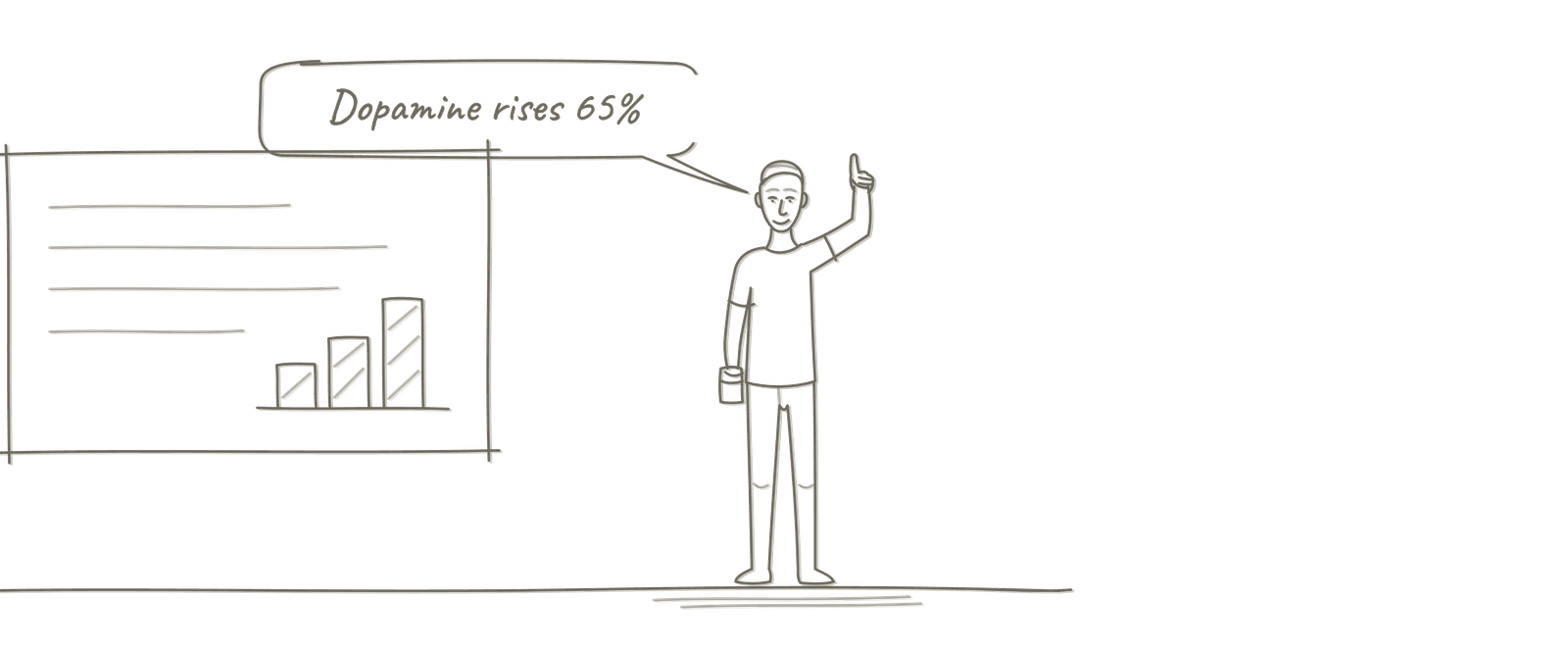
- Yoga nidra raises dopamine 65%.Eight people. A PET study of eight experienced meditators during yoga nidra found a 65% rise in dopamine release in the ventral striatum.27 The finding is real and has never been replicated at that size. I said the number and not the n.true, oversold
- A University of Utah study showed GABA jumps 27% after an hour of yoga.Boston-led, with Utah on the author list, and eight people. Chris Streeter's pilot at Boston University found a 27% rise in brain GABA in eight experienced practitioners after a session; her follow-up randomized trial, which found yoga raised GABA more than walking did, had the University of Utah's Perry Renshaw and Andrew Prescot running the brain imaging.28,29 So the home-state credit was partly earned. The n is the part I should have said.true, oversold
- One cobra pose raises testosterone 16% and drops cortisol 11%.A Russian study of healthy volunteers did report that, after a three-minute hold.30 It is a small, unreplicated hormone study in a journal most of my colleagues have not heard of, and I would not say it again without the caveat.true, thin
- Forty minutes of daily yoga beat Valium ten-fold for anxiety over three months.The study is real, and the number is almost exactly what I said. Sahasi and colleagues at AIIMS in New Delhi gave 91 outpatients with anxiety neurosis either forty minutes of daily yoga (postures, breathing and meditation, five days a week supervised) or diazepam for three months. Mean anxiety scores fell 3.39 points with yoga and 0.36 with diazepam, a 9.4-fold numerical difference, which is where my "ten-fold" came from.31,32 What I didn't say: it was published in 1989, patients chose their own arm rather than being randomized, the diazepam dose isn't reported, and two-thirds of the drug group dropped out against a fifth of the yoga group, which can manufacture a difference on its own. A real source that deserves heavy qualification, which is a more interesting category than wrong. The modern comparison is the 2021 GAD trial: yoga beats education, doesn't match CBT.13true, needs the caveats
- Teens who took yoga instead of PE felt more balanced and in control of their emotions.Roughly, yes, in one semester-long trial: the yoga group's mood and anger stayed stable while the PE group's worsened.24 The "Nobel prize" joke was mine, not the authors'.holds up
- Fifty distressed German women: depression down 50%, anxiety 30%, well-being up 65% after three months of twice-weekly Iyengar yoga.Accurate to the paper, which compared yoga to a waiting list.33 A wait-list control is the weakest kind, so the real effect is smaller than the raw numbers.holds up, with caveat
- Yoga helps with depression, sleep, ADHD and eating disorders (2013 review of 16 trials).That's what the review said, rated "emerging evidence" across the board.34 The depression and sleep claims have since strengthened; ADHD and eating disorders have not. I'd drop eating disorders from the list.mostly
- Yogis have bigger brains in the regions for body awareness, attention and the sense of self.More gray matter in those regions, in cross-section, scaling with practice.22 "Bigger brains" was me. Cause and effect is assumed, not shown.true, overstated
- For mild to moderate depression, anxiety and insomnia, there is quite possibly a better first-line therapy than a pill.I still think so, and the evidence since has moved toward me rather than away, with the caveat that "yoga" in those trials usually means a gentle, breath-heavy practice taught by someone kind, and that the person has to actually do it.holds up
Four oversold, five that hold, nothing invented. For a conference keynote with a clicker in one hand, I'll take it.
Where yoga meets the road
Someone at a studio once told me what makes a person a yogi: someone who practices regularly, and goes beyond the physical. Thirty-six million Americans practice yoga by the last big count, and nearly all of them walked in for the body, the same way I did.35 Then, almost invariably, something else happens, and it's hard to describe, I think because what it unlocks is different in each person. An Ashtanga teacher in India, Deepika Mehta, has the best list I know: looking for a slim body, we find a clear mind; hoping for stamina, we find determination; waiting to be free of back pain, we find freedom from compulsive worry; trying to release a stiff neck, we find a new level of joy. You come for the hamstrings. You stay for the thing the hamstrings were in the way of.
And here is the part that no study measures and that I believe more than anything above. The real reason to do your yoga is kindness: compassion and love, toward yourself first and then toward every being you meet, including the ones you don't like. Most of our lives are spent in a distracted state, rehashing what just happened, worrying about tomorrow, missing the actual day. With the monkeys chattering it's impossible to be fully here with anyone. The practice is a systematic way to set the chatter down for an hour, and when the chatter and the false identities are set aside, even temporarily, what's left has been there all along. The traditions call it waking up. I called it that in the last post too, and warned that waking up isn't growing up. Yoga is where, for me, the two meet: a daily, physical, slightly boring rehearsal of attention and equanimity that then has to be carried off the mat, into the conversation I didn't want to have and the tone I didn't need to use.
One of my Ashtanga books tells the old story that at the start of the dark age the sages withdrew into the Himalayas, and are watching from a distance, and will return when we are ready for what they know.3 I used to read that as mythology. I now read it as a job description. The sages are not coming back; the practice is how we become, each of us, a little of what they were waiting to see. Look after yourself first, a little, every day. Then take it to your family, your friends, the stranger, the person you'd rather avoid. Connect, and notice that the connection was never actually broken. That is the yoga of connection, and it is the only one that matters in the end.
Yoga is like music, Iyengar said: the rhythm of the body, the melody of the mind, the harmony of the soul.36 Ram Dass said it plainer. We're all just walking each other home.37 The mat is where I practice walking.
This post is educational and isn't medical advice. Yoga is a reasonable thing to try for mild low mood, anxiety or poor sleep, and a reasonable thing to add to treatment for the moderate and severe kinds; it is not a reason to stop a treatment that's working. If you have an injury, a heart condition, or are pregnant, tell the teacher. If you're in crisis, in the US you can call or text 988 any time.
References
- Patanjali. Yoga Sutras, I.2, I.14, II.29, II.46. Satchidananda S, trans. Integral Yoga Publications; 1978.
- Jois KP. Yoga Mala. North Point Press; 2002.
- Maehle G. Ashtanga Yoga: Practice and Philosophy. New World Library; 2006.
- Farb N, Daubenmier J, Price CJ, et al. Interoception, contemplative practice, and health. Front Psychol. 2015;6:763.
- Gard T, Noggle JJ, Park CL, Vago DR, Wilson A. Potential self-regulatory mechanisms of yoga for psychological health. Front Hum Neurosci. 2014;8:770.
- Zaccaro A, Piarulli A, Laurino M, et al. How breath-control can change your life: a systematic review on psycho-physiological correlates of slow breathing. Front Hum Neurosci. 2018;12:353.
- Tyagi A, Cohen M. Yoga and heart rate variability: a comprehensive review of the literature. Int J Yoga. 2016;9(2):97–113.
- Porges SW. The polyvagal perspective. Biol Psychol. 2007;74(2):116–143.
- Hebb DO. The Organization of Behavior. Wiley; 1949.
- Cramer H, Lauche R, Langhorst J, Dobos G. Yoga for depression: a systematic review and meta-analysis. Depress Anxiety. 2013;30(11):1068–1083.
- Brinsley J, Schuch F, Lederman O, et al. Effects of yoga on depressive symptoms in people with mental disorders: a systematic review and meta-analysis. Br J Sports Med. 2021;55(17):992–1000.
- Streeter CC, Gerbarg PL, Whitfield TH, et al. Treatment of major depressive disorder with Iyengar yoga and coherent breathing: a randomized controlled dose-finding study. J Altern Complement Med. 2017;23(3):201–207.
- Simon NM, Hofmann SG, Rosenfield D, et al. Efficacy of yoga vs cognitive behavioral therapy vs stress education for the treatment of generalized anxiety disorder: a randomized clinical trial. JAMA Psychiatry. 2021;78(1):13–20.
- van der Kolk BA, Stone L, West J, et al. Yoga as an adjunctive treatment for posttraumatic stress disorder: a randomized controlled trial. J Clin Psychiatry. 2014;75(6):e559–e565.
- Seppälä EM, Nitschke JB, Tudorascu DL, et al. Breathing-based meditation decreases posttraumatic stress disorder symptoms in U.S. military veterans: a randomized controlled longitudinal study. J Trauma Stress. 2014;27(4):397–405.
- Mustian KM, Sprod LK, Janelsins M, et al. Multicenter, randomized controlled trial of yoga for sleep quality among cancer survivors. J Clin Oncol. 2013;31(26):3233–3241.
- Pascoe MC, Thompson DR, Ski CF. Yoga, mindfulness-based stress reduction and stress-related physiological measures: a meta-analysis. Psychoneuroendocrinology. 2017;86:152–168.
- Kiecolt-Glaser JK, Bennett JM, Andridge R, et al. Yoga's impact on inflammation, mood, and fatigue in breast cancer survivors: a randomized controlled trial. J Clin Oncol. 2014;32(10):1040–1049.
- Jensen PS, Kenny DT. The effects of yoga on the attention and behavior of boys with attention-deficit/hyperactivity disorder (ADHD). J Atten Disord. 2004;7(4):205–216.
- Chimiklis AL, Dahl V, Spears AP, Goss K, Fogarty K, Chacko A. Yoga, mindfulness, and meditation interventions for youth with ADHD: systematic review and meta-analysis. J Child Fam Stud. 2018;27:3155–3168.
- Villemure C, Čeko M, Cotton VA, Bushnell MC. Insular cortex mediates increased pain tolerance in yoga practitioners. Cereb Cortex. 2014;24(10):2732–2740.
- Villemure C, Čeko M, Cotton VA, Bushnell MC. Neuroprotective effects of yoga practice: age-, experience-, and frequency-dependent plasticity. Front Hum Neurosci. 2015;9:281.
- Gothe NP, Khan I, Hayes J, Erlenbach E, Damoiseaux JS. Yoga effects on brain health: a systematic review of the current literature. Brain Plast. 2019;5(1):105–122.
- Noggle JJ, Steiner NJ, Minami T, Khalsa SBS. Benefits of yoga for psychosocial well-being in a US high school curriculum: a preliminary randomized controlled trial. J Dev Behav Pediatr. 2012;33(3):193–201.
- Cramer H, Quinker D, Schumann D, Wardle J, Dobos G, Lauche R. Adverse effects of yoga: a national cross-sectional survey. BMC Complement Altern Med. 2019;19:190.
- Swain TA, McGwin G. Yoga-related injuries in the United States from 2001 to 2014. Orthop J Sports Med. 2016;4(11):2325967116671703.
- Kjaer TW, Bertelsen C, Piccini P, Brooks D, Alving J, Lou HC. Increased dopamine tone during meditation-induced change of consciousness. Cogn Brain Res. 2002;13(2):255–259.
- Streeter CC, Jensen JE, Perlmutter RM, et al. Yoga Asana sessions increase brain GABA levels: a pilot study. J Altern Complement Med. 2007;13(4):419–426.
- Streeter CC, Whitfield TH, Owen L, et al. Effects of yoga versus walking on mood, anxiety, and brain GABA levels: a randomized controlled MRS study. J Altern Complement Med. 2010;16(11):1145–1152.
- Minvaleev RS, Nozdrachev AD, Kir'yanova VV, Ivanov AI. Postural influences on the hormone level in healthy subjects: I. The cobra posture and steroid hormones. Hum Physiol. 2004;30(4):452–456.
- Sahasi G, Mohan D, Kacker C. Effectiveness of yogic techniques in the management of anxiety. J Pers Clin Stud. 1989;5(1):51–55.
- Saeed SA, Antonacci DJ, Bloch RM. Exercise, yoga, and meditation for depressive and anxiety disorders. Am Fam Physician. 2010;81(8):981–986.
- Michalsen A, Grossman P, Acil A, et al. Rapid stress reduction and anxiolysis among distressed women as a consequence of a three-month intensive yoga program. Med Sci Monit. 2005;11(12):CR555–CR561.
- Balasubramaniam M, Telles S, Doraiswamy PM. Yoga on our minds: a systematic review of yoga for neuropsychiatric disorders. Front Psychiatry. 2013;3:117.
- Yoga Journal, Yoga Alliance. 2016 Yoga in America Study. January 2016.
- Iyengar BKS. Light on Yoga. Schocken; 1966.
- Ram Dass, Bush M. Walking Each Other Home. Sounds True; 2018.