Made in the shade
Seventy years of teen slang, four cohorts of mortified parents, the generations we keep inventing, and the main event: the adolescent brain, watched as it grows, prunes, speeds up and does something stupid in front of its friends.
By Reid Robison, MD. 3,828 words, with comics, a translator quiz, and a walk through the teenage brain. Contains the number 67.
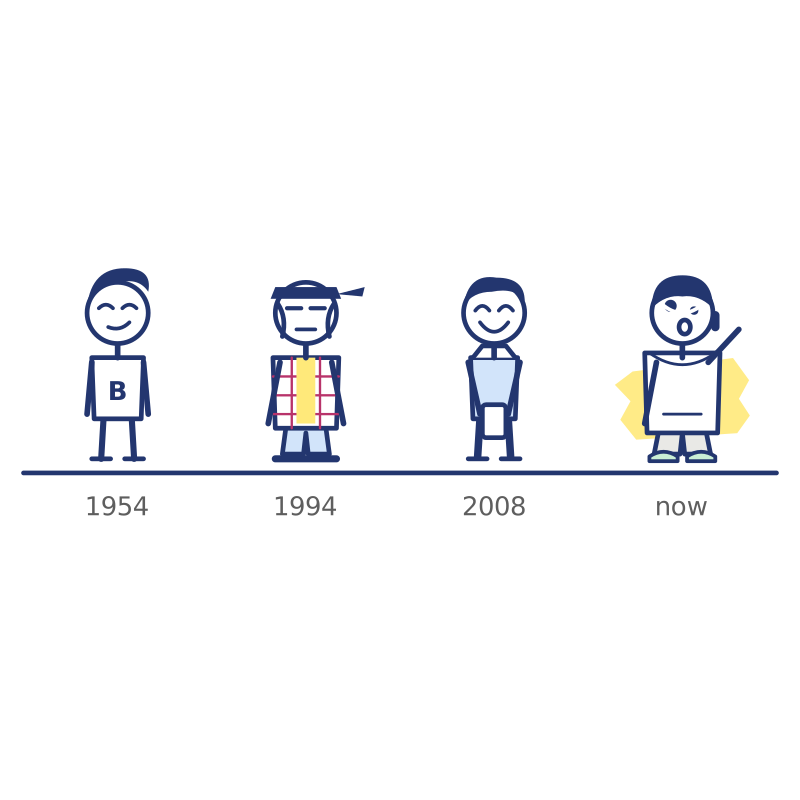
In 1954 an American newspaper ran a public service for frightened parents. Under the headline Teen Slang, it explained that "George" meant money, that "give me a bell" meant phone me, that a "flookie" was a jerk and a "hot spook" a good kid, and that if your son said he'd "got shot," a teacher had ruined him. "Made in the shade" meant done with ease. "Bird's nested" meant all mixed up, which is also how the parents felt.
Read it today and two things jump out. The first is that every single word is dead, and most of them died within a few years of the article. The second is that the article exists at all. Adults in 1954 needed a translator for their own children, badly enough that a newspaper printed one. Adults in 1994 needed one. Adults in 2026 are, at this moment, googling "what does 67 mean," and Dictionary.com has just named it word of the year while admitting it can't be defined.1
So this post is a translator, but it's also an investigation. Why do teenagers always talk like this? Why does the language change faster every decade? Are "generations" even real? And what, exactly, is happening inside a fifteen-year-old's head that makes "six seven" the funniest thing they have ever heard? That last question has a good answer, and it's the main event. First, the field trip.
- Teen slang does three jobs: it marks who's in, it keeps adults out, and it's play. Every generation's words die the moment a parent uses them, which is the system working as designed.2
- Slang used to take years to travel from a subculture to a newspaper. The internet cut that to months; TikTok cut it to weeks. The spike-and-crash shape of a word's life gets steeper every decade.
- Generational labels are mostly a media invention. Meta-analyses find generation explains almost nothing once you account for age and the year someone was measured, and Pew now uses the labels sparingly.3,4
- What is real is the adolescent brain: a reward system that peaks mid-teens, a control system that matures years later, a social radar turned all the way up, and a body clock running two hours late. "Not done until 25" is a meme; the truth is more interesting.5,6
Part 1A field trip through time
Four stops. Each has a comic, a glossary you can tap, and a parent who tries. Scroll slowly; the strips come to life as you reach them.
1954
The Silent Generation, born 1928–45. Letter sweaters, poodle skirts, pompadours, and parents who had just survived a war and were not prepared for "Daddio."
Every word in this strip is from the real 1954 list.
Notice how much of 1954's slang is about parents and teachers. "Daddio" is a parent you can tolerate. "Got shot" is a teacher who ruined you. Slang's first job has always been to draw a line, and the line goes around the adults.2
1994
Generation X, born 1965–80. My stop. Burlington, Ontario; high school in the nineties; flannel over a T-shirt, jeans wide enough to lose a cat in, a backwards cap, and a Discman that skipped if you walked.
"Hella" is Northern Californian. It reached Ontario through movies and we used it anyway, which is how slang has always travelled: downhill from somewhere cooler.
Two things were new in the nineties. First, a lot of the words were borrowed from Black American English and hip-hop, which has been the main engine of English slang for a century and still is.7,2 Second, the words were starting to arrive by television and film rather than by word of mouth, which meant a phrase could be in Burlington the same month it was in Los Angeles. The pipeline was getting shorter.
2008
Millennials, born 1981–96. Skinny jeans, a side-swept fringe, a popped collar on the boys who could afford it, and a flip phone that was about to become something else.
"On fleek" was coined in a six-second video in 2014, peaked in 2015, and was being used in fast-food marketing by 2016, which killed it.
This is the generation whose slang became text first and speech second. "YOLO," "epic fail" and "I can't even" are written phrases that got said out loud, rather than the other way round. And for the first time, the adults could watch the words being born, because the births happened on a platform.
Now
Gen Z, born 1997–2012, and the first of Gen Alpha behind them. Hoodies three sizes up, jeans back to wide, Crocs, one earbud in at all times, hair that a 1994 kid would have called a mushroom and a 2026 kid calls broccoli.
Dictionary.com, naming 6-7 its word of 2025: "perhaps the most defining feature of 6-7 is that it's impossible to define."1
What the heck is 67
Here's the whole story, and it's a good one. In late 2024 a Philadelphia rapper called Skrilla released a song, "Doot Doot (6 7)," with the numbers as a hook. Basketball clips set the hook to highlight reels of players who happen to be six-foot-seven, LaMelo Ball among them. A kid at a youth game got filmed chanting it. By the 2025 school year it had become a reflex: say "six" anywhere near a teenager and they will say "seven," usually with both hands raised palms-up and juggling an invisible weight. Searches for it rose sixfold over the summer.1
What does it mean? Nothing. That isn't me being old; it's the joke. The humour is in the randomness and in the fact that adults keep asking. Dictionary.com's own definition is a shrug ("so-so," "maybe this, maybe that"), and it describes the word as having "all the hallmarks of brainrot."1 Which is itself slang, and was Oxford's word of the year in 2024, one year after "rizz."8,9 The dictionaries, in other words, have given up trying to be ahead of this and have settled for being a good sport.
Something has changed, though. Look at the shape of a word's life across these four stops.
The half-life of a word
How long slang takes to rise, peak and die, by era. The curves are illustrative shapes, built from the years each word was first recorded, peaked and was declared over; they are not search data. Tap a word.
Slang has always been perishable; that's the point of it. A word that everyone knows no longer marks anyone as in.2 What's new is the speed. In 1954 a word had to travel by mouth, from a city to a suburb to a newspaper, which took years. In 1994 it travelled by film and TV, which took a season. Now a word is born on one platform, is global in a week, is on a T-shirt in a month, and is dead the first time a teacher says it, which is also in a month. The lifecycle hasn't changed shape. It's been compressed.
The translator test
Twelve words, four eras. Pick the meaning. At the end you'll find out which decade you're fluent in, which may not be the one you'd like.
Part 2Psychoanalysing the troops
Every generation gets a personality. Here are the standard ones, and I've written them with a straight face, because they're fun and because some of it rings true. Tap a card for what the evidence says.
Silent Generation
born 1928–45 · teens in the 1950s
Dutiful, private, conflict-averse. Raised in the Depression, taught not to make a fuss, and made a fuss by inventing rock and roll anyway. Temperament: the steady one who keeps the receipts.
Tap for the evidence
Generation X
born 1965–80 · teens in the 80s and 90s
Latchkey, sceptical, allergic to sincerity, fine. Raised on divorce rates and MTV, told the world was ending, shrugged. Temperament: avoidant and self-sufficient; says "whatever" and means it.
Tap for the evidence
Millennials
born 1981–96 · teens in the 2000s
Earnest, over-scheduled, raised to believe they were special and then handed a financial crisis. Temperament: anxious optimist; wants feedback, wants meaning, wants a participation trophy they'd be embarrassed to accept.
Tap for the evidence
Gen Z
born 1997–2012 · teens now
Ironic on the surface, sincere underneath, fluent in three platforms, cooked but kind. Raised on a phone through a pandemic. Temperament: anxious, funny, allergic to phoniness, surprisingly earnest about mental health.
Tap for the evidence
Now the honest turn. The idea that people born in the same twenty-year window share a temperament comes from a 1928 essay by Karl Mannheim, who argued that living through the same formative events shapes a cohort's outlook.13 That's reasonable. The version we use, with hard birth-year boundaries, catchy names and a personality per group, mostly comes from a 1991 pop-history book by two consultants.14 It is not a scientific classification. The boundaries are arbitrary (why does Gen X end in 1980 and not 1979?), the names are marketing, and the research that tests whether "generation" explains anything beyond a person's age and the year they were surveyed finds, again and again, that it explains very little.3,10 Pew Research Center, which did more than anyone to popularise the labels, announced in 2023 that it would use them "sparingly" and only when the data actually supported a generational lens, because the categories "aren't scientific" and "can encourage stereotypes."4
So what's left? Two things, and they're both true. Cohorts do grow up in different environments, and environments matter: a teenager in 1954 and a teenager in 2026 are running the same hardware in very different weather. And the hardware itself is remarkable, which brings us to the part of the post I actually came here to write.
Part 3, the main eventThe adolescent brain
Here's what nobody told the parents of 1954: their kids weren't being difficult. They were being built. The brain between ages ten and twenty-five goes through its second great remodelling, and almost everything that makes a teenager a teenager, including the slang, the risk, the eye-rolling and the astonishing capacity for sudden growth, falls out of what that remodelling does, in what order. Scroll, and watch it happen.
1. Overbuilt on purpose
Grey matter, the stuff of neurons and their connections, doesn't just grow. It peaks around age 11 in girls and 12 in boys and then starts to decline, as MRI studies following the same children for years first showed in 1999.15 The teenage brain is not unfinished. It's over-finished, and about to be edited.
2. Pruning
The edit is synaptic pruning: connections that get used are kept and strengthened; connections that don't are cut. Up to half of the synapses in some regions go.16 This is why the teenage years are such a strong learning window and such a risky one. Whatever a fifteen-year-old does a lot of, the brain keeps the wiring for. Including, yes, saying "six seven."
3. Back to front
Meanwhile the surviving wiring gets insulated with myelin, which makes it fast, and this happens in a wave from the back of the brain forward. Sensory and motor areas finish first; the prefrontal cortex, the part that plans, weighs consequences and says "maybe not," finishes last, well into the twenties.17
4. The accelerator and the brake
Put those two timelines together and you get the dual-systems model.5,18 The reward system, driven by dopamine, ramps up fast at puberty and peaks in the mid-teens: novelty, thrill and social approval have never felt better and never will again. The control system matures slowly and steadily. For about a decade, the accelerator is ahead of the brake. That gap, not a lack of intelligence, is why smart kids do dumb things.19
5. Add friends, double the risk
In a driving simulator, adolescents playing alone took about as many risks as adults. Add two friends watching, and the teens' risky driving roughly doubled; the adults' didn't change.20 In the scanner, the friends' presence lit up the teens' reward circuitry.21 Adolescence is a sensitive period for social information, the way early childhood is for language.22,23 Slang is this system talking: a password that proves you're in, said in front of the people who matter most.
6. The clock runs late
At puberty the body clock shifts about two hours later. Melatonin rises later, so a teenager who can't fall asleep before midnight isn't being defiant; she's on Pacific time in an Eastern household. School still starts at 7:30. The result, Mary Carskadon's phrase, is a "perfect storm" of chronic sleep loss that worsens everything above.24
7. Not "done at 25"
You've heard the brain isn't finished until 25. It's a meme, not a finding. In a study across eleven countries, cognitive capacity, the ability to reason when calm, reached adult levels by about 16. Psychosocial maturity, the ability to resist a peer, wait for a reward and keep a cool head, kept improving into the early twenties.6 There is no single age at which a brain is "done," and neuroscientists who looked for a signature of maturity concluded there isn't one to find.25 What there is, is a gap: a thinking adult and a feeling adolescent sharing one skull for a few years.
The thing I most want parents to take from that walk: the same features that make adolescence dangerous make it the richest window for growth a person will ever have. A brain that is pruning, myelinating and hungry for reward and belonging is a brain that can learn a language, an instrument, a sport or a value system faster than at any other time of life. Developmental scientists now argue that adolescence is as important a window for investment as early childhood, and more neglected.26 The job isn't to stop the accelerator. It's to be the brake for a while, and to point the car somewhere worth going.
Part 4Grading the textbook
If you took a human development class, you learned a set of theories about adolescence, most of them older than the parents in the 1954 clipping. Here's how they hold up, with grades.
- C−1904Hall's "storm and stress"
G. Stanley Hall, who coined the modern idea of adolescence, declared it a period of inevitable turmoil.27 A century of data says: more conflict with parents, more mood swings and more risk-taking than other ages, yes, but most teenagers are not in crisis, and the ones who are usually were before puberty too. "Storm and stress" describes a tendency, not a stage.28
- B−1958Piaget's formal operations
Around 11 or 12, children start to reason abstractly, test hypotheses and think about thinking.29 The direction is right and the timing roughly so. But the stage is far less universal than Piaget thought: many adults never reliably use formal reasoning, and teenagers who can reason beautifully about chemistry reason badly about their own lives, which is the dual-systems point in different words.30
- B1968Erikson's identity vs role confusion
Adolescence as the age of working out who you are.31 Durable, and the reason the word "identity" is in your vocabulary. The weakness is that it's hard to test; it reads better as a description than a theory.
- B+1966Marcia's identity statuses
James Marcia made Erikson testable: diffusion, foreclosure, moratorium, achievement, defined by whether you've explored and whether you've committed.32 A meta-analysis of 124 studies finds the expected movement toward achievement with age, but slower and messier than the textbooks imply; only about half of people reach "achievement" by their twenties, and many go backwards.33 The slang stop, by the way, is moratorium in action: trying on a voice.
- C1984Kohlberg's stages of moral reasoning
Six stages from fear of punishment to universal principles.34 Criticised early for a sample of boys and a bias toward abstract justice over care,35 and later for a deeper problem: people mostly reason after they've already felt what's right, and the reasoning is often a press release for the intuition.36 The stages describe how people talk about morality, not how they do it.
- A−1967Elkind's imaginary audience
Teenagers feel watched by an audience that isn't there, and believe their experience is unique (the "personal fable").37 The best-aged of the bunch, because the neuroscience later explained it: a social-sensitivity system turned up to maximum, in a brain that can now imagine other minds.22 Every comic strip above is the imaginary audience in action.
- A2008The dual-systems model
The current textbook answer, and the one with the most direct evidence from imaging, behaviour and cross-cultural data.5,19 Its critics are right that "accelerator and brake" is a simplification; its defenders are right that it predicts the age curve of risk-taking across 11 countries better than anything before it.
Part 5Where the journey goes from here
The old map ended adolescence at 18 and called everything after it "adult." Jeffrey Arnett's observation in 2000 was that, in wealthy countries, nobody actually lives like that any more: the years from 18 to 29 have become their own stage, with their own instability, self-focus and sense of being in between.38 He called it emerging adulthood, and it's where the maturity gap from step 7 finally closes. The brake catches up. The slang gets quieter. Most people, somewhere in their mid-twenties, stop performing for the imaginary audience and discover there was never anyone in the seats.
Which is the moment for a piece of advice. In June 1997, Mary Schmich, a columnist at the Chicago Tribune, wrote the commencement speech she'd give if anyone asked her, starting with the one piece of advice she could prove: wear sunscreen.39 Within two months it was circulating by email as a speech Kurt Vonnegut had supposedly given at MIT. He hadn't; the speaker that year was Kofi Annan. The attribution was wrong, the speech went around the world anyway, and in 1998 Baz Luhrmann set it to music and it reached number one in Britain.40 So the most famous advice ever given to the young is a column, mislabelled by the internet, that survived because it was true. Like the slang, it travelled faster than the facts about it. Unlike the slang, it lasted.
I won't reprint it, because it's hers. But the heart of it is a list of things that matter more than they seem at 17 (your knees, your friends, your parents, kindness to your body) and things that matter less (worry, other people's opinions, and the certainty that you've figured anything out). If you're a parent reading the slang above and feeling bird's nested, that's the list. If you're a teenager reading this, the list is for you too, and you won't believe any of it yet, and that's the brain, and it's fine.
This post is educational and isn't medical advice. If a teenager in your life is struggling, the comics stop being funny and the clinicians start being useful; talk to one. In the US you can call or text 988 any time.
References
- Dictionary.com. 2025 Word of the Year: 6-7. October 2025.
- Eble C. Slang and Sociability: In-Group Language Among College Students. University of North Carolina Press; 1996.
- Costanza DP, Badger JM, Fraser RL, Severt JB, Gade PA. Generational differences in work-related attitudes: a meta-analysis. J Bus Psychol. 2012;27(4):375–394.
- Pew Research Center. How Pew Research Center will report on generations moving forward. May 22, 2023.
- Steinberg L. A social neuroscience perspective on adolescent risk-taking. Dev Rev. 2008;28(1):78–106.
- Icenogle G, Steinberg L, Duell N, et al. Adolescents' cognitive capacity reaches adult levels prior to their psychosocial maturity: evidence for a "maturity gap" in a multinational, cross-sectional sample. Law Hum Behav. 2019;43(1):69–85.
- Labov W. Sociolinguistic Patterns. University of Pennsylvania Press; 1972.
- Oxford University Press. Oxford Word of the Year 2024: brain rot. December 2024.
- Oxford University Press. Oxford Word of the Year 2023: rizz. December 2023.
- Rudolph CW, Rauvola RS, Zacher H. Leadership and generations at work: a critical review. Leadersh Q. 2018;29(1):44–57.
- Twenge JM. iGen. Atria; 2017.
- Orben A, Przybylski AK. The association between adolescent well-being and digital technology use. Nat Hum Behav. 2019;3(2):173–182.
- Mannheim K. The problem of generations. 1928. In: Essays on the Sociology of Knowledge. Routledge; 1952:276–320.
- Strauss W, Howe N. Generations: The History of America's Future, 1584 to 2069. Morrow; 1991.
- Giedd JN, Blumenthal J, Jeffries NO, et al. Brain development during childhood and adolescence: a longitudinal MRI study. Nat Neurosci. 1999;2(10):861–863.
- Huttenlocher PR, Dabholkar AS. Regional differences in synaptogenesis in human cerebral cortex. J Comp Neurol. 1997;387(2):167–178.
- Gogtay N, Giedd JN, Lusk L, et al. Dynamic mapping of human cortical development during childhood through early adulthood. Proc Natl Acad Sci USA. 2004;101(21):8174–8179.
- Casey BJ, Jones RM, Hare TA. The adolescent brain. Ann N Y Acad Sci. 2008;1124:111–126.
- Shulman EP, Smith AR, Silva K, et al. The dual systems model: review, reappraisal, and reaffirmation. Dev Cogn Neurosci. 2016;17:103–117.
- Gardner M, Steinberg L. Peer influence on risk taking, risk preference, and risky decision making in adolescence and adulthood: an experimental study. Dev Psychol. 2005;41(4):625–635.
- Chein J, Albert D, O'Brien L, Uckert K, Steinberg L. Peers increase adolescent risk taking by enhancing activity in the brain's reward circuitry. Dev Sci. 2011;14(2):F1–F10.
- Blakemore SJ, Mills KL. Is adolescence a sensitive period for sociocultural processing? Annu Rev Psychol. 2014;65:187–207.
- Nelson EE, Jarcho JM, Guyer AE. Social re-orientation and brain development: an expanded and updated view. Dev Cogn Neurosci. 2016;17:118–127.
- Carskadon MA. Sleep in adolescents: the perfect storm. Pediatr Clin North Am. 2011;58(3):637–647.
- Somerville LH. Searching for signatures of brain maturity: what are we searching for? Neuron. 2016;92(6):1164–1167.
- Dahl RE, Allen NB, Wilbrecht L, Suleiman AB. Importance of investing in adolescence from a developmental science and health perspective. Nature. 2018;554(7693):441–450.
- Hall GS. Adolescence: Its Psychology and Its Relations to Physiology, Anthropology, Sociology, Sex, Crime, Religion and Education. Appleton; 1904.
- Arnett JJ. Adolescent storm and stress, reconsidered. Am Psychol. 1999;54(5):317–326.
- Inhelder B, Piaget J. The Growth of Logical Thinking from Childhood to Adolescence. Basic Books; 1958.
- Kuhn D. Adolescent thinking. In: Lerner RM, Steinberg L, eds. Handbook of Adolescent Psychology. 3rd ed. Wiley; 2009:152–186.
- Erikson EH. Identity: Youth and Crisis. Norton; 1968.
- Marcia JE. Development and validation of ego-identity status. J Pers Soc Psychol. 1966;3(5):551–558.
- Kroger J, Martinussen M, Marcia JE. Identity status change during adolescence and young adulthood: a meta-analysis. J Adolesc. 2010;33(5):683–698.
- Kohlberg L. The Psychology of Moral Development. Harper & Row; 1984.
- Gilligan C. In a Different Voice. Harvard University Press; 1982.
- Haidt J. The emotional dog and its rational tail: a social intuitionist approach to moral judgment. Psychol Rev. 2001;108(4):814–834.
- Elkind D. Egocentrism in adolescence. Child Dev. 1967;38(4):1025–1034.
- Arnett JJ. Emerging adulthood: a theory of development from the late teens through the twenties. Am Psychol. 2000;55(5):469–480.
- Schmich M. Advice, like youth, probably just wasted on the young. Chicago Tribune. June 1, 1997.
- Luhrmann B. Everybody's Free (To Wear Sunscreen). On: Something for Everybody. EMI; 1998.