When the trip doesn't end
Hallucinogen persisting perception disorder, from the neurons up. Why edges go fuzzy, why trails and halos happen, what we've learned in the past five years about how common HPPD is and what helps, and what to do if it's happening to you.
By Reid Robison, MD. About 30 minutes, with a walk down a visual pathway and nine things to try.
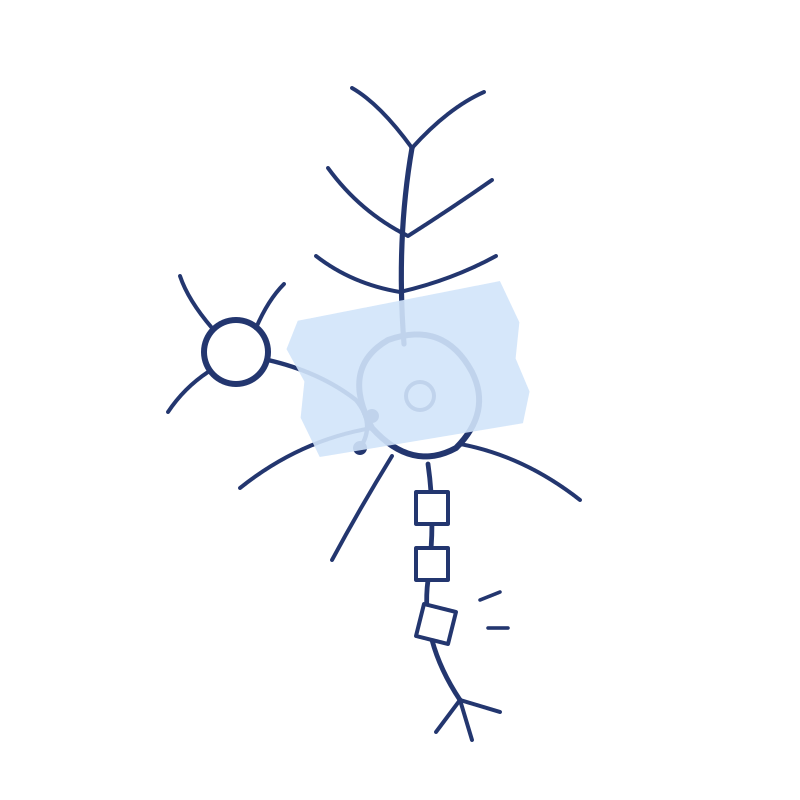
Every now and then someone writes to me with a version of this same story: Months ago they took psilocybin or LSD, once or a handful of times. The trip ended. The edges didn't. Lamps have halos. A hand waved in front of the face leaves a trail. In a dark room the air is full of static. Nobody warned them, a doctor shrugged, and the internet told them it was permanent.
I've been speaking on this topic occasionally over the past five years, and the field has moved more in that time span than in the thirty before. There are now population-level numbers, a large health-record study, a systematic review of every treatment ever tried, a recognised cousin condition called visual snow syndrome, and phase 3 psychedelic trials that have to record exactly these symptoms. This post pulls that together. It starts where the symptoms do, in the wiring of the visual system, because once you understand why an edge can go fuzzy, HPPD stops being mysterious and becomes a problem of a brake that hasn't come all the way back on.
- PushCells along an edge fire.
- BrakeTheir neighbours hush them, so the edge is sharp.
- Brake offA psychedelic loosens the brake. Edges soften, lights bloom, motion trails.
- StuckIn HPPD the brake settles a notch low and dips with stress, dark and cannabis.
- Seeing is a balance of push and brake. Excitatory neurons shout about edges; inhibitory interneurons hush their neighbours so the edge comes out sharp. Loosen the brake and edges blur, bright things grow halos, moving things leave trails, and the dark fills with noise.
- Psychedelics loosen that brake on purpose. They act on serotonin 2A receptors on cortical pyramidal cells and interneurons. In mouse visual cortex a psychedelic cut visual response gain and changed its timing.1 HPPD is best understood as the brake not fully re-engaging.2
- Mild after-effects are common, the disorder is rare. In a web survey of 2,455 people who had used hallucinogens, 60% reported at least one unusual visual experience afterwards and 4% had considered treatment.3 In a 2025 prospective study, 32% noticed HPPD-like visuals four weeks after a psychedelic and under 1% found them distressing.4 About 1.3% of users in a US survey said a doctor had told them they had HPPD.5
- Anxiety travels with it. In 25,778 people with an HPPD diagnosis in a global health-record network, anxiety disorders and functional somatic conditions were more common before the diagnosis than in other psychedelic users.6 Younger age, female sex, a psychiatric history and high "absorption" predicted symptoms.4
- Treatment evidence is thin but encouraging. Across 31 studies and 87 treated patients, 28% recovered fully and 61% partly within a year; clonidine, clonazepam and levetiracetam had the most consistent reports, and risperidone made several people worse.7
- Most people get better. Protect sleep, treat the anxiety, avoid the re-triggers (cannabis, stimulants, more psychedelics), and give it time. Benzodiazepines can help short-term but are not a plan.
Part 1A walk down neuron lane
Here is the path a single edge takes, from a lamp on a table to the sharp line you see, and the point where a psychedelic steps in. Scroll slowly; the picture on the left changes with each stop.
Stop 1. Light becomes spikes
A lamp beside a dark wall throws a hard edge onto your retina. Photoreceptors under the bright half fire more than the ones under the dark half. So far the brain only knows "brighter here, darker there." No edge yet.
Stop 2. Neighbours hush each other
Each retinal ganglion cell listens to a small patch and is inhibited by the patches around it, a centre-surround receptive field.8 Cells just inside the bright side have dark neighbours that can't hush them, so they fire extra hard; cells just inside the dark side are hushed by bright neighbours and go quieter than they should. The edge is exaggerated on purpose. This is lateral inhibition, first measured in the horseshoe crab's eye in 1956,9 and it's why you see faint bright and dark bands at any sharp boundary.
Stop 3. Primary visual cortex draws the line
In V1, cells are tuned to orientation: one fires for a vertical edge, its neighbour for one tilted a few degrees.10 Along the lamp's edge, a row of vertically tuned cells lights up and, again, their neighbours tuned to other angles are suppressed. The line you see is the winner of a competition.
Stop 4. The brake
About one in five cortical neurons is an inhibitory interneuron that releases GABA. They don't carry the picture; they shape it, sharpening timing, setting gain and ending each response so the next one can start clean.11 Turn the brake down and the same inputs produce responses that are bigger, blurrier and longer-lasting. That is the physiology of a halo, a soft edge and a trail.
Stop 5. The psychedelic arrives
LSD, psilocin and mescaline act on serotonin 2A receptors, which are dense on the big layer 5 pyramidal cells of the cortex and on some interneurons.12,13 In mouse V1, a psychedelic drug cut the gain of visual responses roughly in half and changed their timing, more so in animals that had been trained on a visual task.1 In people, psilocybin's visual effects track its action on those receptors, with a drop in the alpha rhythm that normally holds visual cortex in check.14
Stop 6. The brain fills in
Perception isn't a photograph; the brain predicts what should be there and checks it against the input.15 With less reliable input and looser constraints, predictions win more often: textures organise into lattices, a shadow becomes a face. In a lab, healthy people can be trained to hear a tone that isn't there, and the ones who hallucinate most weight their expectations most.16 Psychedelics are thought to relax the brain's high-level predictions and let lower levels run free.17
Stop 7. The geometry is built in
V1 maps the retina with a log-polar stretch and its cells are wired in orientation-tuned stripes. When that sheet of cortex becomes unstable, the patterns it makes on its own, translated back onto the retina, are tunnels, spirals, honeycombs and cobwebs: Klüver's four form constants.18,19,20 That's why the eyes-closed visuals of a psilocybin session, a migraine aura and a fever all draw from the same four shapes.
Stop 8. When the brake doesn't come back
After the drug is gone the system should settle. In HPPD it doesn't quite: visual cortex stays a notch too excitable, so halos, trails and snow return with low light, stress, fatigue or cannabis. EEG studies of people with post-LSD visual disorder found stable differences in the visual regions and in how they coordinate with the rest of the cortex.21,22 The leading explanation is a lasting loss of inhibitory tone in the visual system, possibly with sensitisation, the opposite of tolerance.2,23
If you'd like to see what those changes look like on a real scene, the perception lab runs colour, breathing surfaces, trails, geometry and visual snow on your camera or a photo. The lab below is narrower: it's about the brake.
Part 2The fuzzy-edges lab
Four dials, one scene. "Brake" is lateral inhibition; turn it down and edges soften and bright things bloom. "Persistence" is how long a response lingers; up means trails and afterimages. "Spontaneous firing" is cells firing without input, which you see as snow. "Gain" is how loudly the cortex responds to what it's given.
What a lamp looks like with the brake off
Move the dials, or pick a preset. Nothing flashes; the scene is slow.
Part 3A field guide to hallucinations
Clinicians sort perceptual experiences along three lines, and the words matter when you're describing symptoms to a doctor or reading a trial's safety table.
- Illusion
- A real thing, misperceived. A coat on a chair reads as a person; a wall seems to breathe. Most psychedelic visuals, and nearly all of HPPD, are illusions and distortions, not things appearing from nothing.
- Pseudohallucination
- A perception with no source that you know isn't real. Eyes-closed geometry is the classic case. Insight is intact.
- Hallucination
- A perception with no source that is taken as real. In psychedelic and HPPD contexts this is uncommon; it's more typical of delirium, psychosis and some neurological conditions. Seeing Things covers that whole landscape.
- Simple vs complex
- Simple: lights, colours, lines, geometry (phosphenes, form constants). Complex: objects, faces, scenes. Simple ones come from early visual areas; complex ones from higher visual cortex, as fMRI of people with Charles Bonnet syndrome showed.24
- Palinopsia
- Seeing an image after it's gone. Illusory palinopsia (trails, afterimages that follow motion and light) comes from unstable visual processing and is the HPPD kind; hallucinatory palinopsia (a formed image recurring later) points to a lesion or seizure and needs a neurologist.25
The HPPD symptom gallery
The visuals people with HPPD describe most, each animated. Tap one for what it is and where it comes from.
Part 4What HPPD is
The DSM defines hallucinogen persisting perception disorder as the re-experiencing, after stopping a hallucinogen, of one or more of the perceptual symptoms that occurred during intoxication: geometric hallucinations, false perceptions of movement at the edge of vision, flashes of colour, intensified colours, trails behind moving objects, positive afterimages, halos, macropsia and micropsia. It has to cause real distress or impairment, and it can't be better explained by another condition such as a brain lesion, delirium, dementia or schizophrenia.26
Two features of that definition are worth noticing. First, the symptoms are mostly visual and mostly distortions, which separates HPPD from psychotic illness, where the hallucinations are usually auditory and insight is lost. Second, distress is part of the diagnosis. A person who sees mild trails after a session and finds them interesting doesn't have HPPD. The same trails in someone who lies awake convinced they've broken their brain does. That's not a technicality; it turns out to be the heart of the matter.
Clinicians have long split the condition in two.27 Type 1 is the flashback: brief, episodic, often triggered, usually benign and sometimes even welcome ("free trips"). Type 2 is pervasive: continuous or near-continuous changes to vision, lasting months to years, with anxiety and impairment. People who write to me almost always have type 2, or type 1 plus the fear that it is becoming type 2.
The syndrome was described within a few years of LSD's spread and formally characterised by Henry Abraham in 1983, who compared 123 LSD users with controls and catalogued the visual symptoms that still define it.28 It's been reported after LSD, psilocybin, mescaline, ayahuasca, DMT, salvia, iboga, datura, ketamine, DXM, MDMA, cannabis and synthetic cannabinoids, and in one published case after risperidone.2,29
Part 5How common is it?
This was the biggest gap in the literature five years ago. Then, the honest answer was "about fifty case reports and a web survey," and a 2022 scoping review of everything published to that point could only call it "uncommon yet serious."30 Now there are several kinds of number, and they tell a consistent story once you line them up.
Out of 100 people who've used a psychedelic
Each dot is a person. Pick a question.
So: some visual after-effect is common, distress is uncommon, a diagnosis is rare. One more piece. In 9,732 US and UK adults surveyed twice two months apart, the 100 people who used a psychedelic in between reported a rise in unusual visual experiences, and the rise was larger in first-time users.31 The after-effects are real and measurable, and they're mostly mild.
Modern supervised trials sit at the low end. A pooled analysis of 110 healthy volunteers given psilocybin in the lab found no cases of persisting perceptual disorder.32 The phase 2b and phase 3 programmes for lysergide and psilocybin report visual effects in most participants on the dosing day and resolving by the next, with no HPPD signal reported so far, although trials are built to detect what they ask about, and follow-up windows are short.33,34 More on that in Part 11.
Part 6Who gets it
Five years ago the risk literature was a handful of small Israeli case series pointing at depressive and anxious traits, bipolar disorder and psychotic illness.27,35 Two 2025–2026 studies changed the picture.
The first followed 654 people who were planning to take a psychedelic, from a week before to four weeks after. Four things predicted HPPD-type symptoms: younger age, female sex, a history of psychiatric diagnosis, and high trait absorption, the tendency to get immersed in imagery and sensation.4 Absorption is also the trait that predicts visual snow in the general population, which is a clue.
The second looked at 25,778 people with an HPPD diagnosis in TriNetX, a network of electronic health records, against 31,210 psychedelic users without the diagnosis and over a million people with other visual symptoms. Before the HPPD diagnosis, 29% had had a depressive episode, 26% an anxiety disorder, 16% chronic pain, 15% a headache syndrome and 12% post-viral fatigue. Anxiety (odds ratio 1.5) and post-viral fatigue (1.9) predicted going on to get the diagnosis, and after it, people were twice as likely as other psychedelic users to be diagnosed with a functional somatic syndrome.6 HPPD keeps company with anxiety, migraine, chronic pain and fatigue, which is the same company visual snow and persistent postural-perceptual dizziness keep.36
Halpern's exploratory series of 20 people with type 2 HPPD found something that fits: many had had perceptual oddities before they ever took a hallucinogen, and most had dissociative symptoms and low mood alongside the visuals.23 And a 2024 study that put eight HPPD patients through a full neuropsychological battery against matched psychedelic-using and non-using controls found no significant deficits after correction, with hints of slower set-shifting. Whatever HPPD is, it is not a general brain injury.37
The visual system in HPPD is a little too excitable. The suffering mostly comes from the alarm wired to it.
Part 7Visual snow, the cousin
In 2014 Christoph Schankin and Peter Goadsby described a syndrome of continuous, dynamic, tiny dots across the whole visual field, with palinopsia, light sensitivity, poor night vision and enhanced "entoptic" phenomena like floaters and blue-field sparks, distinct from migraine aura.38 It now has criteria in the headache classification's appendix39 and a clinical description from 1,100 cases.40 A UK population survey put visual snow at 3.7% and the full syndrome at 2.2%, with a surprisingly high mean age of onset and no clear link to hallucinogen use in most.41
Put the two symptom lists side by side and they overlap almost completely: snow, trails, afterimages, halos, floaters, photophobia, night blindness, tinnitus, anxiety, migraine. Many people with HPPD meet visual snow criteria, and many people with visual snow have never touched a drug. The working idea is that both are states of cortical hyperexcitability in the visual system, reached by different roads: a psychedelic for one, migraine biology or a viral illness or nothing identifiable for the other.40,6 That matters for treatment, because the visual snow world has run slightly bigger case series than the HPPD world ever has.
Part 8Why it persists
Nobody has a complete answer, but the pieces fit a single picture.
- A brake that stays loose. Psychedelics act on 5-HT2A receptors on both excitatory pyramidal cells and inhibitory interneurons in the visual cortex. The 2018 synthesis by Martinotti and colleagues proposes a persisting disinhibition of visual processing in predisposed people, worsened by arousal.2
- Sensitisation, not tolerance. In the mouse work, the drug's effect on visual responses was larger in animals with prior visual training, a hint that experience can amplify rather than blunt the change.1 Clinically, HPPD often appears after many exposures, but can follow one.
- A measurable trace. Abraham and Duffy found stable quantitative EEG differences in people with post-LSD visual disorder, with altered coherence between visual and other cortical areas.21,22
- Attention and alarm. Everyone has some visual noise, floaters and afterimages. Absorption and anxiety turn the volume up and keep attention on them, and the more you check, the more you find. This is the same loop that drives tinnitus distress and PPPD, and it's why treating the anxiety so often shrinks the visuals.36,4
- Arousal as the trigger. Stress, sleep loss, cannabis, stimulants, alcohol withdrawal, dark rooms and sex are the triggers people report, and they share a common thread: a nervous system turned up.23,2 That's also why clonidine, which turns it down, shows up in the treatment data.
Part 9What helps
In 2025 Neven and Blom published the first systematic review of every pharmacological treatment reported for HPPD: 31 studies, 87 patients, nearly all case reports and small open-label series.7 The headline numbers are the ones I quote to patients. Within a year, 28% had recovered fully and 61% partly. Benzodiazepines, antiepileptics, antidepressants and alpha-2 agonists all had similar response rates. The three observational studies with the most substantial symptom reduction used clonidine, clonazepam and levetiracetam. Several reports documented worsening on risperidone, and benzodiazepines seemed to help less when LSD was the trigger.
The treatment evidence, graded
Filter by how solid the evidence is. None of this is from a randomised trial; nothing is approved for HPPD.
- Small open seriesbest we have
Clonidine 0.025 mg three times daily helped most of nine patients in an open-label series, with one remission. An alpha-2 agonist that lowers noradrenergic arousal.2,7
- Small open seriesdependence risk
Clonazepam in 16 patients with LSD-related HPPD and anxiety gave significant improvement lasting six months. Works through GABA-A, the brake itself, but tolerance and dependence make it a bridge, not a destination.42,7
- Small open seriesplus visual snow data
Levetiracetam and lamotrigine: antiepileptics that lower cortical excitability. Levetiracetam had substantial responses in one series. In 58 visual snow patients, lamotrigine was the only drug with partial remission in a meaningful fraction (about one in five), with side effects in half.7,43
- Case reportsmixed
SSRIs and other antidepressants: responses similar to other classes in the review, mostly where anxiety or depression was prominent. A few older reports of worsening early on.7
- Case reportscaution
Antipsychotics: low-dose older agents helped in some reports. Risperidone made several people worse, and there's a case of HPPD emerging on it. Not a first choice.7,2
- Single case2024
rTMS to the right temporoparietal junction improved symptoms in one published case; until recently there was only the theory.44
- No trialbut low risk
Psychological treatment: CBT aimed at the alarm loop, psychoeducation, tinted lenses and the visual snow community's attention-retraining approaches. No HPPD trials, but these are the treatments with the clearest rationale and the least downside.
Part 10If it's happening to you
- Get the right exam. See a doctor and say exactly what you see and when it started. New persistent visual symptoms deserve a proper look at the eyes and, if anything is one-sided, formed, or comes with headache or weakness, a neurologist. HPPD is a diagnosis made after other causes are considered.
- Stop adding fuel. No more psychedelics for now, and treat cannabis, stimulants and heavy alcohol as triggers, because in most people's accounts they are.
- Sleep like it's the treatment. It is. Sleep loss is the most reliable way to make a hyperexcitable visual cortex noisier.
- Treat the anxiety as its own problem. Whether that's therapy, an SSRI or both. The visuals and the fear feed each other, and the fear is the part that responds fastest.
- Practise not checking. Looking for snow in a dark room will always find some. People with visual snow and tinnitus have learned this the hard way: attention is a dial, and it can be turned down with practice.
- Consider a medicine aimed at excitability with your doctor: clonidine, lamotrigine or levetiracetam have the best rationale and evidence. A short benzodiazepine course can break a bad spell but shouldn't become the plan.
- Expect improvement. The majority of treated people improve within a year, and most untreated mild cases fade. Even when some snow or trails remain, the distress almost always recedes first.
Ask the question at 30 and 90 days after any psychedelic exposure; persisting symptoms are missed mainly because no one schedules the question. Document what the patient sees in their own words before coding it; most HPPD symptoms are distortions and illusions, and "hallucination, visual" is usually the wrong preferred term. The life of an adverse event walks through how these words become safety data.
Part 11What the trials are finding
Five years ago, the phrase "what psychedelic trials report" meant a few hundred volunteers. There are now completed phase 3 programmes, and the regulator has told sponsors what to record.
- The FDA's 2026 guidance on psychedelic trials asks sponsors to record perceptual changes as adverse events even when participants describe them positively, and to follow participants for persisting effects.45 That makes the next few years the first time HPPD incidence will be measured prospectively at scale.
- Lysergide (MM120) for generalised anxiety: in the phase 2b trial I worked on, visual disturbances were dose-dependent and occurred on the dosing day; phase 3 (Voyage and Panorama) report the same pattern of day-of-dosing perceptual effects.33
- Psilocybin (COMP360) for treatment-resistant depression: in the two phase 3 trials, visual hallucinations were among the most common adverse events on dosing day and resolved within 24 hours; no persisting perceptual disorder signal has been reported in the topline data.34
- What that does and doesn't tell you. Trials screen out psychosis and much of the psychiatric history that predicts HPPD, dose once or twice under supervision, and follow for weeks to months. They are the best-case setting. The population numbers above come from the real world, where doses, frequency and context are uncontrolled. Both are true.46
The honest summary for someone asking whether a psychedelic session will leave them with permanent visuals: in a supervised trial it has not been seen; in everyday use some mild after-effects are common and mostly fade; a distressing, lasting disorder is rare, is more likely with anxiety, a psychiatric history and repeated use, and is treatable. If you have it, you are not broken, and you are not alone: the health-record study counted tens of thousands of people with the diagnosis.
This post is educational and isn't medical advice or a guide to using any drug. If you have new or persistent changes in your vision, see a doctor. If you're struggling, in the US you can call or text 988 any time.
References
- Michaiel AM, Parker PRL, Niell CM. A hallucinogenic serotonin-2A receptor agonist reduces visual response gain and alters temporal dynamics in mouse V1. Cell Rep. 2019;26(13):3475–3483.
- Martinotti G, Santacroce R, Pettorruso M, et al. Hallucinogen persisting perception disorder: etiology, clinical features, and therapeutic perspectives. Brain Sci. 2018;8(3):47.
- Baggott MJ, Coyle JR, Erowid E, Erowid F, Robertson LC. Abnormal visual experiences in individuals with histories of hallucinogen use: a web-based questionnaire. Drug Alcohol Depend. 2011;114(1):61–67.
- Prediction of hallucinogen persisting perception disorder and thought disturbance symptoms following psychedelic use. PNAS Nexus. 2025;4(4):pgae560. doi:10.1093/pnasnexus/pgae560
- Simonsson O, Goldberg SB, Chambers R, Osika W, Simonsson C, Hendricks PS. Psychedelic use and psychiatric risks. Psychopharmacology. 2025;242:1–10 (online 2023). doi:10.1007/s00213-023-06478-5
- Butler M, et al. Characterising the clinical associations of hallucinogen persisting perception disorder: a retrospective cohort study. Transl Psychiatry. 2026. doi:10.1038/s41398-026-04042-1
- Neven A, Blom JD. Pharmacological treatment of hallucinogen persisting perception disorder (HPPD): a systematic review. Harv Rev Psychiatry. 2025;33(5):264–275.
- Kuffler SW. Discharge patterns and functional organization of mammalian retina. J Neurophysiol. 1953;16(1):37–68.
- Hartline HK, Wagner HG, Ratliff F. Inhibition in the eye of Limulus. J Gen Physiol. 1956;39(5):651–673.
- Hubel DH, Wiesel TN. Receptive fields, binocular interaction and functional architecture in the cat's visual cortex. J Physiol. 1962;160(1):106–154.
- Isaacson JS, Scanziani M. How inhibition shapes cortical activity. Neuron. 2011;72(2):231–243.
- Aghajanian GK, Marek GJ. Serotonin induces excitatory postsynaptic potentials in apical dendrites of neocortical pyramidal cells. Neuropharmacology. 1997;36(4–5):589–599.
- Nichols DE. Psychedelics. Pharmacol Rev. 2016;68(2):264–355.
- Kometer M, Schmidt A, Jäncke L, Vollenweider FX. Activation of serotonin 2A receptors underlies the psilocybin-induced effects on α oscillations, N170 visual-evoked potentials, and visual hallucinations. J Neurosci. 2013;33(25):10544–10551.
- Corlett PR, Horga G, Fletcher PC, Alderson-Day B, Schmack K, Powers AR. Hallucinations and strong priors. Trends Cogn Sci. 2019;23(2):114–127.
- Powers AR, Mathys C, Corlett PR. Pavlovian conditioning-induced hallucinations result from overweighting of perceptual priors. Science. 2017;357(6351):596–600.
- Carhart-Harris RL, Friston KJ. REBUS and the anarchic brain: toward a unified model of the brain action of psychedelics. Pharmacol Rev. 2019;71(3):316–344.
- Klüver H. Mescal and Mechanisms of Hallucinations. University of Chicago Press; 1966.
- Ermentrout GB, Cowan JD. A mathematical theory of visual hallucination patterns. Biol Cybern. 1979;34(3):137–150.
- Bressloff PC, Cowan JD, Golubitsky M, Thomas PJ, Wiener MC. Geometric visual hallucinations, Euclidean symmetry and the functional architecture of striate cortex. Philos Trans R Soc Lond B. 2001;356(1407):299–330.
- Abraham HD, Duffy FH. Stable quantitative EEG difference in post-LSD visual disorder by split-half analysis. Psychiatry Res. 1996;67(3):173–187.
- Abraham HD, Duffy FH. EEG coherence in post-LSD visual hallucinations. Psychiatry Res. 2001;107(3):151–163.
- Halpern JH, Lerner AG, Passie T. A review of hallucinogen persisting perception disorder (HPPD) and an exploratory study of subjects claiming symptoms of HPPD. Curr Top Behav Neurosci. 2018;36:333–360.
- ffytche DH, Howard RJ, Brammer MJ, David A, Woodruff P, Williams S. The anatomy of conscious vision: an fMRI study of visual hallucinations. Nat Neurosci. 1998;1(8):738–742.
- Gersztenkorn D, Lee AG. Palinopsia revamped: a systematic review of the literature. Surv Ophthalmol. 2015;60(1):1–35.
- American Psychiatric Association. Diagnostic and Statistical Manual of Mental Disorders, 5th ed, text revision (DSM-5-TR). 2022. Hallucinogen persisting perception disorder, 292.89 (F16.983).
- Lerner AG, Rudinski D, Bor O, Goodman C. Flashbacks and HPPD: a clinical-oriented concise review. Isr J Psychiatry Relat Sci. 2014;51(4):296–301.
- Abraham HD. Visual phenomenology of the LSD flashback. Arch Gen Psychiatry. 1983;40(8):884–889.
- Halpern JH, Pope HG Jr. Hallucinogen persisting perception disorder: what do we know after 50 years? Drug Alcohol Depend. 2003;69(2):109–119.
- Doyle MA, Ling S, Lui LMW, et al. Hallucinogen persisting perceptual disorder: a scoping review covering frequency, risk factors, prevention, and treatment. Expert Opin Drug Saf. 2022;21(6):733–743.
- Simonsson O, Hendricks PS, Stenfors CUD, Goldberg SB, Honk L, Osika W. Longitudinal associations between psychedelic use and unusual visual experiences in the United States and the United Kingdom. J Psychopharmacol. 2024;38(1):33–40.
- Studerus E, Kometer M, Hasler F, Vollenweider FX. Acute, subacute and long-term subjective effects of psilocybin in healthy humans: a pooled analysis of experimental studies. J Psychopharmacol. 2011;25(11):1434–1452.
- Robison R, et al. Lysergide D-tartrate (MM120) in generalized anxiety disorder: a phase 2b randomized clinical trial. JAMA Psychiatry. 2025. Visual disturbances occurred in a dose-dependent manner on the dosing day.
- Compass Pathways. COMP360 psilocybin treatment in treatment-resistant depression: COMP005 and COMP006 phase 3 topline results. 2025. Visual hallucinations were common on the dosing day and resolved within 24 hours.
- Lev-Ran S, Feingold D, Rudinski D, Katz S, Arturo LG. Schizophrenia and hallucinogen persisting perception disorder: a clinical investigation. Am J Addict. 2014;23(2):e3–e4.
- Staab JP, Eckhardt-Henn A, Horii A, et al. Diagnostic criteria for persistent postural-perceptual dizziness (PPPD). J Vestib Res. 2017;27(4):191–208.
- Leistenschneider T, Majić T, Reiche S, Riemer TG. Neuropsychological profiles of patients suffering from hallucinogen persisting perception disorder (HPPD): a comparative analysis with psychedelic-using and non-using controls. Sci Rep. 2024;14:82216. doi:10.1038/s41598-024-82216-x
- Schankin CJ, Maniyar FH, Digre KB, Goadsby PJ. "Visual snow": a disorder distinct from persistent migraine aura. Brain. 2014;137(5):1419–1428.
- Headache Classification Committee of the International Headache Society. The International Classification of Headache Disorders, 3rd edition (ICHD-3), appendix A1.4.6: visual snow. Cephalalgia. 2018;38(1):1–211.
- Puledda F, Schankin C, Goadsby PJ. Visual snow syndrome: a clinical and phenotypical description of 1,100 cases. Neurology. 2020;94(6):e564–e574.
- Kondziella D, Olsen MH, Dreier JP. Prevalence of visual snow syndrome in the UK. Eur J Neurol. 2020;27(5):764–772.
- Lerner AG, Gelkopf M, Skladman I, et al. Clonazepam treatment of lysergic acid diethylamide-induced hallucinogen persisting perception disorder with anxiety features. Int Clin Psychopharmacol. 2003;18(2):101–105.
- van Dongen RM, Waaijer LC, Onderwater GLJ, Ferrari MD, Terwindt GM. Treatment effects and comorbid diseases in 58 patients with visual snow. Neurology. 2019;93(4):e398–e403.
- Treatment of hallucinogen-persisting perception disorder: a case report on repetitive transcranial magnetic stimulation targeting the right temporoparietal junction. Brain Stimul. 2024;17(1):107–108.
- US Food and Drug Administration. Psychedelic drugs: considerations for clinical investigations. Guidance for industry. July 2026. Federal Register 2026-14158.
- Schlag AK, Aday J, Salam I, Neill JC, Nutt DJ. Adverse effects of psychedelics: from anecdotes and misinformation to systematic science. J Psychopharmacol. 2022;36(3):258–272.