Waking up is not growing up
Psychedelic therapy talks a lot about waking up. This is about the other verb: how adults keep developing, why the middle of life comes apart on schedule, the spiral map that makes sense of it, and the laundry afterwards.
By Reid Robison, MD. 5,679 words, with a map you can scroll, a circle you can widen, and a quiz that will find all three of you.
I recently turned 50. This is not a complaint; it's a data point. I have spent twenty years sitting with people in altered states, in ketamine rooms and psilocybin sessions and the slow strange weather of a long retreat, and I have watched a great many people wake up. Some of them woke up for an afternoon. A few woke up for good. And a surprising number of them woke up and then went home to exactly the same marriage, job, body and set of habits they had before, with one new story to tell at dinner.
Ken Wilber has a useful way of putting the problem. There are at least two different things we mean by development, and they run on different tracks.1 Waking up is about states: the peak experience, the mystical opening, the hour when the self thins out and something larger shows through. Growing up is about stages: how you make meaning, who counts as a person to you, what you can take responsibility for, how you handle a problem that has no good answer. You can be very awake and not very grown up. The guru with the harem is the cautionary tale; so, more quietly, is the person with four hundred ceremonies behind them who still can't have a hard conversation with their mother.
Jack Kornfield's title says the rest: After the Ecstasy, the Laundry.2 The laundry is the growing up. It is slower, less photogenic, and it has a map, which is what this post is for.
- Two verbs. Waking up is a state; growing up is a stage. Psychedelics are good at the first. The second is done by hand, over years, mostly on ordinary days.
- There is a map. Erikson, Kegan, Loevinger, Jung, Maslow and others each drew part of it. Graded below. Most adults, by the best estimates, never leave the stage where their sense of self is held by other people's expectations.
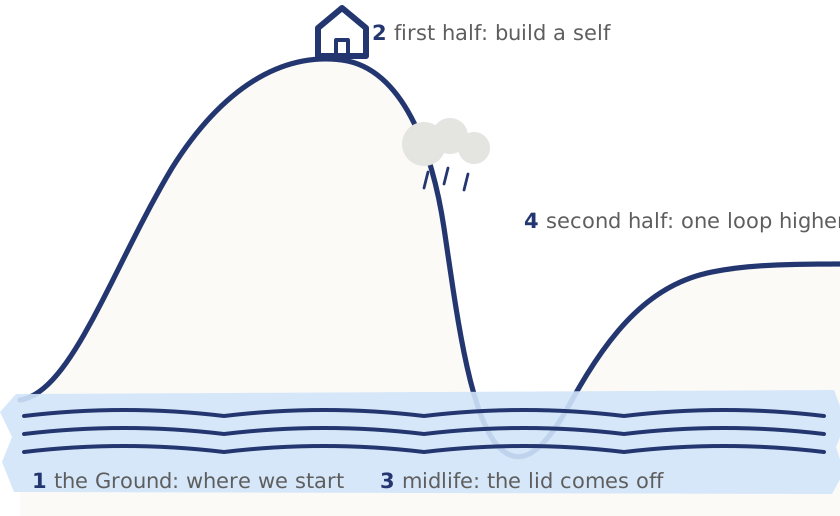
- Midlife comes apart on a schedule, and the most useful account of why is Michael Washburn's spiral: the first half of life is built by putting a lid on something; the second half begins when the lid comes off.
- The "crisis" is mostly a story told afterwards. Only about a quarter of Americans report one, and most of those aren't about age. The real finding is a U: wellbeing sags through the forties and, on average, climbs after. On average is doing a lot of work in that sentence.
- Who counts is a developmental question too. The circle of moral concern widens in stages, and it is where growing up shows up in public.
- It is a passage, not a problem. Hard, on nobody's timetable but your own, and part of the psychospiritual work. Sometimes the hard stuff is what shakes us awake.
Two verbs, four if you're counting
Wilber's full list is four: waking up, growing up, cleaning up and showing up.1 I find all four useful in clinic, and I find the distinction between the first two does more work than any other single idea when someone comes back from a big experience confused about why their life hasn't changed.
Peak and mystical states: unity, boundlessness, the self dropping away. The research term is a self-transcendent experience, and the family includes awe, flow, deep love, mindfulness and the psychedelic state.3 Available to anyone, at any stage, via meditation, grief, childbirth, a mountain or a molecule. Temporary by nature.
How you construct meaning: what you can see as an object rather than being had by it. Moves slowly, in order, and doesn't skip. The subject of this post.
The disowned parts: the anger you don't have, the need you don't admit. Jung's shadow, and his point that what irritates us in others is a map of it. Therapy's home turf. Neither waking up nor growing up does this for you, and a lot of spiritual bypass is an attempt to prove otherwise.
Whether any of it reaches your family, your work, your town. The laundry, in Kornfield's phrase. The part nobody posts about.
The crucial point is that the tracks are independent. A state does not promote you a stage. You can have a full-blown unitive experience and interpret it entirely from the stage you were already at: the tribalist comes back more sure the tribe is chosen, the narcissist comes back as the messenger. This is why the integration conversation matters more than the dose, and why the people I worry about after a session are not the ones who had a hard time but the ones who had a wonderful time and learned nothing.
Wilber adds a second idea that I find myself using daily: development runs along separate lines, cognitive, emotional, moral, interpersonal, spiritual, and a person can be far along on one and barely started on another.4 The brilliant surgeon with the emotional range of a nine-year-old is not a paradox; he is uneven. So is everyone. Growing up is less a single ladder than a handful of them, climbed at different speeds, and the spiritual line is the one most easily mistaken for all the others.
Jung saw the failure mode a century ago. We crave answers and shortcuts, a system, a recipe, a step-by-step guide to life, and that is exactly what a religion, a movement or a guru can supply. Pair the ready-made answer with a sense of belonging and you have, in his view, a machine for keeping adults immature: the responsibility for one's life is projected onto the teacher, and the community quietly agrees not to ask the questions that would disturb it. His line was that most people do not choose their own way but convention, and so develop a method rather than themselves.5 That is the socialized mind, sixty years before Kegan named it, and it is also an exact description of what can happen around a charismatic psychedelic facilitator.
Washburn's spiral
There are two families of map for the spiritual side of adult development. Wilber's is a ladder: you climb through structures of increasing complexity and never come back down; the Ground you came from is reached again only at the top.4 Michael Washburn's is a spiral: you leave the Ground to build an ego, and in the second half of life you go back through it, on purpose or otherwise, and come out the other side.6,7 The two men argued about this for decades. I think the spiral is the better description of what actually walks into my office, and it was built from clinical practice rather than library work, which is a point in its favour.8,9
Here is Washburn's map, in seven stops. Scroll.
1 · Original embedment
Washburn's starting point is the Dynamic Ground: the source of psychic energy, which he reads as the same thing the traditions call spirit, libido, kundalini, the numinous, depending on who is pointing at it. The infant is not separate from it. There is bliss, and there is no "I" present to know it, which is why you can't remember it and why it feels, later, like something lost.
2 · Primal repression
To become a self, the child has to stop being the Ground. Somewhere around four or five, a lid goes on. The Ground, and the body, and the mother who stood for both, are pushed down so that a mental ego can be built on top of them. Washburn calls this primal repression, and it is not a mistake. It is the price of having a self at all. The ego's project for the next thirty-five years is to make that self solid.
3 · The mental ego
The first half of life. School, work, partner, house, children, reputation. The mental ego lives in thought, in plans and stories, and keeps the body and the Ground at arm's length. It works. It is supposed to work. Most of what we call being an adult is this stage done well, and it would be a strange therapy that tried to talk someone out of it at thirty.
4 · Alienation
Then the house is finished and something goes wrong that nothing is wrong with. Washburn's word is alienation: the world loses its spell. Anxiety without an object, guilt without a crime, the sense that the self you spent decades building is not actually substantial. Jung saw the same thing in his forty-year-olds and said we cannot live the afternoon of life by the programme of the morning.10 This is the part people call a midlife crisis when they want it to sound silly.
5 · Regression in the service of transcendence
The lid lifts. What was repressed at five comes back at fifty, and it comes back as it was: raw, bodily, not interested in your calendar. Washburn's phrase is regression in the service of transcendence, and the regression is real: dark moods, flooding affect, the body suddenly alive with energy, dreams and images that can look, from outside and sometimes from inside, like illness. The Grofs called the clinical face of this a spiritual emergency.11 The mystics called it the dark night. It is the hardest stretch on the map and the one most often medicated flat.
6 · Regeneration in spirit
If the storm is allowed to run, the same energy changes character. Washburn describes it turning from violent to healing: the second half of the dark night, where what flooded in starts to feel like what was missing. This is where psychedelic sessions sometimes drop people directly, which is both their gift and their problem; arriving somewhere is not the same as having walked there.
7 · Integration
The ego is not destroyed and the Ground is not abandoned; they are, in Washburn's phrase, wedded. You end up on the same side of the map you started, one loop higher: embodied, less self-centred, less in need of the story. Not a return to childhood. The spiral's whole point is that you can go back for what you left without going back to who you were.
Two honest caveats. First, this is a map, not a measurement; Washburn has no longitudinal data, and nor does Wilber.9 Second, it is a map drawn from people who came to therapy. Plenty of people never have the fourth stop, and plenty who do never have the fifth. But I have yet to find a better description of what the fourth and fifth feel like from inside, and I have never found a patient who, hearing it, didn't recognise something.
The child who knows
The oldest version of the spiral is Taoist, and it is older than every theory on this page by two and a half thousand years. The Tao Te Ching's advice to return to the beginning and become a child again is not nostalgia; Benjamin Hoff's gloss is that the wise are children who know, their minds emptied of the small learning and filled with the large kind.12 That is Washburn's seventh stop in different clothes: not the infant's embedment, which had no "I" in it, but an adult who has gone back for it on purpose. Chapter 32 has the operating instructions for the first half of life and the second in four lines: once the whole is divided, the parts need names; there are already enough names; one must know when to stop.13 The first half of life is naming. The second begins when you know when to stop.
The Taoist sage is also the best portrait I know of what integration actually looks like from outside, because it is a list of contradictions held without strain: detached yet compassionate; enjoying life without clinging to it; careful about the work and indifferent to the credit; knowing the answers and preferring to stay quiet; the playfulness of a child and the inner strength of someone who has been through something. Osho's image for the same thing is a tree: happiness is the branches going up, sadness the roots going down, and the taller the tree the deeper the roots, always in proportion. The descent into the Ground is the roots. It is why the people who have done the fifth stop are, in my experience, the ones you'd want in the room when something goes wrong.
The midlife crisis, audited
The phrase is from 1965, a psychoanalyst named Elliott Jaques, who noticed that a surprising number of great artists had either died, dried up, or changed style entirely in their late thirties, and concluded that the sudden personal discovery of death is what did it.14 The red sports car came later, from the culture, and it stuck because it is funny.
The data are less dramatic. In the big American midlife survey, about a quarter of people said they had had a midlife crisis, and when asked what it was, most described a hard event, a divorce or a job loss or an illness, that happened to fall between forty and sixty.15 Age was not the cause; age was where they were standing when it hit. The thing that is reliably age-linked is quieter and larger: across more than a hundred countries, in every kind of sample, self-rated wellbeing follows a U across adulthood, sagging through the forties to a low near forty-seven and, on average, climbing afterwards.16,17 It is one of the most replicated findings in social science and also one of the most argued about, because an average U contains a great many lives that are not U-shaped at all.18
Where you are on the U
The curve is a schematic of the average shape, not your data. Drag the age.
The "it gets better" reading of the curve is true on average and useless to the individual at the bottom of it. Many of the people I work with have not found the upslope and are not sure it exists. The honest version is: the shape is real, the timing is yours, and nobody climbs it by being told it's there.
So the "crisis" is mostly a story told afterwards, and the dip is real. What the survey can't see is what Washburn and Jung were describing: that the dip has content. The second half of life isn't just the first half with worse knees. Something that was put away comes back and asks to be dealt with, and whether it arrives as a divorce, a diagnosis, a child leaving, a parent dying, a business ending or nothing you can point to, the work it brings is the same.
Checking out, checking in
Michael Brown's Alchemy of the Heart is not a scientific book and I don't endorse all of it; its chapters on talk therapy and medication are a polemic I'd argue with for an hour. But his account of the midlife passage is one of the clearest I've read, and it maps onto Washburn almost line for line.19 Brown's version: for most of life we keep the condition of what he calls the emotional body out of awareness, and we call that project the pursuit of happiness. Somewhere between forty and sixty, the true condition starts surfacing on its own, which is what the eruption is: the emotional body trying to free itself. Because that body was stunted at about the age the lid went on, we respond to its return the way a child would. Hence the car.
His most useful distinction is between two responses to the symptom when it comes:
The symptom is an enemy. Life is happening to me and I have to beat it. Numb it, outrun it, buy something, leave someone, find a stronger substance or a newer teacher.
The symptom is an ally that has come to show me where I am already hurting. Brown's pun is out-sight: the body showing on the outside what I can no longer see from inside. Life is happening through me. Listen first.
What I'd add, as the psychiatrist Brown is arguing with: checking in and getting help are not opposites. Sometimes the ally has come to tell you that you need a doctor. The error is not in treating the symptom; it is in treating it and never asking what it came to say.
The map, graded
Nobody has drawn the whole map of adult development; several people have drawn pieces, and the pieces don't quite line up. Here are the ones I use, graded the way I graded the adolescence theories in the last post: on how testable the theory is, how well it has held up, and whether it changes what I do on a Tuesday.
- A1950Erikson's adult stages
Intimacy vs isolation in young adulthood; generativity vs stagnation in the middle; integrity vs despair at the end.20 Simple, humane, and the only model on this list that most people can locate themselves on without a tutorial. Generativity, the turn from building a self to building for others, is the best one-word description of what growing up looks like from outside. Weak on mechanism; strong on being right.
- A−1982Kegan's orders of consciousness
Robert Kegan's claim is that development is the process of making what was subject into object: the thing that had you becomes a thing you have.21 Three adult orders: the socialized mind, whose self is held together by others' expectations; the self-authoring mind, which has its own system and can be held to it; and the rare self-transforming mind, which can hold its own system as one of several. His estimate was that most adults are at the socialized order or somewhere between it and the next, and that modern life quietly demands the one after.22 Measurable with a long interview, which is both its rigour and why nobody does it. The idea that you can't see what you're subject to is the most clinically useful sentence on this page.
- B+1976Loevinger's ego development
A sentence-completion test and a sequence of stages from impulsive through conformist and conscientious to autonomous and integrated.23 Susanne Cook-Greuter extended the top with post-autonomous stages that read like the integral and transpersonal literature with better psychometrics.24 Actually measured, actually replicated, and the finding people least like: the modal adult sits in the conformist-to-conscientious range, and the top stages are a few percent.
- B+1933Jung's afternoon of life
The original midlife theorist, and the first major psychologist to say that decisive change happens after the first two decades at all; Freud and Adler, in his view, had the morning covered and nobody had the afternoon. The first half is for building the ego and the outer life; the second is for turning inward, and the mistake is carrying the morning's programme into the afternoon.10 Untestable as stated, and the source of nearly everything above and below. Washburn is Jung with the furniture rearranged.
- B1995Washburn's spiral path
The map you just scrolled.6 No data of its own; borrows its early childhood from psychoanalysis and its second half from the mystics. The grade is for description, where it is unmatched, not for prediction, where it offers none. Washburn himself gives no treatment advice, which is either a limitation or a form of honesty.9
- B1943Maslow's hierarchy
The pyramid everyone has seen and Maslow never drew.25 The stages don't actually gate each other the way the picture implies, and the research record is thin. Two points keep it on the list: self-actualisation as an adult destination was a new idea in 1943, and late in life Maslow added a stage above it, self-transcendence, which the textbooks quietly dropped.26 That missing top floor is this whole post.
- B−1978Levinson's seasons
Daniel Levinson interviewed forty men and produced the "seasons" of a man's life, with a midlife transition pencilled in at forty to forty-five.27 Vivid, influential, the source of the pop version of the crisis, and based on forty men. Half the human race got a sequel volume years later.
- A−2006The maturity principle
Not a stage theory; a meta-analysis of ninety-two longitudinal studies showing that across adulthood, on average, people become more conscientious, more agreeable and more emotionally stable, with the biggest gains in the twenties and thirties and continued movement after.28 George Vaillant found the same thing in the Harvard men: defences mature with age, from acting out toward humour and altruism.29 This is growing up measured with a ruler, and it says the direction is real even when the map is argued about.
Who counts
One way to think about moral development that I find more useful than any stage name: it is the question of who you feel is worthy of moral consideration. Not what you believe, but who is inside the circle when you decide.
It starts with the self. A baby's circle is the baby, and then the baby and the two large people who bring food. Some adults stay there, and we have words for them. The next ring is the clan: family, team, tribe, nation. A great many people stop here, and it is not a stupid place to stop; it is where most of human history was run from. You can see it in the news every day: when Americans die in a war, we are told the number; when the people on the other side die, we usually aren't. That isn't malice. It is the edge of a circle.
Then, for some people, the circle widens to all people, and for some of those, to all beings. Peter Singer called it the expanding circle,30 Kohlberg mapped the human part of it as stages of moral reasoning,31 Carol Gilligan pointed out that Kohlberg's ladder was built from boys and that care is a form of moral reasoning too,32 and a 2016 scale now measures how far out a given person's circle goes, with family at the centre and rocks at the edge, and finds enormous and stable variation between people.33
The circle
Tap a ring. The yellow ring is the edge of who counts; the rings inside it are the people you'd already die for.
Here is how it widens in practice, because it never widens from an argument. You grow up with a dog. You learn, slowly and not from a book, that the dog feels pain and has moods and misses you. Then one night you watch a documentary about a slaughterhouse, or a warehouse of hens producing cheap eggs, and you have a moment of something like panic: how could we breed a creature just to kill and eat it? And then you do one of three things, depending on who you are that year. You stop eating meat, a silent protest. Or you decide you'll only eat what you kill yourself. Or you chain yourself to a fence outside the plant, which, having been near one, I can tell you smells terrible. None of these is the grown-up answer. All of them are what it looks like when a ring moves.
Brian McLaren, a pastor who spent his career watching congregations grow and fracture, has a four-stage version that I find clearer than Kohlberg's six: simplicity, complexity, perplexity and harmony, where each stage is an increase in the capacity to experience someone else as real, to be able to state their position the way they would state it.34 At simplicity, the people in your tribe are real. At complexity, people outside it are real, as long as they don't contradict it. At perplexity, even the people whose views directly deny yours are real. At harmony, the people at every one of the earlier stages are real too, including the ones you used to be. It is the circle again, drawn as a capacity rather than a boundary.
Everyone has a piece of the truth. The person whose circle stops at the family is seeing something real about loyalty that the person whose circle includes the rivers may have lost. The point of knowing it is a circle is not to rank people by radius. It is the same discovery we make in parts work: the metaphor of parts that we use to look inside ourselves came from, and applies with full force to, the parts out there in the world.35 No bad parts. Seek first to understand. Love things back into the light rather than eradicating them with force. The rings are not a hierarchy of people; they are a description of what each of us can currently see.
Three worldviews in one skull
Zoom out from the individual and the same stages show up in whole societies, where Clare Graves, and after him Beck, Cowan and Wilber, mapped them as a sequence of value systems.36,37,4 Three of them are live and loud right now, and you know them by their arguments:
- Traditional
- Order, faith, family, flag. Social conservatives, nationalists, the religious, the patriotic. Its gift is loyalty and the long view; its shadow is that the circle stops at the border.
- Modern
- Secular, scientific, commercial. The people who keep the trains running and the trials enrolled. Its gift is that things work; its shadow is that it can't see what it can't measure.
- Postmodern
- Progressive, pluralist, focused on justice and on the voices that have been kept in the shadows. Its gift is that it hears the quiet ones; its shadow is that it struggles to rank anything, including itself.
The interesting thing is not that these three are competing out there in real time, though they are. It is that, to a degree that varies hugely from person to person, all three are inside each of us. Our parents' beliefs shaped us, and those were shaped by our grandparents, so our grandparents shaped us; the culture we grew up in did the rest. Don't shoot the messenger. The traditional voice shows up when you talk to your parents, the modern one at work, the postmodern one with your kids, and on a good day you can hear which one is talking.
Which of you is answering?
Six situations, three honest answers each. There is no right column.
The integral idea, which I hold loosely, is that there is a stage after these three whose whole job is to see that each of the first three is right about something and build with all of them.4 Whether or not that's a stage, it is a decent description of a grown-up.
What changes at 40, 60, 80
The teenage brain gets the headlines; the adult brain keeps changing for the rest of your life, and the changes are not the ones people fear. A chart built from more than a hundred thousand scans puts grey matter volume at its peak before age six, cortical thickness before two, and white matter volume, the wiring, at about twenty-nine; after that the cables slowly thin.38 Processing speed starts to decline from the twenties, which is why the ping-pong gets worse before anything else does.39
But different abilities peak at different ages. In one study of nearly fifty thousand people, short-term memory peaked in the mid-twenties, the ability to read emotions in faces around forty to fifty, and vocabulary kept rising into the late sixties and early seventies.40 Reasoning about social conflicts, the thing the wisdom researchers actually measure, improved into old age in a Michigan sample, independent of IQ.41,42 And emotional life changes direction: Laura Carstensen's work shows that as the horizon shortens, people prune their social world down to the people who matter and attend more to what's good than what's wrong, the so-called positivity effect.43,44 The shrinking circle of friends in your sixties is, mostly, a choice.
What peaks when
Schematic curves, not data: each line is one ability's rough shape across adulthood, scaled to its own peak.
Put the two halves together and you get the biological case for the spiral. The first half of life is run on speed and storage, which is what building a self needs. The second runs on knowledge, pattern and feeling, which is what reckoning with one needs. The hardware changes to suit the job.
A note on eating disorders
I spend a lot of my week at an eating disorder treatment centre, and I can't write about growing up without it. Most eating disorders begin in adolescence, right at the second remodelling, and one of the cruellest things about them is that they stop the clock: the illness takes over the developmental tasks of those years, identity, autonomy, a body you live in rather than manage, and holds them in place.45 A twenty-six-year-old who has been ill since fourteen often has fourteen-year-old work still to do, and recovery, when it goes well, looks less like getting rid of a symptom than like growing up on a delay. In Kegan's terms it is the move from a self held together by what others see to a self that can hold its own standard against the mirror.
And they come back at midlife. Eating disorders in women in their forties, fifties and sixties are more common than most clinicians assume, and a good fraction are relapses of an adolescent illness that had been quiet for decades.46 I don't think that's a coincidence. Washburn's fifth stop is the return of what was put away at the age the lid went on. For some people, what was put away was a way of not feeling that lived in the body, and when the Ground comes back, so does the old solution. Checking in, in Brown's sense, is the whole of eating disorder recovery in two words; checking out is the illness.
The laundry
I said I'd just turned 50, and I meant it as a data point, but it is also where I am writing from. The kids are growing up and leaving, which is the job done and also a door closing. The work has matured, which means that the problems are no longer the kind you solve with more hours. And there turns out to be personal work at this stage that I did not know I had to do; new things come up at new stages, to be processed, and nobody mentioned that the processing doesn't finish.
Here is what I'd tell a friend, and what I'm telling myself. It is a passage, not a problem. It is hard, and it is on nobody's schedule but your own; the U-curve gives an average, and the average is not a promise. Sometimes the hard stuff is what shakes us awake, and I have come to think that's the point of it rather than a bug: the lid doesn't come off because you decide it should. Viktor Frankl, who had more standing than anyone to say otherwise, held that suffering can be turned into something, that guilt is an opportunity to change, and that a life transition is a chance to take responsible action rather than a thing that happens to you.47 He wasn't being cheerful. He was describing the fifth stop from inside. And it is transformative, in the specific sense Washburn means. You don't get your twenties back. You get the thing you put away in order to have your twenties, and you get to decide, this time, what to do with it.
Growing up, at this stage, turns out to be mostly integration into daily life. Not the ecstasy; the laundry. The conversation you'd been avoiding. The body you'd been managing. The question of what you're for now that the house is built. That's the work I'm in, and my hope is only that I'm headed in the right direction and learning from it. I'll let you know.
This post is educational and isn't medical advice. The fourth and fifth stops on the spiral can look a great deal like depression, mania or psychosis, and sometimes they are; a passage and an illness are not mutually exclusive, and the people who can tell them apart are clinicians. If you're in that stretch and it's frightening, please see one. In the US you can call or text 988 any time.
References
- Wilber K. The Religion of Tomorrow. Shambhala; 2017.
- Kornfield J. After the Ecstasy, the Laundry: How the Heart Grows Wise on the Spiritual Path. Bantam; 2000.
- Yaden DB, Haidt J, Hood RW, Vago DR, Newberg AB. The varieties of self-transcendent experience. Rev Gen Psychol. 2017;21(2):143–160.
- Wilber K. Integral Psychology: Consciousness, Spirit, Psychology, Therapy. Shambhala; 2000.
- Jung CG. The Development of Personality. Collected Works vol. 17. Princeton University Press; 1954, §296.
- Washburn M. The Ego and the Dynamic Ground: A Transpersonal Theory of Human Development. 2nd ed. State University of New York Press; 1995.
- Washburn M. Transpersonal Psychology in Psychoanalytic Perspective. State University of New York Press; 1994.
- Cortright B. Psychotherapy and Spirit: Theory and Practice in Transpersonal Psychotherapy. State University of New York Press; 1997.
- Bell N. Regression in the service of transcendence: the ideas of Michael Washburn. Lecture notes, 2013. noelbell.net.
- Jung CG. The stages of life. In: Modern Man in Search of a Soul. Harcourt; 1933.
- Grof S, Grof C, eds. Spiritual Emergency: When Personal Transformation Becomes a Crisis. Tarcher; 1989.
- Hoff B. The Tao of Pooh. Dutton; 1982.
- Lao Tzu. Tao Te Ching, chapter 32. Feng GF, English J, trans. Vintage; 1972.
- Jaques E. Death and the mid-life crisis. Int J Psychoanal. 1965;46:502–514.
- Wethington E. Expecting stress: Americans and the "midlife crisis". Motiv Emot. 2000;24(2):85–103.
- Blanchflower DG. Is happiness U-shaped everywhere? Age and subjective well-being in 145 countries. J Popul Econ. 2021;34(2):575–624.
- Stone AA, Schwartz JE, Broderick JE, Deaton A. A snapshot of the age distribution of psychological well-being in the United States. Proc Natl Acad Sci USA. 2010;107(22):9985–9990.
- Galambos NL, Krahn HJ, Johnson MD, Lachman ME. The U shape of happiness across the life course: expanding the discussion. Perspect Psychol Sci. 2020;15(4):898–912.
- Brown M. Alchemy of the Heart: Transform Turmoil into Peace Through Emotional Integration. Namaste Publishing; 2008.
- Erikson EH. Childhood and Society. Norton; 1950.
- Kegan R. The Evolving Self: Problem and Process in Human Development. Harvard University Press; 1982.
- Kegan R. In Over Our Heads: The Mental Demands of Modern Life. Harvard University Press; 1994.
- Loevinger J. Ego Development. Jossey-Bass; 1976.
- Cook-Greuter SR. Making the case for a developmental perspective. Ind Commer Train. 2004;36(7):275–281.
- Maslow AH. A theory of human motivation. Psychol Rev. 1943;50(4):370–396.
- Koltko-Rivera ME. Rediscovering the later version of Maslow's hierarchy of needs: self-transcendence and opportunities for theory, research, and unification. Rev Gen Psychol. 2006;10(4):302–317.
- Levinson DJ. The Seasons of a Man's Life. Knopf; 1978.
- Roberts BW, Walton KE, Viechtbauer W. Patterns of mean-level change in personality traits across the life course: a meta-analysis of longitudinal studies. Psychol Bull. 2006;132(1):1–25.
- Vaillant GE. Aging Well. Little, Brown; 2002.
- Singer P. The Expanding Circle: Ethics and Sociobiology. Farrar, Straus & Giroux; 1981.
- Kohlberg L. The Psychology of Moral Development. Harper & Row; 1984.
- Gilligan C. In a Different Voice. Harvard University Press; 1982.
- Crimston D, Bain PG, Hornsey MJ, Bastian B. Moral expansiveness: examining variability in the extension of the moral world. J Pers Soc Psychol. 2016;111(4):636–653.
- McLaren B. Faith After Doubt. St. Martin's Essentials; 2021.
- Schwartz RC. No Bad Parts. Sounds True; 2021.
- Graves CW. Levels of existence: an open system theory of values. J Humanist Psychol. 1970;10(2):131–155.
- Beck DE, Cowan CC. Spiral Dynamics: Mastering Values, Leadership, and Change. Blackwell; 1996.
- Bethlehem RAI, Seidlitz J, White SR, et al. Brain charts for the human lifespan. Nature. 2022;604(7906):525–533.
- Salthouse TA. When does age-related cognitive decline begin? Neurobiol Aging. 2009;30(4):507–514.
- Hartshorne JK, Germine LT. When does cognitive functioning peak? The asynchronous rise and fall of different cognitive abilities across the life span. Psychol Sci. 2015;26(4):433–443.
- Grossmann I, Na J, Varnum MEW, Park DC, Kitayama S, Nisbett RE. Reasoning about social conflicts improves into old age. Proc Natl Acad Sci USA. 2010;107(16):7246–7250.
- Baltes PB, Staudinger UM. Wisdom: a metaheuristic (pragmatic) to orchestrate mind and virtue toward excellence. Am Psychol. 2000;55(1):122–136.
- Carstensen LL, Isaacowitz DM, Charles ST. Taking time seriously: a theory of socioemotional selectivity. Am Psychol. 1999;54(3):165–181.
- Reed AE, Chan L, Mikels JA. Meta-analysis of the age-related positivity effect: age differences in preferences for positive over negative information. Psychol Aging. 2014;29(1):1–15.
- Treasure J, Stein D, Maguire S. Has the time come for a staging model to map the course of eating disorders from high risk to severe enduring illness? Early Interv Psychiatry. 2015;9(3):173–184.
- Mangweth-Matzek B, Hoek HW, Pope HG. Pathological eating and body dissatisfaction in middle-aged and older women. Curr Opin Psychiatry. 2014;27(6):431–435.
- Frankl VE. Man's Search for Meaning. Beacon Press; 1959/2006.
- Thayer S, Robison R. Adult development: waking up vs growing up, enlightenment, and the midlife crisis. Psychedelic Therapy Frontiers (podcast), rebroadcast February 11, 2025.
- Waldinger R, Schulz M. The Good Life: Lessons from the World's Longest Scientific Study of Happiness. Simon & Schuster; 2023.